effort-router
Make your Claude Code usage go up to twice as far. Picks the right reasoning effort for every prompt and every subagent, so easy work stops burning your limits…
newbandspinnerguardcommandprompt

Make your Claude Code usage go up to twice as far. Picks the right reasoning effort for every prompt and every subagent, so easy work stops burning your limits…
A Claude Code plugin that saves time and money by running each task at the lowest reasoning effort that does it well. Your session's own model assesses each of your first five prompts and moves the level to whichever gets the work done fastest and cheapest, up or down. Then the level locks for the rest of the session. Each subagent gets its own level, chosen by the agent that launches it.
<img src="https://raw.githubusercontent.com/tommy5dollar/effort-router/main/docs/launch.gif" width="720" alt="Claude Code is overthinking your renames. Everyday prompts all run at high and usage drains fast. effort-router picks the effort for every prompt, easy ones drop to low, and usage lasts far longer. Up to 2x the usage, up to 3.5x faster, same results">
It works with Fable 5.1, Opus 5.5, Sonnet 5.5 and Haiku 5.5, in the terminal and in the Desktop app's Code tab. It requires Claude Code 2.1.287 or later in the terminal, or the Desktop app with Claude Code 2.1.286 or later. Haiku 5.5 needs Claude Code 2.1.293 or later.
In the Desktop app, first add the marketplace: go to Customize, then Plugins, Add marketplace, Add from a repository, and enter tommy5dollar/effort-router. The app then opens the new marketplace: click Add on effort-router (if you've left that screen, it's under effort-router at the bottom of Plugins, Discover). In the terminal:
claude plugin install effort-router --marketplace tommy5dollar/effort-routerBefore Claude Code 2.1.292 that's two commands: claude plugin marketplace add tommy5dollar/effort-router, then claude plugin install effort-router@effort-router.
Then start a new session. In the Desktop app the footer appears once you've sent the first message.
Claude Code runs every request at the level you picked. Anthropic's Using Claude Code: Spending your effort (Thariq Shihipar, 25 September 2026) found that effort buys verification and edge-case testing, not a better approach, so the right level depends on the task. The router gives your session's model those principles and sourced notes on what each level can do on that model, then lets it judge. It never maps a kind of task to a fixed level, because level names mean different things on Opus, Sonnet and Fable.
Does it save money and time? That's what it's for. When two levels would both do the work, it picks the cheaper one. The higher you run, the more it saves. In our test, Fable 5.1 on xhigh was given three small chores in a payments repo to hand to subagents. The router moved it to medium and its Opus subagents to medium or low. It finished in about 2 minutes for $1.10 to $1.65, against 6 to 8.5 minutes and $3.20 to $3.75 left on xhigh, and every test passed both ways. Those figures include the router's own assessments. On Opus 5.5's default of medium there's less to step down from, so it mostly picks off the small tasks. It still steps up when the work clearly needs it, because a hard task done right first time costs less than the rework, in tokens and in your own time. /er report shows what ran at each level, so you can see what it did to your own work.
What routing costs. Assessments run on your own login, so they come out of your normal usage, with nothing extra to pay or sign up for. The figures here are at API prices. Each of the first five prompts waits about 1.5 seconds for an assessment. The first is a separate call that can't use the prompt cache: about 5 cents on Opus 5.5 or 13 cents on Fable 5.1. The other four read your conversation from the session's cache, about 3 cents each on Opus. So a session costs about 20 cents to route on Opus, then nothing more. A subagent's assessment is about 2 cents.
This plugin runs inside Claude Code without a sandbox, so here's exactly what it does:
~/.claude/effort-router/spend/, and nothing else.highestLevel is max. Once the level has locked, prompts aren't assessed, so use the band or /er assess. Without the router, words like that only nudge how much the model thinks within the level you set.-p? It routes there too, but there's no footer or band. Use /er instead.promptsToAssess higher (say 50). Each extra assessment costs about 3 cents and 1.5 seconds on Opus 5.5.flowchart LR
P["Prompts 1 to 5"] --> R["Your model picks<br>the level"]
R --> C{"Different from<br>the level running?"}
C -- "yes" --> M["Step up<br>or down"]
C -- "no" --> K["Stay"]
M --> L["After prompt 5,<br>lock"]
K --> LLocking after a fixed number of prompts is deliberate. A fixed window always ends, still catches a task that grows over the first few prompts, and has one number to tune (promptsToAssess).
The footer sits beside the native model and effort pickers. It shows the router's status, the level running and, while unlocked, how much of the window is used.
<img src="https://raw.githubusercontent.com/tommy5dollar/effort-router/main/docs/footer.gif" width="720" alt="The footer in the Desktop app. A rename is assessed and moves from medium to low, a production bug moves from low to high while the effort picker still says Medium, and clicking the footer opens the band">
| Footer | What it means |
|---|---|
🔓 MEDIUM ○ | Unlocked, nothing assessed yet. Your setting (medium) runs |
🔓 HIGH ◔ | Unlocked with one prompt assessed, which moved the level to high |
🔓 HIGH ◑ | Two or three assessed |
🔓 HIGH ◕ | Four assessed. The next prompt is the last one assessed |
🔓 … | An assessment is running (the turn starts when it's done), or a new session hasn't shown your level yet |
🔒 HIGH | Locked. Every request on the main thread runs at high |
⏸️ MEDIUM | Off. Your own effort setting applies |
The circle never fills. When the window ends the padlock closes instead. The level is in capitals, to tell it apart from the picker's own label, which shows your setting.
Levels have no colours, because a scale from green to red would suggest that low effort is good.
Clicking the footer opens the band above the prompt. /er does the same. It never opens by itself.
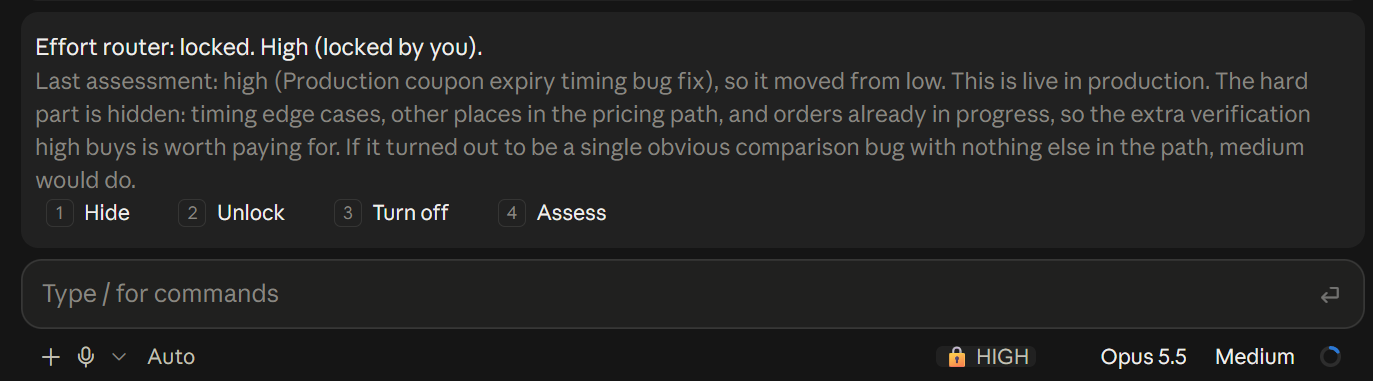
Effort router: unlocked. High (chosen by the router). Locks after 1 more prompt.
Last assessment: high (bug fix touching three services), so it moved from medium.
Subagents get their own level: 4 routed this session.
1 Hide   2 Lock at high   3 Turn off   4 Assess
The first line is the footer in words: the status, the level and where it came from, and what happens next. The second is the last assessment. The third appears once a subagent has been routed.
The four buttons always sit in the same slots, so the digit keys are learnable. They run from doing nothing to taking action:
| Slot | Unlocked | Locked | Off |
|---|---|---|---|
| 1 | Hide | Hide | Hide |
| 2 | Lock at high | Unlock | Turn on, locked at high |
| 3 | Turn off | Turn off | Turn on, unlocked |
| 4 | Assess (greyed out) | Assess | Turn on and assess |
A greyed-out button stays in its slot. Pressing it says why it's greyed out.

/effort-router sits beside /effort in the typeahead, and /er is its short form. Each verb does what the band's matching button does, so the commands are also the controls where there's no band (VS Code and -p).
| Command | Band | What it does | |||
|---|---|---|---|---|---|
/er | Clicking the footer | Opens the band. Where there's no band it prints the band's lines | |||
/er lock | Slot 2 | Locks at the level running. When off, turns on locked at the router's last level | |||
/er unlock | Slot 2 | Unlocks. When off, turns on unlocked | |||
/er off, /er on | Slot 3 | Turns routing off, or on and unlocked | |||
/er assess [hint] | Slot 4 | Assesses now. While unlocked it keeps the hint for your next prompt's assessment instead (/er assess this is a security review) | |||
| `/er report [session\ | week\ | month\ | all]` | Where the effort went | |
/er status | The band's lines, then the details for troubleshooting: the last reply in full and what it was judged against, assessments used, the last error and the routed subagents | ||||
/er rules | The rules in force, where each layer came from, and the notes for your model |
The verbs are explicit rather than toggles, so repeating one is safe ("Already locked at high"). Anything else is refused with the list above, so a typo never runs an assessment.
Each change adds one dim line to the conversation, labelled effort-router by Claude Code. These lines are for you and are never sent to the model. An assessment that stays put adds nothing.
| What changed | Message |
|---|---|
| An assessment moved the level | Assessed, medium to high (bug fix touching three services). |
| It locked after the last prompt | Locked at high. |
| You pressed Lock | You locked it at high. |
| You pressed Unlock | Unlocked. Assessing again from your next prompt. |
| You changed the effort picker | You changed the effort to xhigh, so routing is off. |
| You turned it off | Off. Your effort (medium) applies. |
| You turned it on | On, locked at high. Or: On, unlocked. |
Changing the effort picker turns routing off, whether it was locked or unlocked, and your new level applies from that request on. The router never sets your effort setting itself: it sets the level on each request instead. So the picker keeps showing your own level while the footer shows the one in use.
In the Desktop app the picker keeps showing your setting while the router runs another level. Picking the level it already shows changes nothing there, so use Turn off instead.
/er status says why. A failed assessment still uses up its prompt, so the window ends when the footer says it will./clear, or after a resume that starts afresh.highestLevel (xhigh by default): on all three models max rarely beats xhigh and can overthink. If your own setting is higher (max, say), they're offered levels up to yours, so a session you set to max can stay there.The first time the router sees a session, it counts the prompts already in it. Those count toward the window. A session that already has five or more prompts starts off and the band says "This session started before the router". Its subagents are still routed, because each brief is a fresh, whole task.
The router keeps each session's status in that session's ledger, so claude --resume picks up where it was.
Without the router every subagent runs at the session's level, unless its agent definition sets one or you ask Claude for one. Since Claude Code 2.1.292 you can ask (run the reviewer at high), but Claude is told never to pick a level on its own judgement.
effort: wins. If the agent's definition sets an effort, the router leaves its requests alone and the engine applies that level. The router finds the definition by its name: in the project's .claude/agents/*.md, then your ~/.claude/agents/*.md, and in the agents key of policy, project and user settings. The first definition with that name decides, as it does for the engine./er status lists the last ten, newest first, with each one's level and why. Every routed subagent is also kept in the session's ledger, with the level it would have inherited from its parent, the level it got and why.Set routeSubagents to false to leave subagents at the session's level.
The router supports Fable 5.1, Opus 5.5, Sonnet 5.5 and Haiku 5.5. Level names don't mean the same amount of thinking on each, and each responds to effort differently. In Claude Code, Opus 5.5, Sonnet 5.5 and Haiku 5.5 default to medium and Fable 5.1 to high. Opus 5.5 gains most from low to medium and little above high, while Sonnet 5.5 gains a lot at every step. Routing one like another would be a mistake.
Haiku 5.5 is the first Haiku with effort levels, and in practice a subagent model. The router picks up to high on it, below the highestLevel option, unless your own setting in a Haiku session is higher. Its price goes up 5 times on every token of a request whose prompt passes 100,000 tokens, so its notes tell the check to step up only when the task clearly needs it.
Each has a notes file in rules/models/ on how its levels behave, in the same shape for every model: how effort pays on it, Anthropic's advice for it, then each level with its cost and time against medium and how it behaves. They are heuristics. Benchmark scores are left out, because a few points on a hard benchmark means a few more of the hardest tasks solved, not every task done better. Every assessment carries the notes for the model it's about, after the routing rules. Lines about max are left out unless max is on offer. /er rules prints them. The evidence behind each line, with sources, is in rules/models/research-2026-10.md and its addendum. No eval results are in the notes, ours or anyone's. The router's routing eval (eval/routing.ts) checks 87 prompts against an approved level for each, and any change to the prompt, rules or notes has to pass it.
The notes guide the level instead of fixed rules because of an eval on 4 October 2026. With rules that tied kinds of task to levels, all three models gave almost the same answers and ignored their notes. Without those rules, each model's answers moved the way its evidence predicts (TESTING.md, "Prompt variants").
On any other model the router stands aside: the footer shows ⏸️ with your level, the band names the models it works with, and nothing is assessed. Its state is kept, so switching back with /model picks up where it was. A new model needs a new version of the router.
/er report shows what your requests spent at each level over the last 7 days. /er report session, month or all cover other spans. For example:
Effort for the last 7 days (since 2026-09-28): 412 requests in 9 sessions, 610k output tokens.
By level:
- low: 120 requests, 31k outhooks/register.ts 1303 lines1import type { AgentSpawnInput, EngineInterface, On, PluginOptions } from 'claude-code'
2
3import {
4 telemetryAttributes,
5 type AgentDefinition,
6 type BandAction,
7 type CheckKind,
8 type ComposedRules,
9 type LastAssessment,
10 type Level,
11 type ModelNotes,
12 type Proposal,
13 type ReadDiagnostics,
14 type RoutedAgent,
15 type RouterState,
16 type SpendLedger,
17 type SpendPeriod,
18 type SpendUsage,
19 type SubagentStatus,
20 type TranscriptMessage,
21 type View,
22 DEFAULT_HIGHEST,
23 DEFAULT_TRIM,
24 QUESTION_TOOL,
25 ROUTE_USAGE,
26 SUPPORTED_NAMES,
27 agentFileDefinition,
28 appliedLevel,
29 bandActions,
30 bandHeadline,
31 clampLevel,
32 classifierPrompt,
33 classifierSystem,
34 composeRules,
35 dayOf,
36 definitionFor,
37 emptyLedger,
38 firstSighting,
39 footerLabel,
40 forkPrompt,
41 freshState,
42 humanPromptCount,
43 isLevel,
44 lastAssessmentLine,
45 lockedByYou,
46 message,
47 modelName,
48 offeredLevels,
49 onModel,
50 parentLevel,
51 parseDecision,
52 parseLedger,
53 parseRoute,
54 parseSubagentReply,
55 rank,
56 renderTranscript,
57 restored,
58 routeReport,
59 routesSubagents,
60 ruleLayers,
61 runningLevel,
62 savedOf,
63 settingsAgentDefinitions,
64 settingsRulesOf,
65 settle,
66 spendReport,
67 subagentForkPrompt,
68 subagentLine,
69 subagentPrompt,
70 subagentSystem,
71 supportedModel,
72 turnedOff,
73 turnedOnLocked,
74 turnedOnUnlocked,
75 unlocked,
76 wantsAssessment,
77 withQuestionAnswer,
78 withRead,
79 withSpend,
80 withVerdictOutcome,
81 withSubagentRow,
82 withVerdictRow,
83} from './policy'
84
85/**
86 * effort-router 0.18. On each of a session's first prompts (`promptsToAssess`,
87 * 5 by default) the router assesses the conversation before the turn runs:
88 * a fork of the conversation on the session's own model (`$.model.fork`,
89 * served from its prompt cache), or, when there is nothing to fork yet, one
90 * separate call carrying the session's instructions (CLAUDE.md, rules,
91 * memory). It asks which level gets the work done in the least time and total
92 * inference cost, and the session goes to that level. After the last prompt
93 * of the window it locks whatever is running. A move never locks.
94 *
95 * Statuses: unlocked (it may still move the level), locked, off. The footer
96 * shows the status glyph, the level running and the share of the window
97 * used; clicking it opens the band, which says the same in words and holds
98 * four fixed slots: Hide, the lock, on/off, Assess. `/effort-router` (alias
99 * `/er`) is the band without a mouse.
100 *
101 * Changing the effort picker yourself turns routing off. Only an assessment,
102 * or a button whose label names a level, changes the level.
103 *
104 * Subagents are routed apart: each spawn waits for one read, a fork of its
105 * parent plus the subagent's brief, and its requests carry that level (forks,
106 * and failed reads, take the parent's level). A Haiku 5.5 subagent is read by
107 * Haiku from its brief alone, and offered up to high. An agent whose definition
108 * sets an effort is left to it, and so is one on a model the router doesn't
109 * support.
110 *
111 * The session's state lives in its ledger (`~/.claude/effort-router/spend/
112 * <session>.json`) beside its requests and assessments. Fail open everywhere:
113 * any error leaves the request at the effort it arrived with.
114 */
115
116type Settings = {
117 /** Prompts assessed before the router locks. */
118 promptsToAssess: number
119 /** The highest level the router picks, unless your own setting is higher. */
120 highestLevel: Level
121 /** Route each subagent from its own brief at spawn. */
122 routeSubagents: boolean
123}
124
125/** A session's ledger, where it is saved, and whether it changed since. */
126type Spend = { path?: string; ledger: SpendLedger; dirty: boolean; writing: Promise<void> }
127
128/** Per-session runtime facts. Only the state is saved (in the ledger). */
129type Session = {
130 state: RouterState
131 spend: Spend
132 /** An assessment is in flight. */
133 reading: boolean
134 /**
135 * Your effort setting: `e.effort` as the last main-thread request arrived,
136 * before the router's rewrite. Until a request shows it, a guess from the
137 * settings file's `effortLevel`, shown but never judged against.
138 */
139 picker?: string | number
140 pickerSeen?: boolean
141 /** The band was opened from the footer or `/er`. */
142 bandOpen: boolean
143 /** A line the band shows under its own (why a slot is greyed out, what an action did). */
144 note?: string
145 /** An assessment is running: the footer shows an ellipsis where the progress circle goes. */
146 assessing: boolean
147 /** Assessments this session, for `/er status`. */
148 calls: number
149 verdict?: ReadDiagnostics['verdict']
150 error?: ReadDiagnostics['error']
151 lastReadMs?: number
152 sent?: ReadDiagnostics['sent']
153 /** Routed subagents by agentId, oldest first (memory only: a resume starts empty). */
154 agents: Map<string, RoutedAgent>
155 /** The user's and project's agent definitions, scanned once per session. */
156 definitions?: Promise<AgentDefinition[]>
157 /** The main loop's model, as its last request named it (or `$.session.model()`). */
158 model?: string
159 /** The session's instructions block (CLAUDE.md files, rules, memory), as `prompt.context` carried it. */
160 instructions?: string
161 /** A main-thread turn is running. */
162 busy: boolean
163}
164
165/** What one assessment sees beyond the stored transcript. */
166type ReadInput = {
167 /** The prompt being submitted (not yet in the transcript at prompt.submit). */
168 current?: string
169 /** An AskUserQuestion call just answered (not yet in the transcript at tool.call). */
170 answer?: { toolUseId?: string; input: unknown; text: string }
171 hint?: string
172 /** What prompted it, for `/er status`. */
173 trigger: string
174}
175
176/** What one assessment found: its level (undefined = no clear task, or failed), how it was made, when it answered. */
177type Check = { proposal?: Proposal; kind: CheckKind; model: string; withInstructions?: boolean; checkedAt?: number; failed?: string }
178
179const SESSIONS = new Map<string, Session>()
180const LOADING = new Map<string, Promise<Session>>()
181/** Whether this session draws a band: an interactive terminal or Desktop. VS Code and `-p` don't. */
182let hasBand = true
183/** An assessment that takes longer is abandoned and the prompt runs at the level it has (fail open). */
184// 30 s: on Fable 5.1 at xhigh a fork took 7 s and 15 s (2026-10-05). A shorter limit made the prompt wait and then
185// threw away an answer already paid for.
186const TIMEOUT_MS = 30_000
187/** The most of the conversation a separate call reads, before the prompt being assessed (about 6k tokens). */
188const MAX_CHARS = DEFAULT_TRIM.totalChars
189/** The most instruction text a first assessment sends (about 20k tokens). */
190const MAX_INSTRUCTIONS_CHARS = 80_000
191/** An assessment may think at the model's default effort: room for that and the reply. */
192const SESSION_CHECK_MAX_TOKENS = 4000
193/** Routed subagents kept per session, for turn.step and `/er status`. */
194const MAX_ROUTED_AGENTS = 200
195/** The tool that launches subagents. Since 2.1.292 its call can carry an `effort`, set only when someone asked for one. */
196const AGENT_TOOL = 'Agent'
197/** Efforts asked for in Agent calls, by tool_use_id, from the call until its spawn. */
198const ASKED_EFFORT = new Map<string, Level>()
199/** The reason recorded for a subagent whose Agent call set its effort. */
200const ASKED_REASON = 'asked for when it was launched'
201
202const FALLBACK_RULES =
203 'Effort buys verification, edge-case testing and independent judgement, not a better approach. Weigh how much is ' +
204 'hidden (what a careful engineer could miss: edge cases, existing code, concurrency, security), whether the user ' +
205 'is in the loop, ' +
206 'and how well specified and how big the task is. Pick the level that does the work well on this model without ' +
207 "paying for thinking it won't use."
208
209const HUMAN_ORIGINS = new Set(['composer', 'bridge', 'sdk'])
210/** Sent with each telemetry record, so a collector can tell versions apart. Keep in step with plugin.json. */
211const VERSION = '0.19.0'
212const COMMANDS = ['effort-router', 'er']
213
214function settingsOf(options: PluginOptions): Settings {
215 const n = Number(options.promptsToAssess)
216 return {
217 promptsToAssess: Number.isFinite(n) && n >= 1 ? Math.floor(n) : 5,
218 highestLevel: isLevel(options.highestLevel) && options.highestLevel !== 'low' ? options.highestLevel : DEFAULT_HIGHEST,
219 routeSubagents: options.routeSubagents !== false && options.routeSubagents !== 'false',
220 }
221}
222
223// --- session state ---------------------------------------------------------------
224
225/** Where ledgers are kept: ~/.claude/effort-router/spend (undefined with no home directory). */
226async function spendDir($: EngineInterface): Promise<{ dir?: string; sep: string }> {
227 const { sep, homeDir } = await homeOf($)
228 return { dir: homeDir ? `${homeDir}${sep}.claude${sep}effort-router${sep}spend` : undefined, sep }
229}
230
231/** The session's repository, as a short name: its owner/name when known, else its root folder's name. */
232async function repoName($: EngineInterface): Promise<string> {
233 const repo = await $.session.repo().catch(() => null)
234 if (repo?.name) return repo.name
235 const root = repo?.root ?? (await $.session.root().catch(() => undefined))
236 return root?.split(/[\\/]/).filter(Boolean).pop() ?? 'unknown'
237}
238
239/** This session's ledger, from its file so a resume or a reload carries on from it. */
240async function loadSpend($: EngineInterface, id: string): Promise<Spend> {
241 const { dir, sep } = await spendDir($)
242 const path = dir ? `${dir}${sep}${id}.json` : undefined
243 const text = path ? await readText($, path) : undefined
244 const saved = text === undefined ? undefined : parseLedger(text)
245 return { path, ledger: saved?.session === id ? saved : emptyLedger(id, await repoName($)), dirty: false, writing: Promise.resolve() }
246}
247
248async function loadSession($: EngineInterface, id: string): Promise<Session> {
249 const spend = await loadSpend($, id)
250 let state = restored(spend.ledger.state)
251 const session: Session = { state: state ?? freshState(), spend, reading: false, bandOpen: false, assessing: false, calls: 0, agents: new Map(), busy: false }
252 // Your setting as the last request before a reload, restart or resume showed it, so a change made since is seen.
253 if (spend.ledger.setting) {
254 session.picker = spend.ledger.setting
255 session.pickerSeen = true
256 }
257 if (!state) {
258 // First sighting: prompts already in the session count toward the window. A session with the window already
259 // used up started before the router, and is left off.
260 const messages = (await $.session.messages().catch(() => [])) as TranscriptMessage[]
261 const prior = humanPromptCount(messages)
262 state = firstSighting(prior, currentSettings.promptsToAssess)
263 session.state = state
264 if (prior > 0) {
265 $.ui.log(`effort-router: first sighting with ${prior} prompts already in the session${state.status === 'off' ? ', left off' : ''}`, { to: 'debug' })
266 spend.ledger = { ...spend.ledger, state: savedOf(state) }
267 spend.dirty = true
268 }
269 }
270 return session
271}
272
273async function sessionOf($: EngineInterface): Promise<{ id: string; session: Session }> {
274 const id = await $.session.id()
275 let session = SESSIONS.get(id)
276 if (!session) {
277 let loading = LOADING.get(id)
278 if (!loading) {
279 loading = loadSession($, id)
280 LOADING.set(id, loading)
281 }
282 try {
283 session = await loading
284 } finally {
285 LOADING.delete(id)
286 }
287 if (!SESSIONS.has(id)) SESSIONS.set(id, session)
288 session = SESSIONS.get(id) as Session
289 }
290 return { id, session }
291}
292
293/** The main loop's model now (it can change with /model), remembered for drawing. */
294async function modelOf($: EngineInterface, session: Session): Promise<string | undefined> {
295 const model = await $.session.model().catch(() => undefined)
296 if (model) session.model = model
297 return session.model
298}
299
300/** The session's state as it applies on its model: on an unsupported one the router stands aside. */
301const stateOf = (session: Session): RouterState => onModel(session.state, session.model)
302
303/** Your effort setting as shown: the picker's level, or the settings file's guess before a request shows it. */
304const shownSetting = (session: Session): Level | undefined => (isLevel(session.picker) ? session.picker : undefined)
305
306/** Your effort setting as judged against: only once a main-thread request has shown it. */
307const seenSetting = (session: Session): Level | undefined => (session.pickerSeen ? shownSetting(session) : undefined)
308
309/** The level an assessment is judged against: the router's own, else your setting once seen. */
310const levelInForce = (session: Session): Level | undefined => appliedLevel(session.state) ?? seenSetting(session)
311
312/** The highest level the router picks on a model: the `highestLevel` option, or the model's own lower cap. */
313const highestOn = (settings: Settings, model: string | undefined): Level => {
314 const cap = supportedModel(model)?.highest
315 return cap && rank(cap) < rank(settings.highestLevel) ? cap : settings.highestLevel
316}
317
318/** The levels an assessment is offered. */
319const levelsFor = (settings: Settings, session: Session): readonly Level[] => offeredLevels(highestOn(settings, session.model), shownSetting(session))
320
321/** The last assessment, from the ledger, so the band survives a resume. */
322function lastOf(session: Session): LastAssessment | undefined {
323 const row = session.spend.ledger.verdicts?.at(-1)
324 if (!row) return undefined
325 return {
326 at: row.at,
327 ...(row.level ? { level: row.level } : {}),
328 ...(row.against ? { against: row.against } : {}),
329 ...(row.reason ? { reason: row.reason } : {}),
330 ...(row.why ? { why: row.why } : {}),
331 outcome: row.outcome,
332 }
333}
334
335function viewOf(session: Session, settings: Settings): View {
336 const routed = [...session.agents.values()].filter(agent => !agent.byDefinition).length
337 return {
338 setting: shownSetting(session),
339 last: lastOf(session),
340 limit: settings.promptsToAssess,
341 offered: levelsFor(settings, session),
342 assessing: session.assessing,
343 subagents: routed,
344 }
345}
346
347/**
348 * Loads the session the process is in now and draws it: at start, and after a resume or /clear moves the process to
349 * another session.
350 */
351async function prime($: EngineInterface): Promise<void> {
352 const { session } = await sessionOf($)
353 await modelOf($, session)
354 // A guess at your setting until a request shows it, for drawing only. The settings file's effortLevel
355 // doesn't apply to Opus 5.5 (Claude Code's model-config docs), so it isn't used there.
356 if (session.picker === undefined && supportedModel(session.model)?.id !== 'claude-opus-5-5') {
357 const configured = (await $.settings.read().catch(() => ({}))) as { effortLevel?: unknown }
358 if (isLevel(configured.effortLevel)) session.picker = configured.effortLevel
359 }
360 await saveSpend($, session) // a first sighting's state
361 show($)
362}
363
364// --- showing, saving and saying ---------------------------------------------------------
365
366function show($: EngineInterface): void {
367 try {
368 $.ui.invalidate('ui.render')
369 } catch {
370 // no UI (-p): nothing to draw
371 }
372}
373
374/** One dim line in the conversation (never sent to the model). */
375function say($: EngineInterface, text: string): void {
376 try {
377 $.ui.log(text)
378 } catch {
379 // headless
380 }
381}
382
383/** Writes the ledger when it changed, one write at a time, each with the newest rows and state. */
384async function saveSpend($: EngineInterface, session: Session): Promise<void> {
385 const spend = session.spend
386 if (!spend.path || !spend.dirty) return
387 const path = spend.path
388 spend.dirty = false
389 spend.writing = spend.writing
390 .then(() => $.fs.write(path, JSON.stringify(spend.ledger)))
391 .catch((error: unknown) => {
392 spend.dirty = true
393 $.ui.log(`effort-router: ledger not saved: ${String(error)}`, { to: 'debug' })
394 })
395 await spend.writing
396}
397
398/** Sets a new state, redraws, and saves it in the session's ledger. */
399async function commit($: EngineInterface, session: Session, state: RouterState): Promise<void> {
400 session.state = state
401 session.spend.ledger = { ...session.spend.ledger, state: savedOf(state) }
402 session.spend.dirty = true
403 show($)
404 await saveSpend($, session)
405}
406
407/** Adds a change to the ledger (in memory; it is written at the next commit or when a turn ends). */
408function record(session: Session, change: (ledger: SpendLedger) => SpendLedger): void {
409 session.spend.ledger = change(session.spend.ledger)
410 session.spend.dirty = true
411}
412
413async function today($: EngineInterface): Promise<string> {
414 return dayOf(await $.clock.now().catch(() => Date.now()))
415}
416
417// --- rules ---------------------------------------------------------------------------
418
419async function readText($: EngineInterface, path: string): Promise<string | undefined> {
420 try {
421 return await $.fs.read(path)
422 } catch {
423 return undefined
424 }
425}
426
427/** The path separator, and the home directory (undefined when neither variable is set). */
428async function homeOf($: EngineInterface): Promise<{ sep: string; homeDir?: string }> {
429 const sep = $.plugin.root.includes('\\') ? '\\' : '/'
430 const [profile, home] = await Promise.all([$.env.get('USERPROFILE').catch(() => undefined), $.env.get('HOME').catch(() => undefined)])
431 return { sep, homeDir: sep === '\\' ? (profile ?? home) : (home ?? profile) }
432}
433
434async function rulePaths($: EngineInterface): Promise<{ defaults: string; user?: string; project?: string }> {
435 const [{ sep, homeDir }, root] = await Promise.all([homeOf($), $.session.root().catch(() => undefined)])
436 return {
437 defaults: `${$.plugin.root}${sep}rules${sep}default.md`,
438 user: homeDir ? `${homeDir}${sep}.claude${sep}effort-router.md` : undefined,
439 project: root ? `${root}${sep}.claude${sep}effort-router.md` : undefined,
440 }
441}
442
443async function settingsSource($: EngineInterface, source: 'user' | 'project' | 'policy'): Promise<unknown> {
444 try {
445 return await $.settings.read({ source })
446 } catch {
447 return undefined
448 }
449}
450
451/**
452 * Shipped defaults, then the organisation's (managed settings), yours, the
453 * project's: re-read on every call so edits apply without a reload. Each
454 * source fails open to absent.
455 */
456async function loadRules($: EngineInterface): Promise<{ composed: ComposedRules; defaults: string }> {
457 const paths = await rulePaths($)
458 const [defaults, userText, projectText, policy, user, project] = await Promise.all([
459 readText($, paths.defaults),
460 paths.user ? readText($, paths.user) : Promise.resolve(undefined),
461 paths.project ? readText($, paths.project) : Promise.resolve(undefined),
462 settingsSource($, 'policy'),
463 settingsSource($, 'user'),
464 settingsSource($, 'project'),
465 ])
466 const layers = ruleLayers({
467 defaults: defaults ?? FALLBACK_RULES,
468 org: settingsRulesOf(policy, $.plugin.name),
469 orgSource: 'managed settings',
470 userFile: paths.user ? { path: paths.user, text: userText } : undefined,
471 userSettings: settingsRulesOf(user, $.plugin.name),
472 projectFile: paths.project ? { path: paths.project, text: projectText } : undefined,
473 projectSettings: settingsRulesOf(project, $.plugin.name),
474 })
475 const composed = composeRules(layers)
476 $.ui.log(`effort-router: rules from ${composed.contributors.map(c => `${c.source} (${c.how})`).join(' → ')}`, { to: 'debug' })
477 return { composed, defaults: defaults ?? FALLBACK_RULES }
478}
479
480/** The notes on what effort means on a model (`rules/models/<model>.md`); undefined on an unsupported model or with no file. */
481async function modelNotes($: EngineInterface, model: string | undefined): Promise<(ModelNotes & { path: string }) | undefined> {
482 const known = supportedModel(model)
483 if (!known) return undefined
484 const { sep } = await homeOf($)
485 const path = `${$.plugin.root}${sep}rules${sep}models${sep}${known.notesFile}`
486 const notes = (await readText($, path))?.replace(/<!--[\s\S]*?-->/g, '').trim()
487 return notes ? { name: known.name, notes, path } : undefined
488}
489
490// --- assessing ----------------------------------------------------------------------
491
492/** The last assistant reply's text, capped: a fork replays the request before it, so it is sent along. */
493function lastReplyOf(messages: readonly TranscriptMessage[]): string | undefined {
494 for (let i = messages.length - 1; i >= 0; i--) {
495 const m = messages[i]
496 if (m?.role === 'assistant' && m.text.trim() !== '') return m.text.trim().slice(-DEFAULT_TRIM.lastAssistantChars)
497 if (m?.role === 'user' && m.text.trim() !== '') return undefined
498 }
499 return undefined
500}
501
502/**
503 * Waits for `work` at most `ms`: `{ ok: false }` on a timeout. The work goes on
504 * in the background; its late answer is ignored.
505 */
506async function timed<T>($: EngineInterface, ms: number, work: Promise<T>): Promise<{ ok: true; value: T } | { ok: false }> {
507 work.catch(() => undefined) // a late failure is not unhandled
508 const abort = typeof AbortController === 'function' ? new AbortController() : undefined
509 const timeout = $.clock.sleep(ms, abort ? { signal: abort.signal } : undefined).then(
510 () => ({ ok: false as const }),
511 () => ({ ok: false as const }),
512 )
513 try {
514 return await Promise.race([work.then(value => ({ ok: true as const, value })), timeout])
515 } finally {
516 abort?.abort()
517 }
518}
519
520/**
521 * One assessment of the whole conversation on the session's model: a fork
522 * when the conversation has a request to fork, else (a new session's first
523 * prompt, or after /clear or some resumes) a separate call with the session's
524 * instructions and the trimmed transcript. A spread is judged against the
525 * level in force; with none known yet it is judged at the next request.
526 */
527async function classifyNow($: EngineInterface, settings: Settings, session: Session, input: ReadInput): Promise<Check | undefined> {
528 const now = async () => $.clock.now().catch(() => Date.now())
529 try {
530 const [stored, rules, model] = await Promise.all([
531 $.session.messages().catch(() => [] as TranscriptMessage[]),
532 loadRules($),
533 modelOf($, session),
534 ])
535 const known = supportedModel(model)
536 if (!known) return undefined
537 const messages = input.answer ? withQuestionAnswer(stored as TranscriptMessage[], input.answer) : (stored as TranscriptMessage[])
538 const rendered = renderTranscript(messages, input.current, DEFAULT_TRIM)
539 if (rendered.text.trim() === '' && !input.hint) return undefined
540 const notes = await modelNotes($, model)
541 const levels = levelsFor(settings, session)
542 const inForce = levelInForce(session)
543 session.calls += 1
544 let check: Check = { kind: 'fork', model: known.id }
545 let reply = await $.model.fork({
546 prompt: forkPrompt({ rules: rules.composed.text, model: notes, current: input.current, lastReply: lastReplyOf(messages), hint: input.hint, answered: input.answer?.text, levels, inForce }),
547 })
548 if (!reply.isAnswered && reply.reason === 'nothing-to-fork') {
549 const instructions = session.instructions ? session.instructions.slice(0, MAX_INSTRUCTIONS_CHARS) : undefined
550 session.sent = { sentChars: rendered.sentChars, fullChars: rendered.fullChars, maxChars: MAX_CHARS, omitted: rendered.omitted }
551 reply = await $.model.complete({
552 model: known.id,
553 system: classifierSystem(rules.composed.text, notes, levels),
554 prompt: classifierPrompt(rendered.text, input.hint, instructions, inForce),
555 maxTokens: SESSION_CHECK_MAX_TOKENS,
556 timeoutMs: TIMEOUT_MS,
557 })
558 check = { kind: 'first', model: known.id, withInstructions: instructions !== undefined }
559 } else {
560 session.sent = undefined
561 }
562 if ('usage' in reply && reply.usage) {
563 const day = await today($)
564 const usage = reply.usage as SpendUsage
565 record(session, ledger => withRead(ledger, day, usage, check.kind))
566 }
567 const checkedAt = await now()
568 if (!reply.isAnswered) {
569 session.error = { at: checkedAt, text: `the assessment got no answer (${reply.reason})` }
570 return { ...check, checkedAt, failed: 'no answer' }
571 }
572 session.verdict = { at: checkedAt, trigger: input.trigger, raw: reply.text, kind: check.kind }
573 $.ui.log(`effort-router: ${check.kind} assessment said (${input.trigger}) ${reply.text.trim().slice(0, 200)}`, { to: 'debug' })
574 const decision = parseDecision(reply.text)
575 if (decision.decision !== 'lock') return { ...check, checkedAt }
576 const { decision: _, ...found } = decision
577 return { ...check, checkedAt, proposal: { ...found, level: clampLevel(found.level, levels), ...(inForce ? { against: inForce } : {}), checkedAt } }
578 } catch (error) {
579 session.error = { at: await now(), text: String(error) }
580 throw error
581 }
582}
583
584/** An assessment's row in the ledger. `prompt` is the prompt of the window it assessed (a manual one: the last counted). */
585function recordVerdict(session: Session, check: Check, outcome: string, manual: boolean, prompt: number): void {
586 const { proposal } = check
587 const at = check.checkedAt ?? Date.now()
588 record(session, ledger =>
589 withVerdictRow(ledger, {
590 at,
591 kind: check.kind,
592 model: check.model,
593 prompt,
594 ...(proposal ? { level: proposal.level, reason: proposal.reason } : {}),
595 ...(proposal?.why ? { why: proposal.why } : {}),
596 ...(proposal?.against ? { against: proposal.against } : {}),
597 outcome,
598 ...(check.withInstructions !== undefined ? { withInstructions: check.withInstructions } : {}),
599 ...(manual ? { manual: true as const } : {}),
600 }),
601 )
602}
603
604/** Says what an assessment did: a move, then a lock. */
605function sayChanges($: EngineInterface, settled: ReturnType<typeof settle>, reason: string | undefined): string[] {
606 const said: string[] = []
607 if (settled.moved) said.push(message.moved(settled.moved.from, settled.moved.to, reason ?? 'router'))
608 if (settled.locked) said.push(message.locked(settled.locked))
609 for (const line of said) say($, line)
610 return said
611}
612
613/**
614 * One assessment, applied. `counted` uses up one prompt of the window (the
615 * automatic ones, and Turn on and assess); a manual one while locked moves the
616 * locked level and stays locked. A level picked with no level in force known
617 * yet is applied at the next main-thread request (judgeWaiting).
618 */
619async function assess($: EngineInterface, id: string, session: Session, settings: Settings, input: ReadInput, counted: boolean): Promise<string> {
620 if (session.reading) return 'Already assessing. Try again in a moment.'
621 session.reading = true
622 session.assessing = true
623 show($)
624 const started = await $.clock.now().catch(() => Date.now())
625 let summary = 'The assessment failed, so nothing changed.'
626 try {
627 // A failed assessment (an error, a timeout, no answer) still uses up its prompt: the window stays the length
628 // the band promises.
629 const result = await timed($, TIMEOUT_MS, classifyNow($, settings, session, input).catch((): undefined => undefined))
630 const prompt = counted ? Math.min(settings.promptsToAssess, session.state.assessed + 1) : session.state.assessed
631 const check = result.ok ? result.value : undefined
632 if (!result.ok) session.error = { at: await $.clock.now().catch(() => Date.now()), text: `the assessment timed out after ${TIMEOUT_MS / 1000} s, so the prompt ran at the level it had` }
633 const proposal = check?.proposal
634 if (check && proposal && !proposal.against) {
635 // No level in force known yet: applied at the next request, which shows it.
636 const state = { ...session.state, pending: proposal, hint: undefined, assessed: prompt }
637 recordVerdict(session, check, 'judged at the first request', !counted, prompt)
638 await commit($, session, state)
639 summary = 'Assessed. It is judged against your level when the next request shows it.'
640 return summary
641 }
642 const failed = !check || check.failed !== undefined
643 const settled = settle(session.state, proposal, { limit: settings.promptsToAssess, running: levelInForce(session), counted })
644 if (check) recordVerdict(session, check, failed ? 'failed' : settled.outcome, !counted, prompt)
645 await commit($, session, settled.state)
646 const said = sayChanges($, settled, proposal?.reason)
647 summary = said.length > 0 ? said.join(' ') : failed ? summary : (lastAssessmentLine(lastOf(session), session.state.status === 'locked') ?? 'Nothing changed.')
648 return summary
649 } catch (error) {
650 $.ui.log(`effort-router: assessment failed: ${String(error)}`, { to: 'debug' })
651 return summary
652 } finally {
653 session.reading = false
654 session.assessing = false
655 show($)
656 session.lastReadMs = (await $.clock.now().catch(() => Date.now())) - started
657 $.ui.log(`effort-router: assessment settled in ${session.lastReadMs} ms (${input.trigger})`, { to: 'debug' })
658 }
659}
660
661/** A first assessment made before the level in force was known: judged now, against the level this request shows. */
662async function judgeWaiting($: EngineInterface, session: Session, settings: Settings, setting: Level): Promise<void> {
663 const waiting = session.state.pending
664 if (!waiting) return
665 const judged: Proposal = { ...waiting, against: setting }
666 const settled = settle(session.state, judged, { limit: settings.promptsToAssess, running: setting, counted: false })
667 record(session, ledger => withVerdictOutcome(ledger, settled.outcome, waiting.checkedAt, judged))
668 await commit($, session, settled.state)
669 sayChanges($, settled, judged.reason)
670}
671
672/**
673 * A human turn of the conversation (a prompt, or answers to the model's
674 * questions): assessed while unlocked and within the window, before the turn
675 * goes on, so its first request carries the level.
676 */
677async function humanTurn($: EngineInterface, settings: Settings, input: ReadInput): Promise<void> {
678 const { id, session } = await sessionOf($)
679 if (!supportedModel(await modelOf($, session))) return
680 // A prompt sent while a turn runs isn't assessed (not tested live); answers mid-turn are, by a fork carrying them.
681 if (session.busy && !input.answer) return
682 if (!wantsAssessment(session.state, settings.promptsToAssess)) return
683 await assess($, id, session, settings, { ...input, hint: session.state.hint }, true)
684}
685
686// --- actions (the band's slots, and /er) ---------------------------------------------------
687
688/** What an action did: a message for the conversation, or a reply that changes nothing. */
689type Done = { said?: string; reply?: string }
690
691async function doLock($: EngineInterface, session: Session): Promise<Done> {
692 const state = stateOf(session)
693 if (state.unsupported) return { reply: unsupportedText(session.model) }
694 if (state.status === 'locked') return { reply: `Already locked at ${state.level}.` }
695 if (state.status === 'off') return doTurnOnLocked($, session)
696 // The band's label names the level it locks at (your setting as shown, a guess from the settings file before a
697 // request shows it), so lock exactly that.
698 const running = runningLevel(state, shownSetting(session))
699 if (!running) return { reply: 'Nothing to lock yet: the level shows with the first request.' }
700 await commit($, session, lockedByYou(session.state, running))
701 return { said: message.lockedByYou(running) }
702}
703
704async function doUnlock($: EngineInterface, session: Session): Promise<Done> {
705 const state = stateOf(session)
706 if (state.unsupported) return { reply: unsupportedText(session.model) }
707 if (state.status === 'off') return doTurnOn($, session)
708 if (state.status === 'unlocked') return { reply: `Already unlocked. Assessed ${state.assessed} of ${currentSettings.promptsToAssess} prompts.` }
709 await commit($, session, unlocked(session.state))
710 return { said: message.unlocked() }
711}
712
713async function doTurnOn($: EngineInterface, session: Session): Promise<Done> {
714 const state = stateOf(session)
715 if (state.unsupported) return { reply: unsupportedText(session.model) }
716 if (state.status !== 'off') return { reply: state.status === 'locked' ? `Already on, locked at ${state.level}.` : 'Already on, unlocked.' }
717 await commit($, session, turnedOnUnlocked(session.state))
718 return { said: message.onUnlocked() }
719}
720
721async function doTurnOnLocked($: EngineInterface, session: Session): Promise<Done> {
722 if (session.state.status !== 'off') return doLock($, session)
723 if (!session.state.lastLevel) return { reply: 'The router has no level of its own to lock at yet. /er on turns it on, unlocked.' }
724 await commit($, session, turnedOnLocked(session.state))
725 return { said: message.onLocked(session.state.lastLevel as Level) }
726}
727
728async function doTurnOff($: EngineInterface, session: Session): Promise<Done> {
729 if (session.state.status === 'off') return { reply: 'Already off.' }
730 await commit($, session, turnedOff(session.state, 'you'))
731 return { said: message.off(seenSetting(session)) }
732}
733
734async function doAssess($: EngineInterface, id: string, session: Session, settings: Settings, hint: string | undefined): Promise<Done> {
735 if (!supportedModel(await modelOf($, session))) return { reply: unsupportedText(session.model) }
736 if (session.state.status === 'unlocked') {
737 if (hint) {
738 await commit($, session, { ...session.state, hint })
739 return { reply: 'Your hint is used when your next prompt is assessed.' }
740 }
741 return { reply: 'It assesses before your next prompt anyway.' }
742 }
743 if (session.state.status === 'off') {
744 await commit($, session, turnedOnUnlocked(session.state))
745 say($, message.onUnlocked())
746 return { reply: await assess($, id, session, settings, { hint, trigger: 'Turn on and assess' }, true) }
747 }
748 return { reply: await assess($, id, session, settings, { hint, trigger: hint ? 'Assess, with a hint' : 'Assess' }, false) }
749}
750
751const unsupportedText = (model: string | undefined): string =>
752 `The router doesn't support ${modelName(model)}, so your effort setting applies. It works with ${SUPPORTED_NAMES}.`
753
754// --- the band ------------------------------------------------------------------------
755
756function closeBand($: EngineInterface, session: Session): void {
757 session.bandOpen = false
758 session.note = undefined
759 show($)
760}
761
762/** The footer button: opens the band, or closes it when it is showing. */
763function toggleBand($: EngineInterface, session: Session): void {
764 if (session.bandOpen) closeBand($, session)
765 else {
766 session.bandOpen = true
767 session.note = undefined
768 show($)
769 }
770}
771
772/** A band slot: runs its action and keeps the band open on the new state (Hide closes it). */
773async function bandAction($: EngineInterface, id: string, session: Session, settings: Settings, action: BandAction): Promise<void> {
774 if (action.value === 'hide') return closeBand($, session)
775 if (action.disabled) {
776 session.note = action.disabled
777 show($)
778 return
779 }
780 session.note = undefined
781 try {
782 const done =
783 action.value === 'lock' ? await doLock($, session)
784 : action.value === 'unlock' ? await doUnlock($, session)
785 : action.value === 'off' ? await doTurnOff($, session)
786 : action.value === 'on-unlocked' ? await doTurnOn($, session)
787 : action.value === 'on-locked' ? await doTurnOnLocked($, session)
788 : await doAssess($, id, session, settings, undefined)
789 if (done.said) say($, done.said)
790 else if (done.reply && action.value !== 'assess' && action.value !== 'on-assess') session.note = done.reply
791 } catch (error) {
792 $.ui.log(`effort-router: band action ${action.value} failed: ${String(error)}`, { to: 'debug' })
793 session.note = 'That failed. Nothing changed.'
794 }
795 show($)
796}
797
798// --- /er -------------------------------------------------------------------------------
799
800async function route($: EngineInterface, args: string, settings: Settings): Promise<{ text?: string }> {
801 const { id, session } = await sessionOf($)
802 await modelOf($, session)
803 const command = parseRoute(args)
804 const reply = (done: Done): { text: string } => ({ text: done.said ?? done.reply ?? '' })
805 switch (command.kind) {
806 case 'band': {
807 if (hasBand) {
808 session.bandOpen = true
809 session.note = undefined
810 show($)
811 return {}
812 }
813 const view = viewOf(session, settings)
814 const state = stateOf(session)
815 const last = lastAssessmentLine(view.last, state.status === 'locked')
816 return { text: [bandHeadline(state, view), last, ROUTE_USAGE].filter(Boolean).join('\n') }
817 }
818 case 'lock':
819 return reply(await doLock($, session))
820 case 'unlock':
821 return reply(await doUnlock($, session))
822 case 'on':
823 return reply(await doTurnOn($, session))
824 case 'off':
825 return reply(await doTurnOff($, session))
826 case 'assess':
827 return reply(await doAssess($, id, session, settings, command.hint))
828 case 'report':
829 return { text: await spendReportFor($, id, session, command.period) }
830 case 'status':
831 return {
832 text: routeReport(stateOf(session), viewOf(session, settings), {
833 now: await $.clock.now().catch(() => Date.now()),
834 calls: Math.max(session.calls, session.spend.ledger.reads.reduce((n, r) => n + r.calls, 0)),
835 verdict: session.verdict,
836 error: session.error,
837 lastReadMs: session.lastReadMs,
838 sent: session.sent,
839 subagents: { routing: subagentRouting(settings, session), agents: [...session.agents.values()] },
840 }),
841 }
842 case 'rules': {
843 const { composed } = await loadRules($)
844 const notes = await modelNotes($, session.model)
845 const from = composed.contributors
846 .map(c => (c.how === 'base' ? ` ${c.source}` : c.how === 'spliced' ? ` + ${c.source}` : ` ${c.source} (replaces the rules above)`))
847 .join('\n')
848 const onModel = notes ? `\n + notes on ${notes.name} (${notes.path})` : ''
849 const notesText = notes ? `\n\nOn ${notes.name}:\n${notes.notes}` : ''
850 return { text: `Routing rules in use:\n${from}${onModel}\n\n${composed.text}${notesText}` }
851 }
852 case 'unknown':
853 return { text: `Unknown: ${command.text}. ${ROUTE_USAGE}` }
854 }
855}
856
857// --- subagents -----------------------------------------------------------------------
858
859/** The agent definition files in one `.claude/agents` folder; a missing folder or unreadable file is skipped. */
860async function agentFiles($: EngineInterface, dir: string, sep: string): Promise<AgentDefinition[]> {
861 const entries = await $.fs.list(dir).catch(() => [])
862 const files = entries.filter(entry => entry.kind !== 'dir' && /\.md$/i.test(entry.name)).map(entry => entry.name).sort()
863 const found = await Promise.all(
864 files.map(async name => {
865 const path = `${dir}${sep}${name}`
866 const text = await readText($, path)
867 return text === undefined ? undefined : agentFileDefinition(text, name, path)
868 }),
869 )
870 return found.filter((definition): definition is AgentDefinition => definition !== undefined)
871}
872
873/**
874 * Every agent definition the user and project hold, highest precedence first:
875 * policy settings' `agents`, the project's `.claude/agents/*.md` (the session's
876 * directory, then the project root), project settings' `agents`, the user's
877 * `~/.claude/agents/*.md`, then user settings' `agents`. Plugins' agents are
878 * not here (see definitionFor).
879 */
880async function loadDefinitions($: EngineInterface): Promise<AgentDefinition[]> {
881 const [{ sep, homeDir }, cwd, root, policy, project, user] = await Promise.all([
882 homeOf($),
883 $.session.cwd().catch(() => undefined),
884 $.session.root().catch(() => undefined),
885 settingsSource($, 'policy'),
886 settingsSource($, 'project'),
887 settingsSource($, 'user'),
888 ])
889 const agentsDir = (base: string) => `${base}${sep}.claude${sep}agents`
890 const projectDirs = [...new Set([cwd, root].filter((dir): dir is string => typeof dir === 'string' && dir !== ''))].map(agentsDir)
891 const [projectFiles, userFiles] = await Promise.all([
892 Promise.all(projectDirs.map(dir => agentFiles($, dir, sep))).then(lists => lists.flat()),
893 homeDir ? agentFiles($, agentsDir(homeDir), sep) : Promise.resolve([]),
894 ])
895 const all = [
896 ...settingsAgentDefinitions(policy, 'policy settings'),
897 ...projectFiles,
898 ...settingsAgentDefinitions(project, 'project settings'),
899 ...userFiles,
900 ...settingsAgentDefinitions(user, 'user settings'),
901 ]
902 $.ui.log(`effort-router: ${all.length} agent definitions found, ${all.filter(d => d.effort !== undefined).length} with their own effort`, { to: 'debug' })
903 return all
904}
905
906function definitionsOf($: EngineInterface, session: Session): Promise<AgentDefinition[]> {
907 session.definitions ??= loadDefinitions($).catch(() => [])
908 return session.definitions
909}
910
911/** Whether subagents are routed now, and if not, why. */
912function subagentRouting(settings: Settings, session: Session): SubagentStatus['routing'] {
913 if (!settings.routeSubagents) return 'setting'
914 return routesSubagents(session.state) ? 'on' : 'user-off'
915}
916
917/**
918 * The level for a spawn, decided before it starts. One whose Agent call asked
919 * for an effort keeps it, untouched like a definition's. A fork takes the parent's
920 * level. An agent whose definition sets an effort keeps it: no read, and
921 * `byDefinition` so its requests are left to the engine. Anything else waits
922 * (at most 30 s) for one read: a fork of the parent plus the brief, else, with
923 * nothing to fork, a separate call on the brief alone. A failed, late or
924 * unusable read takes the parent's level. Undefined leaves the subagent's
925 * requests as they would have been.
926 */
927async function routeSpawn($: EngineInterface, settings: Settings, session: Session, e: AgentSpawnInput): Promise<Pick<RoutedAgent, 'level' | 'reason' | 'byDefinition'> | undefined> {
928 const inherited = parentLevel(session.state, session.agents, e.parentAgentId)
929 const fallback = (why: string): Proposal | undefined => (inherited ? { level: inherited, reason: `same as its parent: ${why}` } : undefined)
930 const asked = ASKED_EFFORT.get(e.tool_use_id)
931 if (asked) return { level: asked, reason: ASKED_REASON, byDefinition: true }
932 if (e.fork) return fallback("it's a fork")
933 const definition = definitionFor(e.subagentType, await definitionsOf($, session))
934 if (definition?.effort !== undefined) return { level: definition.effort, reason: `from ${definition.source}`, byDefinition: true }
935 // The model it runs on: the Agent call's, else its definition's, else the parent's. A model the router doesn't
936 // support is left alone. (An alias that resolves to an older model, such as haiku on a cloud provider, gets no
937 // effort at turn.step, which only rewrites a request that carries one.)
938 const runsOn = e.model ?? definition?.model ?? e.parentModel
939 const known = supportedModel(runsOn)
940 if (!known) {
941 $.ui.log(`effort-router: subagent (${e.subagentType}: ${e.description}) runs on ${modelName(runsOn)}, left alone`, { to: 'debug' })
942 return undefined
943 }
944 const rules = await loadRules($)
945 const brief = { subagentType: e.subagentType, description: e.description, prompt: e.prompt }
946 const notes = await modelNotes($, known.id)
947 // Up to the parent's own setting at most, and never above this model's cap.
948 const levels = levelsFor(settings, session).filter(level => rank(level) <= rank(highestOn(settings, known.id)))
949 const alone = () =>
950 $.model.complete({
951 model: known.id,
952 system: subagentSystem(rules.composed.text, notes, levels),
953 prompt: subagentPrompt(brief, MAX_CHARS),
954 maxTokens: SESSION_CHECK_MAX_TOKENS,
955 timeoutMs: TIMEOUT_MS,
956 })
957 const read = async () => {
958 // A small model's subagents get short, self-contained briefs: judging one on the parent's model could cost what
959 // it saves, and slow the helper chosen for speed. Read the brief on the model itself.
960 if (known.checksOwnBrief) return alone()
961 // The parent knows the task and why it delegates this part: ask a fork of it (cached, a few seconds).
962 const forked = await $.model.fork({ prompt: subagentForkPrompt({ rules: rules.composed.text, brief, runsOn: known.name, model: notes, maxChars: MAX_CHARS, levels }) })
963 if (forked.isAnswered || forked.reason !== 'nothing-to-fork') return forked
964 return alone()
965 }
966 const result = await timed($, TIMEOUT_MS, read()).catch((error: unknown) => {
967 $.ui.log(`effort-router: subagent read failed: ${String(error)}`, { to: 'debug' })
968 return undefined
969 })
970 if (!result) return fallback('the assessment failed')
971 if (!result.ok) return fallback('the assessment timed out')
972 if ('usage' in result.value && result.value.usage) {
973 const day = await today($)
974 const usage = result.value.usage as SpendUsage
975 record(session, ledger => withRead(ledger, day, usage, 'subagent'))
976 }
977 if (!result.value.isAnswered) return fallback('the assessment got no answer')
978 $.ui.log(`effort-router: subagent assessment said ${result.value.text.trim().slice(0, 200)}`, { to: 'debug' })
979 const found = parseSubagentReply(result.value.text)
980 return found ? { ...found, level: clampLevel(found.level, levels) } : fallback('the assessment gave no level')
981}
982
983/** Keeps a routed subagent, dropping the oldest past `MAX_ROUTED_AGENTS`. */
984function remember(session: Session, agentId: string, agent: RoutedAgent): void {
985 session.agents.delete(agentId)
986 session.agents.set(agentId, agent)
987 for (const oldest of session.agents.keys()) {
988 if (session.agents.size <= MAX_ROUTED_AGENTS) break
989 session.agents.delete(oldest)
990 }
991}
992
993// --- the report ----------------------------------------------------------------------
994
995/** `/er report`: this session's ledger (in memory, the newest) and, beyond it, every saved ledger touched in the period. */
996async function spendReportFor($: EngineInterface, id: string, session: Session, period: SpendPeriod): Promise<string> {
997 const now = await $.clock.now().catch(() => Date.now())
998 const others: SpendLedger[] = []
999 const { dir, sep } = await spendDir($)
1000 if (period !== 'session' && dir) {
1001 const oldest = period === 'all' ? 0 : now - (period === 'week' ? 8 : 31) * 86_400_000
1002 const entries = await $.fs.list(dir).catch(() => [])
1003 const files = entries.filter(f => f.kind === 'file' && /\.json$/i.test(f.name) && f.name !== `${id}.json` && (f.mtimeMs === 0 || f.mtimeMs >= oldest))
1004 const texts = await Promise.all(files.map(f => readText($, `${dir}${sep}${f.name}`)))
1005 for (const text of texts) {
1006 const ledger = text === undefined ? undefined : parseLedger(text)
1007 if (ledger) others.push(ledger)
1008 }
1009 }
1010 return spendReport([session.spend.ledger, ...others], period, { today: dayOf(now), session: id })
1011}
1012
1013// --- hooks ---------------------------------------------------------------------------
1014
1015/** The settings in force, for code that runs outside a hook's own closure (a first sighting). */
1016let currentSettings: Settings = settingsOf({})
1017
1018export function register(on: On, options: PluginOptions): void {
1019 const settings = settingsOf(options)
1020 currentSettings = settings
1021
1022 // Claude Code's api_request records go to the collector your organisation configured, never anywhere else. They already
1023 // carry the level each request went out at. This adds your own setting and the router's status, so the collector can
1024 // see what the router changed.
1025 on('telemetry.log', { to: 'collector' }, async ($, e, next) => {
1026 if (e.to !== 'collector' || e.event !== 'api_request') return next(e)
1027 try {
1028 const { session } = await sessionOf($)
1029 const extra = telemetryAttributes(stateOf(session), seenSetting(session), VERSION)
1030 return next({ ...e, attributes: { ...e.attributes, ...extra } })
1031 } catch {
1032 return next(e)
1033 }
1034 })
1035
1036 on('session.start', async ($, e, next) => {
1037 hasBand = e.isInteractive && (e.surface === 'terminal' || e.surface === 'desktop')
1038 try {
1039 for (const name of COMMANDS) {
1040 await $.command.register({
1041 name,
1042 description: 'Effort router: open the band, or lock, unlock, on, off, assess [hint], report, status, rules',
1043 argumentHint: '[lock|unlock|on|off|assess|report|status|rules]',
1044 immediate: true,
1045 }).catch((error: unknown) => $.ui.log(`effort-router: /${name} not registered: ${String(error)}`, { to: 'debug' }))
1046 }
1047 await prime($)
1048 } catch (error) {
1049 $.ui.log(`effort-router: start failed: ${String(error)}`, { to: 'debug' })
1050 }
1051 return next(e)
1052 })
1053
1054 // A resume or /clear inside a running process goes on under another session id, and no session.start fires for
1055 // it. Without this the footer kept drawing the session that ended until something else redrew it.
1056 on('session.end', async ($, e, next) => {
1057 const result = await next(e)
1058 if (e.reason === 'resume' || e.reason === 'clear') {
1059 const again = () => void prime($).catch((error: unknown) => $.ui.log(`effort-router: resume failed: ${String(error)}`, { to: 'debug' }))
1060 try {
1061 $.clock.after(50, again)
1062 $.clock.after(1000, again)
1063 } catch {
1064 // no timers: the next redraw picks the new session up
1065 }
1066 }
1067 return result
1068 })
1069
1070 for (const name of COMMANDS) {
1071 on('command.run', { command: name }, async ($, e) => {
1072 try {
1073 return await route($, e.args ?? '', settings)
1074 } catch (error) {
1075 return { text: `/${name} failed: ${String(error)}` }
1076 }
1077 })
1078 }
1079
1080 // The context the conversation's first message carries: keep the instructions block (CLAUDE.md files, rules,
1081 // memory) for the first assessment, which cannot fork a conversation that has sent nothing yet. Unchanged.
1082 on('prompt.context', async ($, e, next) => {
1083 try {
1084 const text = e.blocks.find(block => block.name === 'claudeMd')?.text
1085 if (text) (await sessionOf($)).session.instructions = text
1086 } catch {
1087 // the first assessment goes without them
1088 }
1089 return next(e)
1090 })
1091
1092 // After each human prompt while unlocked and within the window: assess the whole conversation BEFORE the turn
1093 // runs, so its first request carries the level. At most 30 s; on a timeout or error the turn goes ahead.
1094 on('prompt.submit', async ($, e, next) => {
1095 try {
1096 if (HUMAN_ORIGINS.has(e.origin.kind) && !e.text.trimStart().startsWith('/')) {
1097 await humanTurn($, settings, { current: e.text, trigger: 'after a prompt' })
1098 }
1099 } catch (error) {
1100 $.ui.log(`effort-router: prompt.submit failed: ${String(error)}`, { to: 'debug' })
1101 }
1102 return next(e)
1103 })
1104
1105 // The model asked the user multiple-choice questions on the main thread and got answers: that is a human turn
1106 // too (platforms, scope, "keep it simple"), assessed before the answers go back to the model.
1107 on('tool.call', { tool: QUESTION_TOOL }, async ($, e, next) => {
1108 const result = await next(e)
1109 try {
1110 const answered = !('deny' in result && result.deny) && !result.isError && typeof result.text === 'string' && result.text.trim() !== ''
1111 if (e.agentId === undefined && answered) {
1112 await humanTurn($, settings, {
1113 answer: { toolUseId: e.tool_use_id, input: { questions: e.questions }, text: result.text as string },
1114 trigger: 'after answered questions',
1115 })
1116 }
1117 } catch (error) {
1118 $.ui.log(`effort-router: tool.call failed: ${String(error)}`, { to: 'debug' })
1119 }
1120 return result
1121 })
1122
1123 // An Agent call that asks for an effort (you, CLAUDE.md or a skill asked for one): its subagent keeps it.
1124 on('tool.call', { tool: AGENT_TOOL }, async ($, e, next) => {
1125 const effort = (e as { effort?: unknown }).effort
1126 if (!isLevel(effort)) return next(e)
1127 ASKED_EFFORT.set(e.tool_use_id, effort)
1128 try {
1129 return await next(e)
1130 } finally {
1131 ASKED_EFFORT.delete(e.tool_use_id)
1132 }
1133 })
1134
1135 // A subagent is about to start: read its brief (a fork takes its parent's level) BEFORE it starts, and key the
1136 // level to its agentId. next(e) resolves with the id before the agent's first turn.step (verified live), so its
1137 // first request already carries it.
1138 on('agent.spawn', async ($, e, next) => {
1139 let routed: { session: Session; proposal: Pick<RoutedAgent, 'level' | 'reason' | 'byDefinition'>; took: number; at: number; parent?: Level } | undefined
1140 try {
1141 const { session } = await sessionOf($)
1142 if (subagentRouting(settings, session) === 'on') {
1143 const started = await $.clock.now().catch(() => Date.now())
1144 const parent = parentLevel(session.state, session.agents, e.parentAgentId) ?? seenSetting(session)
1145 const proposal = await routeSpawn($, settings, session, e)
1146 if (proposal) routed = { session, proposal, took: (await $.clock.now().catch(() => Date.now())) - started, at: started, parent }
1147 }
1148 } catch (error) {
1149 $.ui.log(`effort-router: agent.spawn failed: ${String(error)}`, { to: 'debug' })
1150 }
1151 const result = await next(e)
1152 try {
1153 if (routed && result.agentId !== undefined) {
1154 const { session, proposal, took, at, parent } = routed
1155 remember(session, result.agentId, { ...proposal, subagentType: e.subagentType, description: e.description })
1156 record(session, ledger =>
1157 withSubagentRow(ledger, {
1158 at,
1159 model: e.model ?? e.parentModel ?? 'unknown',
1160 subagentType: e.subagentType,
1161 description: e.description,
1162 ...(parent ? { parent } : {}),
1163 level: proposal.level,
1164 reason: proposal.reason,
1165 ...(proposal.byDefinition ? { byDefinition: true as const } : {}),
1166 ms: took,
1167 }),
1168 )
1169 $.ui.log(
1170 `effort-router: subagent ${result.agentId} (${e.subagentType}${e.fork ? ', fork' : ''}: ${e.description}) -> ${proposal.level}${proposal.byDefinition ? ', left alone' : ''} (${proposal.reason}) in ${took} ms`,
1171 { to: 'debug' },
1172 )
1173 show($)
1174 }
1175 } catch {
1176 // best effort: an unrouted subagent runs as it would have
1177 }
1178 return result
1179 })
1180
1181 // Every model request. On the main thread `e.effort` as it arrives is your effort setting (the router has not
1182 // rewritten it): a change of it turns routing off, a first assessment waiting for it is judged against it, and
1183 // the window's end locks. Then the level: a routed subagent's own; a subagent whose definition sets its effort,
1184 // untouched; otherwise the router's level, or untouched.
1185 on('turn.step', async function* ($, e, next) {
1186 let effort = e.effort
1187 let byDefinition = false
1188 try {
1189 const { session } = await sessionOf($)
1190 if (e.agentId === undefined) {
1191 session.busy = true
1192 if (session.model !== e.model) {
1193 session.model = e.model
1194 show($)
1195 }
1196 if (isLevel(e.effort)) {
1197 const was = session.pickerSeen ? session.picker : undefined
1198 session.picker = e.effort
1199 if (session.spend.ledger.setting !== e.effort) record(session, ledger => ({ ...ledger, setting: e.effort as Level }))
1200 if (!session.pickerSeen) {hooks/policy.ts 1600 lines1/**
2 * The pure half of effort-router: the levels, the classifier prompt, the
3 * transcript trimming, parsing the classifier's reply, the /er grammar and
4 * the text the mod shows. No `$`, no engine: `bun test` runs it directly.
5 *
6 * Policy source: Anthropic, "Using Claude Code: Spending your effort",
7 * Thariq Shihipar, 2026-09-25 (Anthropic's blog).
8 */
9
10export type Level = 'low' | 'medium' | 'high' | 'xhigh' | 'max'
11
12export const LEVELS: readonly Level[] = ['low', 'medium', 'high', 'xhigh', 'max']
13
14export const isLevel = (value: unknown): value is Level =>
15 typeof value === 'string' && (LEVELS as readonly string[]).includes(value)
16
17export const rank = (level: Level): number => LEVELS.indexOf(level)
18
19// --- the classifier prompt -----------------------------------------------------
20
21/** The highest level the router picks unless the `highestLevel` option says otherwise. Max rarely beats xhigh. */
22export const DEFAULT_HIGHEST: Level = 'xhigh'
23
24/** The levels a check may pick: low up to `highest`. */
25export const levelsUpTo = (highest: Level = DEFAULT_HIGHEST): readonly Level[] => LEVELS.slice(0, LEVELS.indexOf(highest) + 1)
26
27/** A level held inside `levels` (a run of adjacent levels): the nearest end when it falls outside. */
28export function clampLevel(level: Level, levels: readonly Level[]): Level {
29 const lowest = levels[0]
30 const highest = levels[levels.length - 1]
31 if (lowest === undefined || highest === undefined) return level
32 return rank(level) < rank(lowest) ? lowest : rank(level) > rank(highest) ? highest : level
33}
34
35/**
36 * The fixed frame around the routing rules: the job, what to optimise and
37 * when there is nothing to judge yet. It never ties a kind of task to a
38 * level: what a level can do differs by model, and the model notes say it.
39 * (An eval on 2026-10-04 showed a frame whose examples named levels overrode
40 * the notes.) It has no worked examples: the checks run on Opus 5.5 and
41 * Fable 5.1, which read a conversation without being shown how. The rules
42 * (`rules/default.md` and the user's files) hold the principles for choosing.
43 */
44export const classifierFrame = (levels: readonly Level[] = levelsUpTo()): string => `You pick the reasoning-effort level for this Claude Code session. Levels you may pick, lowest to highest: ${levels.join(', ')}.
45
46Pick the level that gets the work from here done in the least time and total inference cost. People turn this router on to spend less, so when two levels would both get the work done, pick the cheaper one, and go higher only when the work clearly needs it. Too little effort is not cheaper when it leads to mistakes, rework or a second attempt. Too much pays for thinking the work won't use. The session switches to your pick straight away and switching costs nothing, so the level it is on now has no special weight.
47
48If the user says how hard to think or how quickly to go ("think really hard about this", "quick one"), that is their call: pick the level that matches it.
49
50If no task has been stated yet (a greeting, setup such as "pull the latest code", a question asked before any work), answer undecided. Once there is a task, pick a level for it even if details are still unclear: you are asked again after each of the user's next few messages.
51
52Principles for choosing. Later rules override earlier ones where they conflict:`
53
54/** The frame at the default highest level. */
55export const CLASSIFIER_FRAME = classifierFrame()
56
57export const classifierContract = (levels: readonly Level[] = levelsUpTo()): string => `Reply with one JSON object and nothing else:
58{"level":"<undecided|${levels.join('|')}>","reason":"<what the task is, 3-8 words>","why":"<one or two sentences: why this level, and what would change your pick>"}`
59
60export const CLASSIFIER_CONTRACT = classifierContract()
61
62/** What effort means on a model: its name and the notes in `rules/models/`. */
63export type ModelNotes = { name: string; notes: string }
64
65/**
66 * A model's notes cut to the levels on offer: a line that starts with a level
67 * the check can't pick (a `| max |` table row or a `- max:` bullet) is left out, so
68 * the notes don't argue about a level nobody is choosing.
69 */
70export function notesFor(notes: string, levels: readonly Level[]): string {
71 const absent = LEVELS.filter(level => !levels.includes(level))
72 if (absent.length === 0) return notes.trim()
73 const starts = new RegExp(`^(?:- |\\|\\s*)?(?:${absent.join('|')})\\b`)
74 return notes
75 .split('\n')
76 .filter(line => !starts.test(line.trim()))
77 .join('\n')
78 .trim()
79}
80
81const modelBlock = (model: ModelNotes | undefined, who: string, levels: readonly Level[]): string =>
82 model && model.notes.trim() !== ''
83 ? `\n\n${who} ${model.name}. Level names buy different amounts of thinking on different models. On this one:\n<model_notes>\n${notesFor(model.notes, levels)}\n</model_notes>`
84 : ''
85
86/** The classifier's whole system prompt around the composed rules, with the session model's notes when there are any. */
87export const classifierSystem = (rules: string, model?: ModelNotes, levels: readonly Level[] = levelsUpTo()): string =>
88 `${classifierFrame(levels)}\n\n<rules>\n${rules.trim()}\n</rules>${modelBlock(model, 'The session runs on', levels)}\n\n${classifierContract(levels)}`
89
90/**
91 * The one message a check sends into a fork of the session (`$.model.fork`):
92 * the whole conversation as the session's model last saw it, its own system
93 * prompt, CLAUDE.md and memory included, then this. A fork replays the last
94 * request, which does not hold the reply it produced, so that reply comes
95 * along here, as do the prompt being submitted and, mid-turn, the answers the
96 * user just gave to the model's questions.
97 */
98/** The question that ends every session check. */
99export const QUESTION = "Which effort level gets this session's work done in the least time and total inference cost? JSON only."
100
101export function forkPrompt(input: { rules: string; model?: ModelNotes; current?: string; lastReply?: string; hint?: string; answered?: string; levels?: readonly Level[]; inForce?: Level }): string {
102 const parts = [
103 'Pause the task for a moment. Do not use any tools and do not carry on with the work: answer only the question below.',
104 classifierSystem(input.rules, input.model, input.levels),
105 ]
106 const lastReply = input.lastReply?.trim()
107 if (lastReply) parts.push(`Your last reply in this conversation, which is not shown above:\n<last_reply>\n${lastReply}\n</last_reply>`)
108 const answered = input.answered?.trim()
109 if (answered) parts.push(`You asked the user questions, and they have just answered:\n<answers>\n${answered}\n</answers>`)
110 const current = input.current?.trim()
111 if (current) parts.push(`The user has just sent this new message, and the work goes on from it:\n<new_message>\n${current}\n</new_message>`)
112 const hint = input.hint?.trim()
113 if (hint) parts.push(`<user_hint>\n${hint}\n</user_hint>\nThe user asked for this routing explicitly and gave this hint; weigh it strongly.`)
114 if (input.inForce) parts.push(`The session is at ${input.inForce} effort now.`)
115 parts.push(QUESTION)
116 return parts.join('\n\n')
117}
118
119// --- rule files and their composition ---------------------------------------------
120
121/** The line that splices in the layer beneath (shipped defaults, then the user's). */
122export const DEFAULTS_MARKER = '$defaults'
123
124export type RuleLayer = {
125 /** Where it came from, for `/er rules` (a path or `defaults`). */
126 source: string
127 /** The file's text; undefined when the file is absent or unreadable. */
128 text: string | undefined
129}
130
131export type ComposedRules = {
132 text: string
133 /** Each layer that contributed, bottom first, and how. */
134 contributors: { source: string; how: 'base' | 'spliced' | 'replaced' }[]
135}
136
137const stripComments = (text: string): string => text.replace(/<!--[\s\S]*?-->/g, '')
138
139/**
140 * Composes rule layers bottom-up. The first layer is the base (the shipped
141 * defaults). Each later layer that exists and has content either splices the
142 * result so far wherever it has a line that is exactly `$defaults`, or, with
143 * no such line, replaces it. An absent, unreadable or empty layer changes
144 * nothing. HTML comments are dropped (the starter file's example lives in one).
145 */
146export function composeRules(layers: readonly RuleLayer[]): ComposedRules {
147 let text = ''
148 const contributors: ComposedRules['contributors'] = []
149
150 layers.forEach((layer, index) => {
151 if (layer.text === undefined) return
152 const body = stripComments(layer.text)
153 if (index === 0) {
154 text = body.trim()
155 contributors.push({ source: layer.source, how: 'base' })
156 return
157 }
158 const lines = body.split(/\r?\n/)
159 const hasMarker = lines.some(line => line.trim() === DEFAULTS_MARKER)
160 const meaningful = lines.some(line => line.trim() !== '' && line.trim() !== DEFAULTS_MARKER)
161 if (!meaningful && !hasMarker) return // empty file: nothing to say
162 if (!meaningful && hasMarker) return // only `$defaults`: identity
163 text = hasMarker
164 ? lines.map(line => (line.trim() === DEFAULTS_MARKER ? text : line)).join('\n').trim()
165 : body.trim()
166 contributors.push({ source: layer.source, how: hasMarker ? 'spliced' : 'replaced' })
167 })
168
169 return { text, contributors }
170}
171
172// --- transcript trimming ---------------------------------------------------------
173
174/** The shape `$.session.messages()` returns, as far as trimming needs it. */
175export type TranscriptToolUse = {
176 tool: string
177 tool_use_id?: string
178 input?: unknown
179 /** The result as the model read it; absent while the call is in flight. */
180 text?: string
181}
182
183export type TranscriptMessage = {
184 role: 'user' | 'assistant'
185 text: string
186 toolUses?: readonly TranscriptToolUse[]
187 toolResults?: readonly unknown[]
188}
189
190/** The tool the model asks the user multiple-choice questions with; its answers are kept. */
191export const QUESTION_TOOL = 'AskUserQuestion'
192
193/** `Which platforms? [options: Xero | QuickBooks]; Where? [options: UK | EU]` from AskUserQuestion's input. */
194export function questionText(input: unknown): string {
195 const questions = (input as { questions?: unknown } | null | undefined)?.questions
196 if (!Array.isArray(questions)) return ''
197 return questions
198 .map(q => {
199 const record = (q ?? {}) as { question?: unknown; options?: unknown }
200 const question = typeof record.question === 'string' ? record.question.trim() : ''
201 const labels = Array.isArray(record.options)
202 ? record.options.map(o => (typeof o === 'string' ? o : (o as { label?: unknown } | null)?.label)).filter((l): l is string => typeof l === 'string')
203 : []
204 return `${question}${labels.length ? ` [options: ${labels.join(' | ')}]` : ''}`
205 })
206 .filter(Boolean)
207 .join('; ')
208}
209
210/**
211 * The transcript with an AskUserQuestion call's answer filled in: at
212 * `tool.call` the answer is known before the transcript holds it. Patches the
213 * matching tool use, or appends one when the transcript has not got it yet.
214 */
215export function withQuestionAnswer(
216 messages: readonly TranscriptMessage[],
217 answer: { toolUseId?: string; input: unknown; text: string },
218): TranscriptMessage[] {
219 const out = messages.map(m => ({ ...m }))
220 for (const message of out) {
221 const uses = message.toolUses ?? []
222 const at = uses.findIndex(u => u.tool === QUESTION_TOOL && answer.toolUseId !== undefined && u.tool_use_id === answer.toolUseId)
223 if (at >= 0) {
224 if (uses[at]?.text) return out
225 message.toolUses = uses.map((u, i) => (i === at ? { ...u, text: answer.text } : u))
226 return out
227 }
228 }
229 out.push({ role: 'assistant', text: '', toolUses: [{ tool: QUESTION_TOOL, tool_use_id: answer.toolUseId, input: answer.input, text: answer.text }] })
230 return out
231}
232
233export type TrimLimits = {
234 /** Cap per human prompt; human prompts are kept whole up to this. */
235 userChars: number
236 /** Cap per assistant message's text. */
237 assistantChars: number
238 /** Cap for the last assistant message, often the question a short reply answers. */
239 lastAssistantChars: number
240 /** Cap on the rendered conversation before the prompt being assessed: the first prompt and the newest lines are kept, human lines before assistant text. */
241 totalChars: number
242}
243
244export const DEFAULT_TRIM: TrimLimits = { userChars: 4000, assistantChars: 300, lastAssistantChars: 2000, totalChars: 24000 }
245
246const COMMAND_MESSAGE = /^\s*<(command-name|command-message|local-command-stdout|local-command-stderr)>/
247
248const cut = (text: string, max: number): string =>
249 text.length <= max ? text : `${text.slice(0, max)}… [${text.length - max} more chars]`
250
251/** Tool names with repeat counts, in first-use order: `Read×3, Edit, Bash`. AskUserQuestion is left out: it is rendered in full. */
252export function toolNames(uses: readonly { tool: string }[] | undefined): string {
253 uses = uses?.filter(use => use.tool !== QUESTION_TOOL)
254 if (!uses || uses.length === 0) return ''
255 const counts = new Map<string, number>()
256 for (const use of uses) counts.set(use.tool, (counts.get(use.tool) ?? 0) + 1)
257 return [...counts].map(([tool, n]) => (n > 1 ? `${tool}×${n}` : tool)).join(', ')
258}
259
260/**
261 * Renders the transcript for the classifier: human prompts in full (capped),
262 * assistant text truncated, tool uses as names only, tool results and slash
263 * command echoes dropped. AskUserQuestion is the exception: its questions
264 * (`ASSISTANT asked:`) and the user's answers (`USER answered:`) are kept,
265 * because they are the user's words about the task. The last assistant message keeps more of its text
266 * (`lastAssistantChars`): it is often the question that a short reply such as
267 * "2" answers. `current` is the prompt being submitted, which
268 * `$.session.messages()` does not hold yet at `prompt.submit`.
269 *
270 * When over `totalChars`, the first human prompt and the most recent lines
271 * are kept and the middle is replaced by a marker.
272 */
273export function trimTranscript(
274 messages: readonly TranscriptMessage[],
275 current?: string,
276 limits: TrimLimits = DEFAULT_TRIM,
277): string {
278 return renderTranscript(messages, current, limits).text
279}
280
281/** The conversation's lines as the classifier reads them, without the prompt being submitted. */
282function transcriptLines(messages: readonly TranscriptMessage[], limits: TrimLimits): string[] {
283 const lines: string[] = []
284 let lastAssistant = -1
285 messages.forEach((message, index) => {
286 if (message.role === 'assistant' && (message.text ?? '').trim() !== '') lastAssistant = index
287 })
288 for (const [index, message] of messages.entries()) {
289 const text = (message.text ?? '').trim()
290 if (message.role === 'user') {
291 if (text === '' || COMMAND_MESSAGE.test(text)) continue // tool results, /commands
292 lines.push(`USER: ${cut(text, limits.userChars)}`)
293 } else {
294 const tools = toolNames(message.toolUses)
295 const cap = index === lastAssistant ? limits.lastAssistantChars : limits.assistantChars
296 const said = text === '' ? '' : cut(text.replace(/\s+/g, ' '), cap)
297 if (said !== '' || tools !== '') lines.push(`ASSISTANT: ${said}${said && tools ? ' ' : ''}${tools ? `[tools: ${tools}]` : ''}`)
298 for (const use of message.toolUses ?? []) {
299 if (use.tool !== QUESTION_TOOL) continue
300 const asked = questionText(use.input)
301 if (asked) lines.push(`ASSISTANT asked: ${cut(asked, limits.lastAssistantChars)}`)
302 const answered = typeof use.text === 'string' ? use.text.replace(/\s+/g, ' ').trim() : ''
303 if (answered) lines.push(`USER answered: ${cut(answered, limits.userChars)}`)
304 }
305 }
306 }
307 return lines
308}
309
310/** What a capped transcript kept, for `/er status`. */
311export type CapStats = { text: string; fullChars: number; sentChars: number; omitted: number }
312
313/** The transcript as `trimTranscript` renders it, with what the cap dropped. */
314export function renderTranscript(messages: readonly TranscriptMessage[], current?: string, limits: TrimLimits = DEFAULT_TRIM): CapStats {
315 const lines = transcriptLines(messages, limits)
316 const now = (current ?? '').trim()
317 // The prompt being assessed goes in whole, outside the cap: a long dictated brief is the prompt that matters most.
318 const currentLine = now !== '' && !COMMAND_MESSAGE.test(now) ? `USER: ${now}` : undefined
319 const capped = capLines(lines, limits.totalChars)
320 const text = [capped.text, currentLine].filter(part => part !== undefined && part !== '').join('\n')
321 const fullChars = [...lines, ...(currentLine ? [currentLine] : [])].join('\n').length
322 return { text, sentChars: text.length, omitted: capped.omitted, fullChars }
323}
324
325const isHumanLine = (line: string): boolean => line.startsWith('USER') || line.startsWith('ASSISTANT asked:')
326
327/**
328 * Fits rendered lines into `max` characters. Always keeps the first human
329 * prompt (the original task). Then, newest first, the human side (prompts,
330 * AskUserQuestion questions and answers) and the last assistant line (often
331 * the question a short reply answers); then, newest first, other assistant
332 * text with what is left. Order is kept; each gap becomes one marker line.
333 */
334export function capLines(lines: readonly string[], max: number): { text: string; sentChars: number; omitted: number } {
335 const size = (line: string) => line.length + 1
336 const whole = lines.reduce((n, line) => n + size(line), 0)
337 if (whole <= max) {
338 const text = lines.join('\n')
339 return { text, sentChars: text.length, omitted: 0 }
340 }
341 // Budget the output as it will be rendered: kept lines, plus one marker per
342 // run of dropped lines (adding a line can split a run, shrink it or close it).
343 const n = lines.length
344 const keep = new Set<number>()
345 const MARKER = 30 // `[… 123 messages omitted …]` and its newline
346 let used = n > 0 ? MARKER : 0
347 const dropped = (i: number) => i >= 0 && i < n && !keep.has(i)
348 const add = (i: number): boolean => {
349 const left = dropped(i - 1)
350 const right = dropped(i + 1)
351 const markers = left && right ? 1 : !left && !right ? -1 : 0
352 const cost = size(lines[i] as string) + markers * MARKER
353 if (used + cost > max) return false
354 keep.add(i)
355 used += cost
356 return true
357 }
358 const firstUser = lines.findIndex(line => line.startsWith('USER: '))
359 if (firstUser >= 0) add(firstUser)
360 let lastAssistant = -1
361 lines.forEach((line, i) => {
362 if (line.startsWith('ASSISTANT: ')) lastAssistant = i
363 })
364 for (let i = lines.length - 1; i >= 0; i--) {
365 if (keep.has(i)) continue
366 if (isHumanLine(lines[i] as string) || i === lastAssistant) {
367 if (!add(i)) break
368 }
369 }
370 for (let i = lines.length - 1; i >= 0; i--) {
371 if (keep.has(i)) continue
372 if (!add(i)) break
373 }
374 const out: string[] = []
375 let gap = 0
376 lines.forEach((line, i) => {
377 if (keep.has(i)) {
378 if (gap > 0) out.push(`[… ${gap} messages omitted …]`)
379 gap = 0
380 out.push(line)
381 } else gap++
382 })
383 if (gap > 0) out.push(`[… ${gap} messages omitted …]`)
384 const text = out.join('\n')
385 return { text, sentChars: text.length, omitted: lines.length - keep.size }
386}
387
388/** Human prompts in a stored transcript: the ones a person typed, not tool results, /commands or interruptions. */
389export function humanPromptCount(messages: readonly TranscriptMessage[]): number {
390 return messages.filter(message => {
391 if (message.role !== 'user') return false
392 const text = (message.text ?? '').trim()
393 return text !== '' && !COMMAND_MESSAGE.test(text) && !text.startsWith('[Request interrupted')
394 }).length
395}
396
397/**
398 * The user message sent to the classifier. The session's instructions
399 * (CLAUDE.md files, rules, memory) come first when known; a manual
400 * `/er assess <hint>` adds the hint after the transcript.
401 */
402/** The line that tells a check which level the session is on now. */
403const inForceLine = (inForce: Level | undefined): string => (inForce ? `\n\nThe session is at ${inForce} effort now.` : '')
404
405export const classifierPrompt = (transcript: string, hint?: string, instructions?: string, inForce?: Level): string => {
406 const said = hint?.trim()
407 const hintBlock = said ? `\n\n<user_hint>\n${said}\n</user_hint>\nThe user asked for this routing explicitly and gave this hint; weigh it strongly.` : ''
408 const given = instructions?.trim()
409 const instructionsBlock = given ? `The session's instructions (CLAUDE.md files, rules and memory), as its model sees them:\n<instructions>\n${given}\n</instructions>\n\n` : ''
410 return `${instructionsBlock}Transcript so far (oldest first):\n<transcript>\n${transcript}\n</transcript>${hintBlock}${inForceLine(inForce)}\n\n${QUESTION}`
411}
412
413// --- parsing the classifier's reply ---------------------------------------------
414
415export type Decision =
416 | { decision: 'undecided' }
417 | { decision: 'lock'; level: Level; reason: string; why?: string; against?: Level }
418
419/**
420 * Reads the classifier's reply: the first `{...}` in it, so a reply fenced
421 * in a json code block or wrapped in prose still parses. A reply with a level
422 * and no `decision` is read as that level. Anything unparseable or an unknown
423 * level is `undecided`: the router never moves on a reply it cannot read
424 * (fail open).
425 */
426export function parseDecision(reply: string | undefined | null): Decision {
427 const record = levelInDecision(jsonObjectOf(reply))
428 const decided = record?.decision === 'level' || record?.decision === 'lock' || record?.decision === 'suggest' || (record?.decision === undefined && record?.level !== undefined)
429 if (!record || !decided) return { decision: 'undecided' }
430 const proposal = proposalOf(record)
431 return proposal ? { decision: 'lock', ...proposal } : { decision: 'undecided' }
432}
433
434/**
435 * A reply that names its level as the decision (`{"decision":"medium"}`, seen
436 * from Sonnet 5.5 on a subagent check) is read as that level.
437 */
438function levelInDecision(record: Record<string, unknown> | undefined): Record<string, unknown> | undefined {
439 const named = typeof record?.decision === 'string' ? record.decision.trim().toLowerCase() : undefined
440 return record && isLevel(named) && record.level === undefined ? { ...record, decision: 'level', level: named } : record
441}
442
443/**
444 * The first JSON object in a reply, parsed; undefined when there is none.
445 * Reads from the first `{` to the brace that closes it, so text after the
446 * object is ignored, and closes braces left open at the end of the reply
447 * (Fable 5.1 sometimes stops before its last `}`).
448 */
449function jsonObjectOf(reply: string | undefined | null): Record<string, unknown> | undefined {
450 if (typeof reply !== 'string') return undefined
451 const start = reply.indexOf('{')
452 if (start < 0) return undefined
453 let depth = 0
454 let inString = false
455 let end = reply.length
456 for (let i = start; i < reply.length; i++) {
457 const c = reply[i]
458 if (inString) {
459 if (c === '\\') i++
460 else if (c === '"') inString = false
461 } else if (c === '"') inString = true
462 else if (c === '{') depth++
463 else if (c === '}' && --depth === 0) {
464 end = i + 1
465 break
466 }
467 }
468 const text = reply.slice(start, end).trimEnd() + (end === reply.length && depth > 0 && !inString ? '}'.repeat(depth) : '')
469 try {
470 const data: unknown = JSON.parse(text)
471 return typeof data === 'object' && data !== null ? (data as Record<string, unknown>) : undefined
472 } catch {
473 return undefined
474 }
475}
476
477/** A reply's level (case-insensitive) and reason (capped); undefined for an unknown level. */
478function proposalOf(record: Record<string, unknown>): Proposal | undefined {
479 const level = typeof record.level === 'string' ? record.level.trim().toLowerCase() : undefined
480 if (!isLevel(level)) return undefined
481 const reason = typeof record.reason === 'string' ? record.reason.replace(/\s+/g, ' ').trim() : ''
482 const why = typeof record.why === 'string' ? record.why.replace(/\s+/g, ' ').trim().slice(0, 400) : ''
483 return { level, reason: reason === '' ? 'classifier' : cut(reason, 60).replace(/… \[\d+ more chars\]$/, '…'), ...(why ? { why } : {}) }
484}
485
486
487// --- supported models ---------------------------------------------------------------
488
489/**
490 * The models the router supports: the current generation, each with a notes
491 * file in `rules/models/` on what effort means there. On any other model the
492 * router stands aside, because its rules and notes were written for these
493 * levels. A new model needs a new version of the plugin.
494 */
495export type SupportedModel = {
496 id: string
497 alias: string
498 name: string
499 notesFile: string
500 /** The highest level the router picks on this model, below the highestLevel option. */
501 highest?: Level
502 /** Its subagents are checked by a call on this model with their brief alone, not a fork of the parent. */
503 checksOwnBrief?: boolean
504}
505
506export const SUPPORTED_MODELS: readonly SupportedModel[] = [
507 { id: 'claude-fable-5-1', alias: 'fable', name: 'Fable 5.1', notesFile: 'fable-5-1.md' },
508 { id: 'claude-opus-5-5', alias: 'opus', name: 'Opus 5.5', notesFile: 'opus-5-5.md' },
509 { id: 'claude-sonnet-5-5', alias: 'sonnet', name: 'Sonnet 5.5', notesFile: 'sonnet-5-5.md' },
510 // A subagent model in practice: short, scoped jobs that a fork of a bigger parent would cost as much to judge as they
511 // save, and where each step above high buys little for many more steps (Haiku 5.5 needs Claude Code 2.1.293).
512 { id: 'claude-haiku-5-5', alias: 'haiku', name: 'Haiku 5.5', notesFile: 'haiku-5-5.md', highest: 'high', checksOwnBrief: true },
513]
514
515/** `Fable 5.1, Opus 5.5, Sonnet 5.5 and Haiku 5.5`. */
516export const SUPPORTED_NAMES = SUPPORTED_MODELS.map(m => m.name).join(', ').replace(/, ([^,]*)$/, ' and $1')
517
518/** The supported model a model id or alias names (`claude-opus-5-5`, `claude-opus-5-5[1m]`, `opus`, a cloud provider's id), or undefined. */
519export function supportedModel(model: string | undefined): SupportedModel | undefined {
520 if (!model) return undefined
521 const id = model.toLowerCase().replace(/\[[^\]]*\]$/, '').trim()
522 return SUPPORTED_MODELS.find(m => id === m.alias || id.includes(m.id))
523}
524
525/** A model's name as people say it: `Opus 5.5`, `Haiku 4.5`; the id itself when it is not a Claude id. */
526export function modelName(model: string | undefined): string {
527 if (!model) return 'this model'
528 const known = supportedModel(model)
529 if (known) return known.name
530 const match = model.toLowerCase().match(/claude-([a-z]+)-(\d+)(?:-(\d{1,2})(?!\d))?/)
531 if (!match?.[1] || !match[2]) return model
532 return `${match[1].charAt(0).toUpperCase()}${match[1].slice(1)} ${match[2]}${match[3] ? `.${match[3]}` : ''}`
533}
534
535// --- subagents --------------------------------------------------------------------
536
537/**
538 * The frame for a subagent's read. A subagent is routed once, at spawn. Like
539 * the session frame it ties no kind of task to a level: the notes on the
540 * model the subagent runs on say what each level can do. The same rules sit
541 * inside it, so a user's or organisation's rules ("payments code is never
542 * below high") still apply to subagents.
543 */
544export const subagentFrame = (levels: readonly Level[] = levelsUpTo()): string => `You pick the reasoning-effort level for one Claude Code subagent. Levels you may pick, lowest to highest: ${levels.join(', ')}.
545
546No user is in the loop: the subagent works alone from its brief until it reports back. Pick the level that gets its work done in the least time and total inference cost. People turn this router on to spend less, so when two levels would both get the work done, pick the cheaper one. If the brief says how hard to think, follow it. Too little effort is not cheaper when its work is wrong or has to be redone. Too much pays for thinking the work won't use.
547
548Principles for choosing. They were written for whole sessions, so read them for a subagent. Later rules override earlier ones where they conflict:`
549
550export const SUBAGENT_FRAME = subagentFrame()
551
552export const subagentContract = (levels: readonly Level[] = levelsUpTo()): string => `Reply with one JSON object and nothing else:
553{"level":"<${levels.join('|')}>","reason":"<what the subagent's task is, 3-8 words>"}`
554
555export const SUBAGENT_CONTRACT = subagentContract()
556
557/** The subagent read's whole system prompt around the composed rules, with the notes on the model it runs on. */
558export const subagentSystem = (rules: string, model?: ModelNotes, levels: readonly Level[] = levelsUpTo()): string =>
559 `${subagentFrame(levels)}\n\n<rules>\n${rules.trim()}\n</rules>${modelBlock(model, 'The subagent runs on', levels)}\n\n${subagentContract(levels)}`
560
561/** What `agent.spawn` says about the subagent, as far as its read needs it. */
562export type SubagentBrief = { subagentType: string; description: string; prompt: string }
563
564/**
565 * Fits a brief into `max` characters: the head (the task is usually stated
566 * first) and the tail (often what to report back), with a marker between.
567 */
568export function capBrief(text: string, max: number): string {
569 if (text.length <= max) return text
570 const marker = (n: number) => `\n[… ${n} chars omitted …]\n`
571 const room = Math.max(0, max - marker(text.length).length)
572 const head = Math.ceil(room * 0.75)
573 const tail = room - head
574 return `${text.slice(0, head)}${marker(text.length - head - tail)}${tail > 0 ? text.slice(-tail) : ''}`
575}
576
577/** The user message for a subagent's read on another model: its type, description and brief (capped at `maxChars`). */
578export const subagentPrompt = (brief: SubagentBrief, maxChars: number = DEFAULT_TRIM.totalChars): string =>
579 `Agent type: ${brief.subagentType || 'unknown'}\nDescription: ${brief.description.trim() || '(none)'}\n<brief>\n${capBrief(brief.prompt.trim(), maxChars)}\n</brief>\n\nPick the effort level this subagent should run at, from its brief alone: decide from it and do not assume context it does not state. JSON only.`
580
581/**
582 * The message a subagent's read sends into a fork of its parent at spawn:
583 * the parent knows the task and why it is delegating this part, which the
584 * brief alone often doesn't say.
585 */
586export function subagentForkPrompt(input: { rules: string; brief: SubagentBrief; runsOn: string; model?: ModelNotes; maxChars?: number; levels?: readonly Level[] }): string {
587 const { brief } = input
588 return [
589 `Pause the task for a moment. Do not use any tools and do not start the subagent yourself: answer only the question below. You are about to start a ${brief.subagentType || 'general-purpose'} subagent on ${input.runsOn}${brief.description.trim() ? ` ("${brief.description.trim()}")` : ''} with the brief below. You know the task and why you are delegating this part of it: use that.`,
590 subagentSystem(input.rules, input.model, input.levels),
591 `<brief>\n${capBrief(brief.prompt.trim(), input.maxChars ?? DEFAULT_TRIM.totalChars)}\n</brief>`,
592 'Pick the effort level this subagent should run at. JSON only.',
593 ].join('\n\n')
594}
595
596/**
597 * Reads a subagent read's reply: a level and reason, from the first `{...}`.
598 * The `decision` field may be left out; an explicit undecided, an unknown
599 * level or anything unparseable is undefined, and the caller falls back.
600 */
601export function parseSubagentReply(reply: string | undefined | null): Proposal | undefined {
602 const record = levelInDecision(jsonObjectOf(reply))
603 if (!record) return undefined
604 if (record.decision !== undefined && record.decision !== 'level' && record.decision !== 'lock' && record.decision !== 'suggest') return undefined
605 return proposalOf(record)
606}
607
608/**
609 * A subagent the router routed: the level its requests carry, and why. With
610 * `byDefinition`, its agent definition sets the level (the engine applies it;
611 * the router leaves its requests alone and only records it), which may be a
612 * number.
613 */
614export type RoutedAgent = { level: Level | number; reason: string; subagentType: string; description: string; byDefinition?: boolean }
615
616// --- agent definitions that set their own effort ------------------------------------
617
618/** One agent definition, as far as the router needs it: its name, and its effort when it sets one. */
619export type AgentDefinition = { name: string; effort?: Level | number; model?: string; source: string }
620
621/** A definition's model, unless it inherits the parent's. */
622const definitionModel = (value: unknown): string | undefined => {
623 const text = typeof value === 'string' ? value.trim().replace(/^(['"])(.*)\1$/, '$2').trim() : ''
624 return text === '' || text.toLowerCase() === 'inherit' ? undefined : text
625}
626
627/** A definition's effort when it is one the engine takes: a level, or a positive number. */
628export function definitionEffort(value: unknown): Level | number | undefined {
629 if (typeof value === 'number') return Number.isFinite(value) && value > 0 ? value : undefined
630 if (typeof value !== 'string') return undefined
631 const text = value.trim().replace(/^(['"])(.*)\1$/, '$2').trim().toLowerCase()
632 if (isLevel(text)) return text
633 return /^\d+(\.\d+)?$/.test(text) && Number(text) > 0 ? Number(text) : undefined
634}
635
636/**
637 * The top-level `key: value` pairs of a markdown file's YAML frontmatter
638 * (between `---` lines at the very start); undefined without one. Values are
639 * unquoted; nested and list values are left out (the router reads only
640 * `name` and `effort`).
641 */
642export function frontmatterOf(text: string): Record<string, string> | undefined {
643 const match = text.replace(/^\uFEFF/, '').match(/^---\r?\n([\s\S]*?)\r?\n---[ \t]*(\r?\n|$)/)
644 if (!match) return undefined
645 const fields: Record<string, string> = {}
646 for (const line of (match[1] as string).split(/\r?\n/)) {
647 const field = line.match(/^([A-Za-z_][\w-]*)[ \t]*:[ \t]*(.*?)[ \t]*$/)
648 if (!field) continue
649 const value = (field[2] as string).replace(/[ \t]+#.*$/, '').replace(/^(['"])(.*)\1$/, '$2')
650 if (value !== '' && !(field[1] as string in fields)) fields[field[1] as string] = value
651 }
652 return fields
653}
654
655/**
656 * An agent definition file (`.claude/agents/*.md`): named by its frontmatter
657 * `name:`, else by its file name. Undefined for a file with no frontmatter,
658 * which is not an agent definition.
659 */
660export function agentFileDefinition(text: string, fileName: string, source: string): AgentDefinition | undefined {
661 const fields = frontmatterOf(text)
662 if (!fields) return undefined
663 const name = fields.name?.trim() || fileName.replace(/\.md$/i, '')
664 const effort = definitionEffort(fields.effort)
665 const model = definitionModel(fields.model)
666 return { name, ...(effort === undefined ? {} : { effort }), ...(model === undefined ? {} : { model }), source }
667}
668
669/**
670 * The agent definitions in a settings source's `agents` key: an object keyed
671 * by agent name (as `--agents` takes them), or a list of `{ name, ... }`.
672 * Anything malformed is skipped.
673 */
674export function settingsAgentDefinitions(settings: unknown, source: string): AgentDefinition[] {
675 const agents = (settings as { agents?: unknown } | null | undefined)?.agents
676 if (typeof agents !== 'object' || agents === null) return []
677 const entries: [unknown, unknown][] = Array.isArray(agents)
678 ? agents.map(agent => [(agent as { name?: unknown } | null)?.name, agent])
679 : Object.entries(agents)
680 const out: AgentDefinition[] = []
681 for (const [name, spec] of entries) {
682 if (typeof name !== 'string' || name.trim() === '' || typeof spec !== 'object' || spec === null) continue
683 const effort = definitionEffort((spec as { effort?: unknown }).effort)
684 const model = definitionModel((spec as { model?: unknown }).model)
685 out.push({ name: name.trim(), ...(effort === undefined ? {} : { effort }), ...(model === undefined ? {} : { model }), source })
686 }
687 return out
688}
689
690/**
691 * The definition a spawn of `subagentType` runs under: the first one with that
692 * name, highest precedence first, whether or not it sets an effort (a project
693 * definition without one still overrides a user definition with one). A
694 * plugin's agent (`<plugin>:<name>`) is never looked up here.
695 */
696export function definitionFor(subagentType: string, definitions: readonly AgentDefinition[]): AgentDefinition | undefined {
697 if (subagentType.includes(':')) return undefined
698 return definitions.find(definition => definition.name === subagentType)
699}
700
701/**
702 * Whether subagents are routed in this state. They are unless you turned the
703 * router off (Turn off, `/er off`, or changing the effort picker). A session
704 * that started before the router still routes them: each brief is a new,
705 * whole task.
706 */
707export const routesSubagents = (state: RouterState): boolean => state.status !== 'off' || state.offReason === 'mid-flow'
708
709/**
710 * The level a spawn inherits, for a fork or when its read fails: the parent
711 * subagent's level for a nested spawn (routed, or a level its definition
712 * set), else the main thread's level in use; undefined when neither has one
713 * (the request is left alone).
714 */
715export function parentLevel(state: RouterState, agents: ReadonlyMap<string, RoutedAgent>, parentAgentId?: string): Level | undefined {
716 const parent = parentAgentId !== undefined ? agents.get(parentAgentId)?.level : undefined
717 return isLevel(parent) ? parent : appliedLevel(state)
718}
719
720/** Why subagents are or are not routed, for `/er status`. */
721export type SubagentStatus = { routing: 'on' | 'setting' | 'user-off'; agents: readonly RoutedAgent[] }
722
723/** `/er status`'s subagent lines: whether they are routed, then the newest `shown`, newest first. */
724export function subagentReport(status: SubagentStatus, shown = 10): string[] {
725 const why = {
726 on: 'each gets its own level from its task',
727 setting: 'not routed (routeSubagents is off), so they use the session level',
728 'user-off': 'not routed while the router is off, so they use your effort setting',
729 }[status.routing]
730 const lines = [`Subagents: ${why}.`]
731 if (status.agents.length === 0) return lines
732 const recent = status.agents.slice(-shown).reverse()
733 lines.push(`Recent subagents (${status.agents.length}${status.agents.length > recent.length ? `, newest ${recent.length} shown` : ''}):`)
734 for (const agent of recent) {
735 const description = cut(agent.description.replace(/\s+/g, ' ').trim() || agent.subagentType || 'a subagent', 60).replace(/… \[\d+ more chars\]$/, '…')
736 // A bullet, not an indent: the Desktop app drops leading spaces in command output.
737 lines.push(`- ${agent.level}: ${description} (${agent.byDefinition && agent.reason.startsWith('from ') ? 'set by its agent definition' : agent.reason})`)
738 }
739 return lines
740}
741
742// --- the spend ledger -------------------------------------------------------------
743
744/**
745 * What the router records about each model request, so `/er report` can
746 * say where the effort went: the level the request arrived at (the picker's,
747 * or the level a subagent would have inherited), the level it went out at,
748 * and what it cost as the API reported it. Requests are summed into rows per
749 * UTC day and pair of levels. One file per session, written by that session.
750 */
751export type SpendRow = {
752 /** UTC day, YYYY-MM-DD. */
753 day: string
754 caller: 'main' | 'subagent'
755 /** The level the request arrived at: what it would have run at without the router. `none` for a model without effort. */
756 from: string
757 /** The level it went out at. */
758 to: string
759 /** A subagent whose own definition set its level (the router left it alone). */
760 byDefinition?: true
761 requests: number
762 /** Output tokens: thinking and the answer, the part effort changes most. */
763 output: number
764 /** Input tokens, cached and uncached. */
765 input: number
766}
767
768/**
769 * How a check was made: `first`, a separate call on the session's model
770 * before the conversation has a request to fork; `fork`, a fork of the
771 * conversation; `separate`, a call on the check model setting's model;
772 * `subagent`, a subagent's brief.
773 */
774export type CheckKind = 'first' | 'fork' | 'separate' | 'subagent'
775
776export const isCheckKind = (value: unknown): value is CheckKind =>
777 value === 'first' || value === 'fork' || value === 'separate' || value === 'subagent'
778
779/** The router's own reads, per UTC day and kind (no kind: recorded before 0.10). */
780export type ReadRow = { day: string; kind?: CheckKind; calls: number; output: number; input: number }
781
782/**
783 * One assessment and what came of it, kept for calibration: its level, the
784 * level the session was on, and `outcome` (`stayed`, `moved to high`, `no
785 * clear task`, `judged at the first request`). Rows before 0.18 also hold the
786 * check's spread and confidence, and older ones the ask-era outcomes.
787 */
788export type VerdictRow = {
789 at: number
790 kind: CheckKind
791 model: string
792 prompt: number
793 level?: Level
794 confidence?: number
795 /** The check's short task summary and its why, for calibration. */
796 reason?: string
797 why?: string
798 /** Before 0.18: the check's probability for each level. */
799 spread?: Spread
800 /** The level the session was on when the check ran. */
801 against?: Level
802 outcome: string
803 /** A first check that carried the session's instructions (CLAUDE.md, rules, memory), to learn whether they help. */
804 withInstructions?: boolean
805 /** Asked for by you (the band's Assess, `/er assess`), not counted toward the window. */
806 manual?: true
807}
808
809/** Verdicts kept per session. */
810export const MAX_VERDICTS = 200
811
812/** A subagent's level as set at its spawn, against the level it would have inherited, for calibration. */
813export type SubagentRow = {
814 at: number
815 /** The model it runs on: the Agent call's, else its parent's. */
816 model: string
817 subagentType: string
818 description: string
819 /** The level its parent was running at, which it would otherwise have run at. */
820 parent?: Level
821 level: Level | number
822 reason: string
823 /** Its definition set its effort, so the router left it alone. */
824 byDefinition?: true
825 /** How long the spawn waited for its level, in ms. */
826 ms: number
827}
828
829/** One session's ledger: its requests, the router's reads, its assessments and, since 0.17, its state. */
830export type SpendLedger = {
831 version: 1; session: string; repo: string; rows: SpendRow[]; reads: ReadRow[]; verdicts?: VerdictRow[]; state?: SavedState
832 /** Each routed subagent's level and why (since 0.17.3). */
833 subagents?: SubagentRow[]
834 /** Your effort setting as the last main-thread request showed it, so a picker change is still seen after a reload, restart or resume. */
835 setting?: Level
836}
837
838/** A request's usage, in the API's spelling. */
839export type SpendUsage = { input_tokens: number; output_tokens: number; cache_read_input_tokens: number; cache_creation_input_tokens: number }
840
841export type SpendPeriod = 'session' | 'week' | 'month' | 'all'
842
843export const isSpendPeriod = (value: unknown): value is SpendPeriod =>
844 value === 'session' || value === 'week' || value === 'month' || value === 'all'
845
846export const emptyLedger = (session: string, repo: string): SpendLedger => ({ version: 1, session, repo, rows: [], reads: [] })
847
848/** The UTC day of a time in epoch ms, YYYY-MM-DD. */
849export const dayOf = (ms: number): string => new Date(ms).toISOString().slice(0, 10)
850
851const inputOf = (usage: SpendUsage): number =>
852 usage.input_tokens + usage.cache_read_input_tokens + usage.cache_creation_input_tokens
853
854const levelName = (value: unknown): string => (value === undefined || value === null ? 'none' : String(value))
855
856export type SpendEntry = { day: string; caller: 'main' | 'subagent'; from: unknown; to: unknown; byDefinition?: boolean; usage: SpendUsage }
857
858/** Adds one request to its row. */
859export function withSpend(ledger: SpendLedger, entry: SpendEntry): SpendLedger {
860 const from = levelName(entry.from)
861 const to = levelName(entry.to)
862 const byDefinition = entry.byDefinition ? (true as const) : undefined
863 const at = ledger.rows.findIndex(
864 r => r.day === entry.day && r.caller === entry.caller && r.from === from && r.to === to && r.byDefinition === byDefinition,
865 )
866 const old: SpendRow = ledger.rows[at] ?? { day: entry.day, caller: entry.caller, from, to, ...(byDefinition ? { byDefinition } : {}), requests: 0, output: 0, input: 0 }
867 const row = { ...old, requests: old.requests + 1, output: old.output + entry.usage.output_tokens, input: old.input + inputOf(entry.usage) }
868 return { ...ledger, rows: at >= 0 ? ledger.rows.map((r, i) => (i === at ? row : r)) : [...ledger.rows, row] }
869}
870
871/** Adds one of the router's own reads. */
872export function withRead(ledger: SpendLedger, day: string, usage: SpendUsage, kind?: CheckKind): SpendLedger {
873 const at = ledger.reads.findIndex(r => r.day === day && r.kind === kind)
874 const old: ReadRow = ledger.reads[at] ?? { day, ...(kind ? { kind } : {}), calls: 0, output: 0, input: 0 }
875 const row = { ...old, calls: old.calls + 1, output: old.output + usage.output_tokens, input: old.input + inputOf(usage) }
876 return { ...ledger, reads: at >= 0 ? ledger.reads.map((r, i) => (i === at ? row : r)) : [...ledger.reads, row] }
877}
878
879/** Adds one check's verdict, keeping the newest `MAX_VERDICTS`. */
880export function withVerdictRow(ledger: SpendLedger, row: VerdictRow): SpendLedger {
881 return { ...ledger, verdicts: [...(ledger.verdicts ?? []), row].slice(-MAX_VERDICTS) }
882}
883
884export function withSubagentRow(ledger: SpendLedger, row: SubagentRow): SpendLedger {
885 return { ...ledger, subagents: [...(ledger.subagents ?? []), row].slice(-MAX_VERDICTS) }
886}
887
888/**
889 * Sets what came of a verdict (the answer to its question): the one checked at `at`, else the newest. A check
890 * judged later (at the first request) also sets the level the session was on then.
891 */
892export function withVerdictOutcome(ledger: SpendLedger, outcome: string, at?: number, judged?: { level: Level; against?: Level }): SpendLedger {
893 const verdicts = ledger.verdicts ?? []
894 let index = at === undefined ? -1 : verdicts.findLastIndex(v => v.at === at)
895 if (index < 0) index = verdicts.length - 1
896 const row = verdicts[index]
897 const update = {
898 outcome,
899 ...(judged ? { level: judged.level } : {}),
900 ...(judged?.against ? { against: judged.against } : {}),
901 }
902 return row ? { ...ledger, verdicts: verdicts.map((v, i) => (i === index ? { ...row, ...update } : v)) } : ledger
903}
904
905const isCount = (value: unknown): value is number => typeof value === 'number' && Number.isFinite(value) && value >= 0
906
907/** A ledger file's text, checked; rows that do not fit the shape are dropped. Undefined when it is not a ledger. */
908export function parseLedger(text: string): SpendLedger | undefined {
909 let raw: unknown
910 try {
911 raw = JSON.parse(text)
912 } catch {
913 return undefined
914 }
915 if (typeof raw !== 'object' || raw === null) return undefined
916 const value = raw as Record<string, unknown>
917 if (value.version !== 1 || typeof value.session !== 'string') return undefined
918 const rows = (Array.isArray(value.rows) ? value.rows : []).filter(
919 (r): r is SpendRow =>
920 typeof r === 'object' && r !== null &&
921 typeof r.day === 'string' && (r.caller === 'main' || r.caller === 'subagent') &&
922 typeof r.from === 'string' && typeof r.to === 'string' &&
923 (r.byDefinition === undefined || r.byDefinition === true) &&
924 isCount(r.requests) && isCount(r.output) && isCount(r.input),
925 )
926 const reads = (Array.isArray(value.reads) ? value.reads : []).filter(
927 (r): r is ReadRow =>
928 typeof r === 'object' && r !== null && typeof r.day === 'string' && (r.kind === undefined || isCheckKind(r.kind)) &&
929 isCount(r.calls) && isCount(r.output) && isCount(r.input),
930 )
931 const verdicts = (Array.isArray(value.verdicts) ? value.verdicts : []).filter(
932 (r): r is VerdictRow =>
933 typeof r === 'object' && r !== null && isCount(r.at) && isCheckKind(r.kind) && typeof r.model === 'string' && isCount(r.prompt) &&
934 (r.level === undefined || isLevel(r.level)) && (r.confidence === undefined || isCount(r.confidence)) && typeof r.outcome === 'string' &&
935 (r.withInstructions === undefined || typeof r.withInstructions === 'boolean'),
936 )
937 const subagents = (Array.isArray(value.subagents) ? value.subagents : []).filter(
938 (r): r is SubagentRow =>
939 typeof r === 'object' && r !== null && isCount(r.at) && typeof r.model === 'string' && typeof r.subagentType === 'string' &&
940 typeof r.description === 'string' && (isLevel(r.level) || isCount(r.level)) && typeof r.reason === 'string' && isCount(r.ms) &&
941 (r.parent === undefined || isLevel(r.parent)),
942 )
943 const state = restored(value.state)
944 return {
945 version: 1, session: value.session, repo: typeof value.repo === 'string' ? value.repo : 'unknown', rows, reads,
946 ...(verdicts.length > 0 ? { verdicts } : {}),
947 ...(subagents.length > 0 ? { subagents } : {}),
948 ...(state ? { state: savedOf(state) } : {}),
949 ...(isLevel(value.setting) ? { setting: value.setting } : {}),
950 }
951}
952
953/** A token count in a few characters: 950, 12.3k, 450k, 1.23M. */
954export function tokens(n: number): string {
955 if (n < 1000) return String(Math.round(n))
956 if (n < 10_000) return `${(n / 1000).toFixed(1)}k`
957 if (n < 1_000_000) return `${Math.round(n / 1000)}k`
958 return `${(n / 1_000_000).toFixed(2)}M`
959}
960
961const PERIOD_DAYS: Record<Exclude<SpendPeriod, 'session' | 'all'>, number> = { week: 7, month: 30 }
962
963const periodLabel = (period: SpendPeriod, since?: string): string =>
964 period === 'session' ? 'this session'
965 : period === 'all' ? 'all recorded sessions'
966 : `the last ${PERIOD_DAYS[period]} days (since ${since})`
967
968/** Levels first in their order, then anything else (numbers, none). */
969const byLevelOrder = (a: string, b: string): number => {
970 const rankOf = (s: string) => (isLevel(s) ? rank(s) : LEVELS.length)
971 return rankOf(a) - rankOf(b) || a.localeCompare(b)
972}
973
974const plural = (n: number, word: string): string => `${n} ${word}${n === 1 ? '' : 's'}`
975
976/**
977 * `/er report`: where the effort went over a period, measured. Requests and
978 * output tokens per level; the requests the router moved off the level they
979 * arrived at, with the average size of requests left at that level beside
980 * them; agent definitions' own levels; the router's own reads; and, beyond
981 * one session, the split by repo. No "saved" figure (see the last line).
982 */
983export function spendReport(ledgers: readonly SpendLedger[], period: SpendPeriod, at: { today: string; session: string }): string {
984 const since = period === 'week' || period === 'month'
985 ? dayOf(Date.parse(`${at.today}T00:00:00Z`) - (PERIOD_DAYS[period] - 1) * 86_400_000)
986 : undefined
987 const inPeriod = (day: string) => since === undefined || day >= since
988 const chosen = (period === 'session' ? ledgers.filter(l => l.session === at.session) : ledgers).map(l => ({
989 ...l,
990 rows: l.rows.filter(r => inPeriod(r.day)),
991 reads: l.reads.filter(r => inPeriod(r.day)),
992 }))
993 const rows = chosen.flatMap(l => l.rows)
994 const label = periodLabel(period, since)
995 if (rows.length === 0) {
996 return `Nothing recorded for ${label}. Recording started with version 0.9.0.`
997 }
998 const sum = (list: readonly SpendRow[]) => list.reduce((t, r) => ({ requests: t.requests + r.requests, output: t.output + r.output }), { requests: 0, output: 0 })
999 const avg = (t: { requests: number; output: number }) => tokens(t.output / Math.max(1, t.requests))
1000 const group = <K extends string>(list: readonly SpendRow[], key: (r: SpendRow) => K): Map<K, SpendRow[]> => {
1001 const out = new Map<K, SpendRow[]>()
1002 for (const r of list) out.set(key(r), [...(out.get(key(r)) ?? []), r])
1003 return out
1004 }
1005 const all = sum(rows)
1006 const sessions = chosen.filter(l => l.rows.length > 0).length
1007 const lines = [`Effort for ${label}: ${plural(all.requests, 'request')}${period === 'session' ? '' : ` in ${plural(sessions, 'session')}`}, ${tokens(all.output)} output tokens.`]
1008
1009 lines.push('By level:')
1010 for (const [level, list] of [...group(rows, r => r.to)].sort(([a], [b]) => byLevelOrder(a, b))) {
1011 const t = sum(list)
1012 lines.push(`- ${level}: ${plural(t.requests, 'request')}, ${tokens(t.output)} output tokens (avg ${avg(t)})`)
1013 }
1014
1015 const unmoved = group(rows.filter(r => !r.byDefinition && r.from === r.to), r => r.to)
1016 const moved = rows.filter(r => !r.byDefinition && r.from !== r.to)
1017 if (moved.length === 0) {
1018 lines.push('Changed by the router: none.')
1019 } else {
1020 lines.push(`Changed by the router: ${plural(sum(moved).requests, 'request')}`)
1021 const groups = [...group(moved, r => `${r.caller}|${r.from}|${r.to}`)].map(([key, list]) => {
1022 const [caller, from, to] = key.split('|') as [string, string, string]
1023 return { caller, from, to, t: sum(list) }
1024 })
1025 for (const { caller, from, to, t } of groups.sort((a, b) => b.t.requests - a.t.requests)) {
1026 const left = unmoved.get(from)
1027 const beside = left ? `, vs ${avg(sum(left))} for those left at ${from}` : ''
1028 lines.push(`- ${caller === 'main' ? 'main conversation' : 'subagents'}, ${from} → ${to}: ${plural(t.requests, 'request')}, ${tokens(t.output)} output tokens (avg ${avg(t)}${beside})`)
1029 }
1030 }
1031
1032 const defined = rows.filter(r => r.byDefinition)
1033 if (defined.length > 0) {
1034 const levels = [...group(defined, r => r.to)].sort(([a], [b]) => byLevelOrder(a, b)).map(([level, list]) => `${level} ${sum(list).requests}`)
1035 lines.push(`Set by you or an agent definition: ${plural(sum(defined).requests, 'request')} (${levels.join(', ')}).`)
1036 }
1037
1038 const reads = chosen.flatMap(l => l.reads)
1039 if (reads.length > 0) {
1040 const r = reads.reduce((t, x) => ({ calls: t.calls + x.calls, output: t.output + x.output, input: t.input + x.input }), { calls: 0, output: 0, input: 0 })
1041 const count = (kinds: readonly (CheckKind | undefined)[]) => reads.filter(x => kinds.includes(x.kind)).reduce((n, x) => n + x.calls, 0)
1042 const split = [
1043 [count(['first']), 'of a first prompt'],
1044 [count(['fork', 'separate', undefined]), 'of a conversation'],
1045 [count(['subagent']), 'for subagents'],
1046 ].filter(([n]) => (n as number) > 0).map(([n, what]) => `${n} ${what}`)
1047 const by = split.length > 1 ? ` (${split.join(', ')})` : ''
1048 lines.push(`The router's own assessments: ${r.calls}${by}, using ${tokens(r.output)} output and ${tokens(r.input)} input tokens.`)
1049 }
1050
1051 if (period !== 'session') {
1052 const byRepo = new Map<string, number>()
1053 for (const l of chosen) if (l.rows.length > 0) byRepo.set(l.repo, (byRepo.get(l.repo) ?? 0) + sum(l.rows).output)
1054 const repos = [...byRepo].sort(([, a], [, b]) => b - a)
1055 if (repos.length > 1) {
1056 const shown = repos.slice(0, 6).map(([repo, output]) => `${repo} ${tokens(output)}`)
1057 lines.push(`By repo (output tokens): ${shown.join(', ')}${repos.length > 6 ? `, ${repos.length - 6} more` : ''}.`)
1058 }
1059 }
1060
1061 lines.push(
1062 'No "saved" figure: the router lowers easy tasks and raises hard ones, so these averages can\'t show what a changed request would have cost.',
1063 )
1064 return lines.join('\n')
1065}
1066
1067// --- state and what the mod shows -------------------------------------------------
1068
1069/** A check's probability for each level, normalised to sum to 1. */
1070export type Spread = Partial<Record<Level, number>>
1071
1072/**
1073 * An assessment's level. `against`: the level the session was on when it ran.
1074 * `checkedAt` (when it ran, never
1075 * saved) ties a later judgement back to its ledger row.
1076 */
1077export type Proposal = { level: Level; reason: string; why?: string; against?: Level; checkedAt?: number }
1078
1079/**
1080 * The router's three statuses, as the footer's glyph shows them: `unlocked`
1081 * (it may still move the level, assessing each of the first prompts),
1082 * `locked` (the level holds), `off` (your effort setting applies).
1083 */
1084export type Status = 'unlocked' | 'locked' | 'off'
1085
1086/** Why the router is off: you turned it off, you changed the effort picker, or the session started before the router. */
1087export type OffReason = 'you' | 'picker' | 'mid-flow'
1088
1089/**
1090 * Everything the router remembers about one session.
1091 *
1092 * `level` is the router's own level: after a move while unlocked, or the
1093 * locked level. Undefined while unlocked means your effort setting runs.
1094 * Only an assessment moves it, or a button whose label names a level.
1095 */
1096export type RouterState = {
1097 status: Status
1098 level?: Level
1099 /** Prompts assessed in this window (an earlier session's prompts count on a first sighting). */
1100 assessed: number
1101 /** Who locked it: the router after the last prompt of the window, or you. */
1102 lockedBy?: 'router' | 'you'
1103 /** Prompts assessed when it locked, for the band. */
1104 lockedAfter?: number
1105 offReason?: OffReason
1106 /** The router's last level of its own, for `Turn on, locked at <level>`. */
1107 lastLevel?: Level
1108 /** A hint from `/er assess <hint>` while unlocked, used by the next prompt's assessment. */
1109 hint?: string
1110 /**
1111 * A first assessment made before any request showed the level in force: its
1112 * level is compared with the one the next main-thread request shows. Never saved.
1113 */
1114 pending?: Proposal
1115 /** Shown only, never saved: the session's model, which the router does not support, so it stands aside. */
1116 unsupported?: string
1117}
1118
1119export const freshState = (): RouterState => ({ status: 'unlocked', assessed: 0 })
1120
1121/** The state as it applies on a model: on one the router does not support, it stands aside without forgetting its state. */
1122export function onModel(state: RouterState, model: string | undefined): RouterState {
1123 return model === undefined || supportedModel(model) ? state : { ...state, unsupported: modelName(model) }
1124}
1125
1126/** The level `turn.step` applies to the main thread, or undefined to leave the request at your effort setting. */
1127export function appliedLevel(state: RouterState): Level | undefined {
1128 return state.status !== 'off' && !state.unsupported ? state.level : undefined
1129}
1130
1131/**
1132 * What the router adds to Claude Code's own `api_request` records for an organisation's telemetry collector. The record
1133 * already carries `effort`, the level the request went out at, so these say what it would have been and why it wasn't.
1134 * The values are the session's: the engine gives a mod no way to tie a record to one request, so a subagent's request
1135 * carries its session's values too.
1136 */
1137export function telemetryAttributes(state: RouterState, setting: Level | undefined, version: string): Record<string, string> {
1138 const status = state.unsupported ? 'standing aside' : state.status
1139 const attributes: Record<string, string> = { 'effort_router.version': version, 'effort_router.status': status }
1140 if (setting) attributes['effort_router.setting'] = setting
1141 const level = appliedLevel(state)
1142 if (level) attributes['effort_router.level'] = level
1143 if (state.status === 'off' && state.offReason) attributes['effort_router.off_reason'] = state.offReason
1144 return attributes
1145}
1146
1147/** Whether a human prompt should be assessed now. */
1148export function wantsAssessment(state: RouterState, limit: number): boolean {
1149 return state.status === 'unlocked' && !state.unsupported && state.assessed < limit
1150}
1151
1152/**
1153 * The state for a session the router first sees with prompts already in it.
1154 * Those prompts count toward the window; with the window already used up, the
1155 * session started before the router and it is left off.
1156 */
1157export function firstSighting(prior: number, limit: number): RouterState {
1158 if (prior < limit) return { ...freshState(), assessed: prior }
1159 return { status: 'off', assessed: 0, offReason: 'mid-flow' }
1160}
1161
1162/**
1163 * The levels an assessment is offered: low up to `highestLevel`, or up to your
1164 * own setting when that is higher (a session at max would otherwise always
1165 * read max as too high, since the assessment could never vote for it).
1166 */
1167export function offeredLevels(highest: Level, setting?: Level): readonly Level[] {
1168 return levelsUpTo(setting && rank(setting) > rank(highest) ? setting : highest)
1169}
1170
1171/** What one assessment did, for the messages and the ledger. */
1172export type Settled = { state: RouterState; moved?: { from?: Level; to: Level }; locked?: Level; outcome: string }
1173
1174/**
1175 * Applies an assessment: the session goes to the level it picked. Switching
1176 * costs the user nothing (no approval, no review),
1177 * so the router does what the check says rather than second-guessing it with
1178 * a confidence bar in code. The check is asked for the level that gets the
1179 * work done in the least time and total cost, and weighs the risk itself.
1180 * Counted assessments use up the window, and the last one locks whatever is
1181 * running. A manual assessment while locked moves the locked level and stays
1182 * locked. `running` is the level in force (the router's own, else your
1183 * setting); undefined when no request has shown it yet.
1184 */
1185export function settle(
1186 state: RouterState,
1187 judged: Proposal | undefined,
1188 options: { limit: number; running?: Level; counted: boolean },
1189): Settled {
1190 let next: RouterState = { ...state, pending: undefined, hint: undefined }
1191 if (options.counted) next.assessed = Math.min(options.limit, state.assessed + 1)
1192 let moved: Settled['moved']
1193 let outcome = judged ? 'stayed' : 'no clear task'
1194 if (judged && options.running !== undefined && judged.level !== options.running) {
1195 moved = { from: options.running, to: judged.level }
1196 next = { ...next, level: judged.level, lastLevel: judged.level }
1197 outcome = `moved to ${judged.level}`
1198 }
1199 let locked: Level | undefined
1200 const running = next.level ?? options.running