word-predict
Phone-keyboard word prediction for the Claude Code prompt box: finishes the word you type and suggests the next one, from an English word list and your own…
newbandcommandtoaststatusprompt

Phone-keyboard word prediction for the Claude Code prompt box: finishes the word you type and suggests the next one, from an English word list and your own…
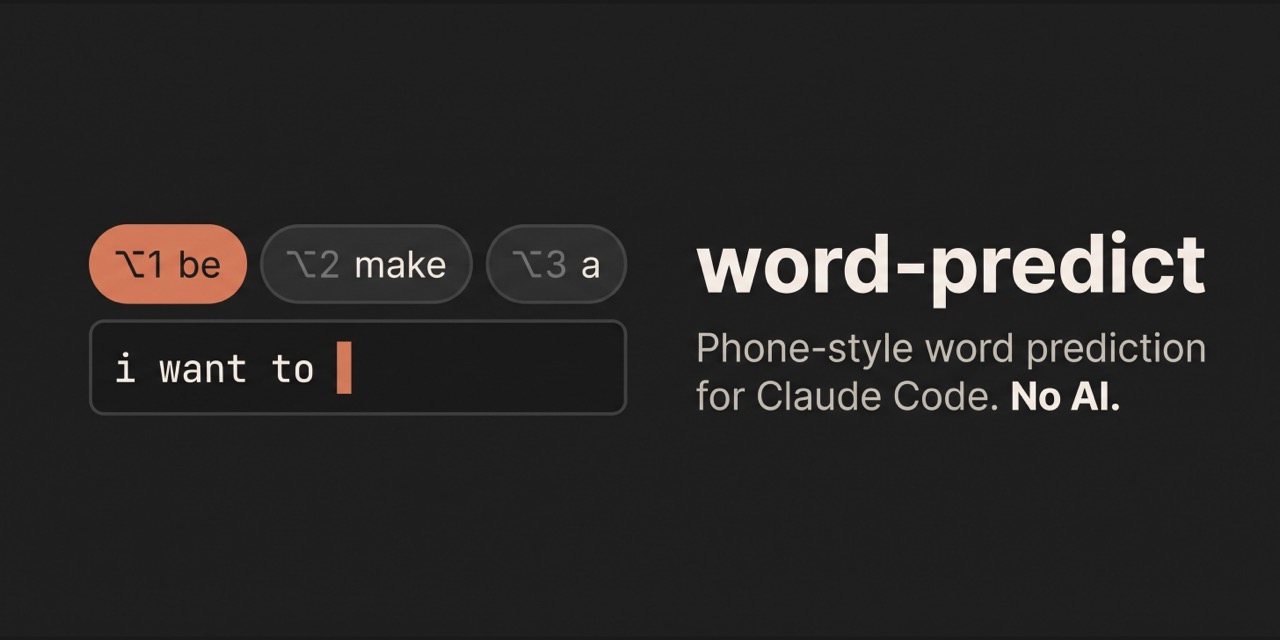
Phone-keyboard word prediction for the Claude Code prompt box. No AI: it finishes the word you are typing and suggests the next one from an English word list and from the way you write.
In a Claude Code session, run:
/plugin install word-predict --marketplace tehwave/claude-word-predictAnswer y to add the marketplace, then pick a scope. On its first start the mod downloads its word list (about 10 MB, once) and says when it is ready. Then tell it your keyboard layout, so Option+1/2/3 work:
/predict layout danish(us, danish, german or british; us until you set one.)
| Command | What it does |
|---|---|
/predict | Shows what it knows |
/predict import | Learns from the prompts you typed in past sessions (needs python3) |
/predict forget | Clears everything it learned from your prompts |
/predict layout <name> | Sets which Option keys take a word: us, danish, german, british |
/predict off, /predict on | Turns prediction off and on, in every session |
/predict import gives the biggest improvement: suggestions start sounding like you. It runs scripts/import_history.py, which reads your local session transcripts (~/.claude/projects), counts which words follow which in what you typed (not Claude's summaries or the app's own notes), and keeps only those counts. Nothing leaves your machine.
The desktop app keeps Tab, the arrow keys and Ctrl shortcuts for itself, so the mod reads Option+1, 2 and 3 by the character each one types on your layout and swaps that character for the word. Only your own layout's three characters count, so your other Option characters (€, £, “, …) type as usual. The US, Danish, German and British Mac layouts are known (LAYOUTS in hooks/keys.ts). For another layout, add what its Option+1, 2 and 3 type, and send a pull request.
The English word and word-pair counts are Peter Norvig's n-gram data, derived from the Google Web Trillion Word Corpus. This repository does not include them: each install downloads them from norvig.com and builds its list locally (hooks/lexicon.ts). The download is checked against the SHA-256 of the exact files the mod was tested with, so a changed or tampered file is refused rather than used.
What the mod reads, sends, runs and keeps.
Network. The mod contacts one host, www.norvig.com, and only to download two public files: https://www.norvig.com/ngrams/count_1w.txt and https://www.norvig.com/ngrams/count_2w.txt. Each is fetched with plain GET requests carrying a Range header, in pieces below Claude Code's 4 MiB response limit. It sends nothing else: no prompts, no words, no identifiers. This happens once, on the first session start (and again only if a new version changes how the list is built). After that it makes no network requests.
Programs. The mod runs one program, and only when you type /predict import: python3 -I <plugin folder>/scripts/import_history.py. Python is needed because the session transcripts it counts are often larger than a mod may read directly. The script reads your local session transcripts under ~/.claude/projects (or $CLAUDE_CONFIG_DIR/projects), keeps only what you typed, and prints word-sequence counts; the mod stores those counts and nothing else. The script writes no files and opens no network connections.
What it keeps. Everything is kept in the plugin's own Claude Code store on your machine: the built word list, the counts from /predict import, word counts from prompts you send, and your /predict settings. /predict forget deletes the counts.
Hooks.
| Hook | What it does |
|---|---|
session.start | Loads the stored data, registers /predict, and downloads the word list if it's missing or out of date |
prompt.edit | Reads each edit in the prompt box to update the suggestions. When the edit is your layout's Option+1/2/3 and a suggestion is showing, it replaces that key's character with the word; every other edit passes through unchanged |
prompt.submit | After a prompt is sent, counts its words and word pairs (not code, paths or prompts another hook refused) into the local store. Prompts submitted by other plugins pass through it too and are counted the same way; it never changes or blocks a prompt |
command.run | Answers /predict |
ui.render | Draws the suggestion strip above the prompt |
claude --plugin-dir .Check and test it with claude plugin validate . and claude plugin test ..
hooks/register.tsx 235 lines1import { atom, read } from 'claude-code'
2import type { EngineInterface, PromptBox, Register } from 'claude-code'
3
4import { LAYOUTS, literal, readPress, take } from './keys'
5import type { Press } from './keys'
6import { SOURCES, buildLexicon, fetchInRanges, isCurrent } from './lexicon'
7import { addition, buildModel, empty, learn, predict } from './predict'
8import type { Model } from './predict'
9
10import type { History, Layout, Learned, Lexicon, Prediction, Settings } from '../types'
11
12const NONE: Prediction = { prefix: '', words: [] }
13const DEFAULTS: Settings = { isOn: true, layout: 'us' }
14
15const PREDICTION = { plugin: 'word-predict', key: 'prediction' } as const
16const SETTINGS = { plugin: 'word-predict', key: 'settings' } as const
17const prediction = atom(PREDICTION, NONE)
18const shown = atom(SETTINGS, DEFAULTS)
19
20const HELP =
21 '/predict on, off, layout us|danish|german|british (which Option+1/2/3 take a word), import (learn from past sessions), forget (clear what it learned)'
22
23// The store holds the whole history; past this, an import is refused rather than
24// crowding out the word list and what is learned (the store's limit is 4 MiB).
25const MAX_HISTORY = 1_500_000
26
27/** Publishes what the strip offers; a plain write, as nothing else writes it. */
28function show($: EngineInterface, next: Prediction) {
29 void $.state.set(PREDICTION, next)
30}
31
32/** Reads what `/predict import`'s script printed; rejects output too large to keep. */
33function parseHistory(run: { exitCode: number; stdout: string; stderr: string; isStdoutTruncated: boolean }): History {
34 if (run.exitCode !== 0) throw new Error(run.stderr.trim().split('\n').pop() || `python3 exited with code ${run.exitCode}`)
35 if (run.isStdoutTruncated || run.stdout.length > MAX_HISTORY) throw new Error('your history is too large to keep')
36
37 return JSON.parse(run.stdout) as History
38}
39
40const LAYOUT_NAMES: Record<Layout, string> = { us: 'US', danish: 'Danish', german: 'German', british: 'British' }
41
42const isLayout =(value: string): value is Layout => Object.hasOwn(LAYOUTS, value)
43
44/** Reads what any session may have changed: settings, learned words, the imported history. */
45async function readStored($: EngineInterface): Promise<{ settings: Settings; learned: Learned; history?: History }> {
46 const [settings, learned, history] = await Promise.all([$.store.get('settings'), $.store.get('learned'), $.store.get('history')])
47 return {
48 settings: { ...DEFAULTS, ...(settings as Partial<Settings> | undefined) },
49 learned: (learned as Learned | undefined) ?? empty(),
50 history: history as History | undefined,
51 }
52}
53
54export const register: Register = on => {
55 let learned: Learned = empty()
56 let lexicon: Lexicon | undefined
57 let history: History | undefined
58 let settings: Settings = DEFAULTS
59 let model: Model = buildModel()
60 // Whether the strip is drawn: Option keys take only words the person can see.
61 let isStripDrawn = false
62 // The last Option press that took a word, so the same key again types its character.
63 let lastPress: { press: Press; after: PromptBox } | undefined
64
65 const rebuild = () => {
66 model = buildModel(lexicon, history)
67 }
68
69 /** Takes in what the store holds now, rebuilding the model only when the history changed. */
70 const adopt = (stored: Awaited<ReturnType<typeof readStored>>) => {
71 settings = stored.settings
72 learned = stored.learned
73 if (stored.history?.prompts !== history?.prompts || stored.history?.next.length !== history?.next.length) {
74 history = stored.history
75 rebuild()
76 }
77 }
78
79 on('session.start', async ($, e, next) => {
80 adopt(await readStored($))
81 void $.state.set(SETTINGS, settings)
82 lexicon = (await $.store.get('lexicon')) as Lexicon | undefined
83 rebuild()
84 await $.command.register({ name: 'predict', description: `Word prediction: ${HELP}` })
85
86 // First run, or a word list from an older version: fetch it in the background.
87 if (!isCurrent(lexicon)) {
88 void (async () => {
89 $.ui.status('Downloading the word list for word prediction…')
90 try {
91 // The only network use: two ranged GETs of Peter Norvig's count files.
92 const [words, pairs] = await Promise.all([
93 fetchInRanges(SOURCES.words, range =>
94 $.http.fetch('https://www.norvig.com/ngrams/count_1w.txt', { headers: { Range: range } }),
95 ),
96 fetchInRanges(SOURCES.pairs, range =>
97 $.http.fetch('https://www.norvig.com/ngrams/count_2w.txt', { headers: { Range: range } }),
98 ),
99 ])
100 const fresh = buildLexicon(words, pairs)
101 await $.store.set('lexicon', fresh)
102 lexicon = fresh
103 rebuild()
104 $.ui.toast('Word prediction is ready. Run /predict layout to pick your keyboard, /predict import to learn from past prompts.')
105 } catch (error) {
106 $.ui.toast(`Word prediction could not set up its word list: ${String(error)}`)
107 } finally {
108 $.ui.status(undefined)
109 }
110 })()
111 }
112
113 return next(e)
114 })
115
116 on('prompt.edit', async ($, e, next) => {
117 const press = settings.isOn && isStripDrawn ? readPress(settings.layout, e) : undefined
118 if (press) {
119 // The same key right after a pick: the person wanted the character, not a word.
120 const isRepeat = lastPress?.press.char === press.char && e.text.trimEnd() === lastPress.after.text.trimEnd()
121 const box = isRepeat && lastPress ? literal(lastPress.press) : take(model, learned, press)
122 lastPress = box && !isRepeat ? { press, after: box } : undefined
123 if (box) {
124 show($, predict(model, learned, box.text, box.cursor))
125 return box
126 }
127 }
128 lastPress = undefined
129
130 const box = await next(e)
131 if (!settings.isOn) return box
132 // The desktop holds a typed space back until the next character, so the box
133 // does not have it yet: predict as if it had, so next words show at once.
134 const isSpaceHeld = e.key?.key === 'space' && e.inputText === '' && box.text === e.text
135 const text = isSpaceHeld ? box.text.slice(0, box.cursor) + ' ' + box.text.slice(box.cursor) : box.text
136 show($, predict(model, learned, text, box.cursor + (isSpaceHeld ? 1 : 0)))
137
138 return box
139 })
140
141 on('prompt.submit', async ($, e, next) => {
142 const result = await next(e)
143 // The box is empty once a prompt is sent.
144 lastPress = undefined
145 show($, NONE)
146 // Learn what entered, as the hooks beneath left it; nothing from a refused prompt.
147 if (result.drop !== undefined || e.command || e.isMeta) return result
148
149 // Merge into what the store holds now, so other sessions' learning and a
150 // `/predict forget` elsewhere are kept, not overwritten by this session's copy.
151 adopt(await readStored($))
152 if (settings.isOn) {
153 learned = learn(learned, result.text)
154 await $.store.set('learned', learned).catch(() => $.ui.toast('Word prediction could not save what it learned: the store is full.'))
155 }
156
157 return result
158 })
159
160 on('command.run', { command: 'predict' }, async ($, e) => {
161 const [arg = '', value = ''] = e.args.trim().toLowerCase().split(/\s+/)
162 adopt(await readStored($))
163
164 if (arg === 'on' || arg === 'off' || arg === 'layout') {
165 if (arg === 'layout' && !isLayout(value)) return { text: `Pick one of: ${Object.keys(LAYOUTS).join(', ')}.` }
166 settings = arg === 'layout' ? { ...settings, layout: value as Layout } : { ...settings, isOn: arg === 'on' }
167 await $.store.set('settings', settings)
168 void $.state.set(SETTINGS, settings)
169 if (!settings.isOn) show($, NONE)
170 return { text: arg === 'layout' ? `Option+1/2/3 now follow the ${value} layout.` : `Word prediction ${arg}.` }
171 }
172 if (arg === 'import') {
173 let imported: History
174 try {
175 imported = parseHistory(
176 await $.process.run(['python3', '-I', `${$.plugin.root}/scripts/import_history.py`], { timeoutMs: 300_000 }),
177 )
178 await $.store.set('history', imported)
179 } catch (error) {
180 return { text: `Could not import past sessions: ${String(error)}` }
181 }
182 history = imported
183 rebuild()
184 return { text: `Learned from ${imported.prompts} prompts in past sessions.` }
185 }
186 if (arg === 'forget') {
187 await Promise.all([$.store.delete('learned'), $.store.delete('history')])
188 learned = empty()
189 history = undefined
190 rebuild()
191 return { text: 'Forgot everything learned from your prompts.' }
192 }
193 const state = settings.isOn ? 'on' : 'off'
194 const words = model.vocab.length > 0 ? `${model.vocab.length} words` : 'no word list yet'
195 const own = history ? `${history.prompts} past prompts imported` : 'past prompts not imported'
196 const sent = `${Object.keys(learned.words).length} words learned since`
197
198 return { text: `Word prediction is ${state} (${settings.layout} layout): ${words}, ${own}, ${sent}.\n${HELP}` }
199 })
200
201 on('ui.render', { component: 'AbovePrompt' }, async ($, e, next) => {
202 const { prefix, words } = await read($, prediction)
203 const { isOn, layout } = (await read($, shown)) as Settings
204 isStripDrawn = isOn && !e.props.hasSurvey && !e.props.isWorking && words.length > 0
205 if (!isStripDrawn) return next(e)
206 const { Box, Button, Text } = $.ui.resolve(e)
207
208 // A press takes the word against the box as it is now.
209 const press = async (word: string) => {
210 const box = await $.prompt.read()
211 const added = addition(box.text.slice(0, box.cursor), word, prefix)
212 const { isFilled } = await $.prompt.fill({ text: added, mode: 'insert' })
213 // A fill is no keystroke, so offer the next words here, for the draft as the person now sees it.
214 const text = box.text.slice(0, box.cursor) + added + box.text.slice(box.cursor)
215 if (isFilled) show($, predict(model, learned, text, box.cursor + added.length))
216 }
217
218 return (
219 <Box flexDirection="row" justifyContent="space-between">
220 <Box flexDirection="row" gap={3}>
221 <Text dimColor>{prefix ? 'complete' : 'next'}</Text>
222 {words.map((word, i) => (
223 <Box key={`s${i}`} flexDirection="row" gap={1}>
224 <Text dimColor>{`⌥${i + 1}`}</Text>
225 <Button key={`w${i}`} label={word} plain onPress={() => press(word)} />
226 </Box>
227 ))}
228 </Box>
229 {/* Which keyboard layout the ⌥ keys follow (/predict layout). */}
230 <Text dimColor>{LAYOUT_NAMES[layout]}</Text>
231 </Box>
232 )
233 })
234}
235hooks/keys.ts 52 lines1import type { PromptBox, PromptEditInput } from 'claude-code'
2
3import { accept, predict } from './predict'
4import type { Model } from './predict'
5
6import type { Layout, Learned } from '../types'
7
8// What Option+1, Option+2 and Option+3 type on each Mac layout. The desktop app
9// keeps Tab, the arrows and Ctrl chords for itself, but sends an Option key as
10// the character it types, with `meta`. Only the person's own layout counts, so
11// another layout's Option characters are never taken.
12export const LAYOUTS: Record<Layout, readonly string[]> = {
13 us: ['¡', '™', '£'],
14 danish: ['¡', '“', '§'],
15 german: ['¡', '“', '¶'],
16 british: ['¡', '€', '#'],
17}
18
19/** An Option+1..3 press: which place it takes, its character, and the draft as the person sees it. */
20export type Press = { place: number; char: string; text: string; cursor: number }
21
22/** Reads an edit as an Option+1..3 press on `layout`, or undefined for any other edit. */
23export const readPress = (layout: Layout, e: PromptEditInput): Press | undefined => {
24 const char = e.key?.meta && !e.key.ctrl ? e.key.key : ''
25 const place = char ? LAYOUTS[layout].indexOf(char) : -1
26 // Only the key itself, after the space the desktop may hold back: not an
27 // undo or a paste that happens to end in the same character.
28 const typed = e.inputText.slice(0, -char.length)
29 if (place < 0 || !e.inputText.endsWith(char) || typed.trim() !== '') return undefined
30
31 // The desktop may send the key as replacing the space before it: then keep
32 // the draft as it was, else add the held space it carried.
33 const text = typed ? e.text.slice(0, e.start) + typed + e.text.slice(e.end) : e.text
34 const cursor = typed ? e.start + typed.length : e.cursor
35
36 return { place, char, text, cursor }
37}
38
39/** The box with the suggestion at the press's place taken, or undefined when there is none. */
40export const take = (model: Model, learned: Learned, press: Press): PromptBox | undefined => {
41 const { prefix, words } = predict(model, learned, press.text, press.cursor)
42 const word = words[press.place]
43
44 return word ? accept(press.text, press.cursor, word, prefix) : undefined
45}
46
47/** The press's own character typed into its draft, for when the person wanted the character. */
48export const literal = (press: Press): PromptBox => ({
49 text: press.text.slice(0, press.cursor) + press.char + press.text.slice(press.cursor),
50 cursor: press.cursor + press.char.length,
51})
52hooks/lexicon.ts 122 lines1import type { Lexicon } from '../types'
2
3// Peter Norvig's English word and word-pair counts, derived from the Google Web
4// Trillion Word Corpus. Each person's copy is downloaded from his site on first
5// run and built here, so this repository ships none of the data. The hashes pin
6// the exact files the mod was built and tested against: anything else is refused.
7export const SOURCES = {
8 words: { bytes: 4956241, sha256: '51df159fd3de12b20e403c108f526e96dbd723d9cabdd5f17955cdc16059e690' },
9 pairs: { bytes: 5566017, sha256: '781c0596c3eea532d30bef9f3dba1d5137d652f00376260822c761a7584dfb8c' },
10} as const
11
12/** One ranged GET of a source file, as `register.tsx` writes it with the file's fixed address. */
13export type FetchRange = (range: string) => Promise<{ status: number; text: string }>
14
15// Bumped whenever buildLexicon's output changes, so stored copies are rebuilt.
16export const LEXICON_VERSION = 2
17
18// `$.http.fetch` cuts a body at 4 MiB, so each file is fetched in ranges below that.
19const CHUNK = 2 * 1024 * 1024
20
21const SIZE = 25000
22const NEXT_PER_WORD = 5
23const MAX_WORD = 24
24
25// Kept out of suggestions, as a phone keyboard does; still typeable. A word is
26// blocked when it starts with one of PREFIXES, or is one of ROOTS with an
27// inflection added.
28const PREFIXES = `porn xxx fuck shit cunt pussy pussies milf hentai slut whore dildo blowjob cumshot
29 upskirt shemale tranny faggot bdsm gangbang bukkake masturbat orgasm erotic horny
30 voyeur incest bestiality squirting creampie handjob threesome`.split(/\s+/)
31const ROOTS = `sex sexy nude naked anal cum cock dick tit boob escort viagra cialis penis
32 vagina fetish rape retard fag bondage bitch nigger nigga`.split(/\s+/)
33const INFLECTIONS = ['', 's', 'es', 'ed', 'ing', 'er', 'ers', 'y', 'ies']
34
35export const isBlocked = (word: string): boolean =>
36 PREFIXES.some(prefix => word.startsWith(prefix)) ||
37 ROOTS.some(root => word.startsWith(root) && INFLECTIONS.includes(word.slice(root.length)))
38
39// Common, but absent from the corpus, which drops apostrophes.
40const CONTRACTIONS = `don't can't won't isn't doesn't didn't wasn't aren't shouldn't couldn't wouldn't
41 haven't hasn't i'm i've i'll i'd it's that's there's what's let's you're we're they're`.split(/\s+/)
42
43// What the corpus keeps of a contraction once it splits it at the apostrophe.
44const FRAGMENTS = new Set(['re', 'll', 've', 'don', 'haven', 'isn', 'doesn', 'didn', 'wasn', 'aren', 'shouldn', 'couldn', 'wouldn', 'hasn'])
45
46/** Packs `word:next1,next2|...` from counts, each word's most frequent followers first. */
47const pack = (counts: Map<string, Map<string, number>>, keep: number): string => {
48 const rows: string[] = []
49 for (const [first, nexts] of counts) {
50 const top = [...nexts]
51 .sort((a, b) => b[1] - a[1])
52 .slice(0, keep)
53 .map(([word]) => word)
54 if (top.length > 0) rows.push(`${first}:${top.join(',')}`)
55 }
56 return rows.join('|')
57}
58
59/** Builds the vocabulary and next-word table from the text of the two count files. */
60export const buildLexicon = (wordCounts: string, pairCounts: string): Lexicon => {
61 // A contraction's followers are counted under its apostrophe-less spelling
62 // (`dont`), which leaves the word list for the contraction itself.
63 const spelled = new Map(CONTRACTIONS.map(c => [c.replace(/'/g, ''), c]))
64 const vocab: string[] = []
65 for (const line of wordCounts.split('\n')) {
66 const word = line.split('\t')[0] ?? ''
67 const isWord = /^[a-z]+$/.test(word) && word.length <= MAX_WORD && (word.length > 1 || word === 'a' || word === 'i')
68 if (isWord && !isBlocked(word) && !FRAGMENTS.has(word) && !spelled.has(word)) {
69 vocab.push(word)
70 if (vocab.length === SIZE) break
71 }
72 }
73 const words = [...vocab.slice(0, 300), ...CONTRACTIONS, ...vocab.slice(300)]
74 const known = new Set(words)
75
76 const pairs = new Map<string, Map<string, number>>()
77 for (const line of pairCounts.split('\n')) {
78 const [phrase, count] = line.split('\t')
79 const n = Number(count)
80 const [written, second, extra] = (phrase ?? '').toLowerCase().split(' ')
81 const first = spelled.get(written ?? '') ?? written
82 if (!first || !second || extra !== undefined || !Number.isFinite(n) || !known.has(first) || !known.has(second)) continue
83 const nexts = pairs.get(first) ?? new Map<string, number>()
84 nexts.set(second, (nexts.get(second) ?? 0) + n)
85 pairs.set(first, nexts)
86 }
87
88 return { version: LEXICON_VERSION, words: words.join(' '), next: pack(pairs, NEXT_PER_WORD) }
89}
90
91/** True for a stored lexicon this version built, not a stale or broken copy. */
92export const isCurrent = (lexicon: Lexicon | undefined): lexicon is Lexicon =>
93 lexicon?.version === LEXICON_VERSION && typeof lexicon.words === 'string' && typeof lexicon.next === 'string'
94
95const hex = (bytes: ArrayBuffer): string => [...new Uint8Array(bytes)].map(b => b.toString(16).padStart(2, '0')).join('')
96
97/**
98 * Fetches one source in ranges through `get` and checks its length and hash;
99 * rejects on any mismatch. A range can end inside a multi-byte character, which
100 * arrives broken as text, so each range keeps whole lines and the next starts after them.
101 */
102export async function fetchInRanges(source: { bytes: number; sha256: string }, get: FetchRange): Promise<string> {
103 const encoder = new TextEncoder()
104 const parts: string[] = []
105 let start = 0
106 while (start < source.bytes) {
107 const end = Math.min(start + CHUNK, source.bytes) - 1
108 const response = await get(`bytes=${start}-${end}`)
109 if (response.status !== 206) throw new Error(`the server answered ${response.status}`)
110 const kept = end === source.bytes - 1 ? response.text : response.text.slice(0, response.text.lastIndexOf('\n') + 1)
111 if (kept === '') throw new Error('the server sent no whole line')
112 parts.push(kept)
113 start += encoder.encode(kept).length
114 }
115 const text = parts.join('')
116 const bytes = encoder.encode(text)
117 const digest = hex(await crypto.subtle.digest('SHA-256', bytes))
118 if (bytes.length !== source.bytes || digest !== source.sha256) throw new Error('the downloaded file is not the expected one')
119
120 return text
121}
122hooks/predict.ts 231 lines1import type { History, Learned, Lexicon, Prediction } from '../types'
2
3// Stands for "the start of a sentence" as a previous word.
4export const START = '<s>'
5const WORD = /^[a-z][a-z']*$/
6const STARTERS = ['i', 'can', 'please', 'the', 'what', 'how']
7const MAX_WORDS = 5000
8const MAX_PAIRS = 3000
9const MAX_NEXT = 12
10
11// Web words that follow almost anything on a web page and nothing in a prompt.
12const FILLER = new Set(
13 'click page site home online search contact posted comments reviews rss login http www com print reply cart shipping'.split(' '),
14)
15
16/** What predictions are made from: the word list and, when imported, past prompts. */
17export type Model = {
18 vocab: string[]
19 inVocab: Set<string>
20 next: Map<string, string[]>
21 mine: Map<string, string[]>
22 mine2: Map<string, string[]>
23}
24
25const table = (packed: string): Map<string, string[]> => {
26 const map = new Map<string, string[]>()
27 for (const entry of packed ? packed.split('|') : []) {
28 const at = entry.lastIndexOf(':')
29 if (at > 0) map.set(entry.slice(0, at), entry.slice(at + 1).split(','))
30 }
31 return map
32}
33
34export const buildModel = (lexicon?: Lexicon, history?: History): Model => {
35 const vocab = lexicon?.words ? lexicon.words.split(' ') : []
36 return {
37 vocab,
38 inVocab: new Set(vocab),
39 next: table(lexicon?.next ?? ''),
40 mine: table(history?.next ?? ''),
41 mine2: table(history?.next2 ?? ''),
42 }
43}
44
45export const empty = (): Learned => ({ words: {}, pairs: {} })
46
47// Learned counts are plain objects read back from JSON, so a word such as
48// `constructor` must be read as an own property, never through the prototype.
49const count = (counts: Record<string, number> | undefined, word: string): number => {
50 const value = counts && Object.hasOwn(counts, word) ? counts[word] : undefined
51 return typeof value === 'number' ? value : 0
52}
53
54const followersOf = (learned: Learned, word: string): Record<string, number> | undefined =>
55 Object.hasOwn(learned.pairs, word) ? learned.pairs[word] : undefined
56
57const byCount = (counts: Record<string, number> | undefined): string[] =>
58 Object.keys(counts ?? {})
59 .map(word => [word, count(counts, word)] as const)
60 .sort((a, b) => b[1] - a[1])
61 .map(([word]) => word)
62
63/** Writes `word` in the case the person used for `like`: `Pre` -> `Prediction`. */
64const cased = (word: string, like: string): string => {
65 if (word === 'i' || word.startsWith("i'")) return capital(word)
66 if (like.length > 1 && like === like.toUpperCase()) return word.toUpperCase()
67 if (like[0] && like[0] !== like[0].toLowerCase()) return capital(word)
68 return word
69}
70
71const capital = (word: string): string => word.charAt(0).toUpperCase() + word.slice(1)
72
73const unique = (words: string[], limit: number): string[] => [...new Set(words)].slice(0, limit)
74
75/** The bare lowercase word of a whitespace token, or undefined for code, paths and the like. */
76const bare = (token: string): string | undefined => {
77 const word = token.toLowerCase().replace(/^["'(\[]+|[.,!?;:"')\]]+$/g, '')
78 return WORD.test(word) && word.length <= 24 ? word : undefined
79}
80
81/** True where a new sentence starts after `before`: an empty draft, a full stop, a new line. */
82const isSentenceStart = (before: string): boolean => {
83 const trimmed = before.trimEnd()
84 return trimmed === '' || /[.!?]["')]*$/.test(trimmed) || /\n\s*$/.test(before)
85}
86
87/** True for a word worth offering: in the word list or past prompts, or sent at least twice. */
88const isKnown = (model: Model, learned: Learned, word: string): boolean =>
89 model.inVocab.has(word) || model.mine.has(word) || count(learned.words, word) >= 2
90
91/** Words likely after `previous` (and `earlier` before it), best first: the person's own, then the web's. */
92const candidates = (model: Model, learned: Learned, previous: string, earlier?: string): string[] =>
93 [
94 ...(earlier ? (model.mine2.get(`${earlier} ${previous}`) ?? []) : []),
95 ...byCount(followersOf(learned, previous)).filter(word => isKnown(model, learned, word)),
96 ...(model.mine.get(previous) ?? []),
97 ...(model.next.get(previous) ?? []).filter(word => !FILLER.has(word)),
98 ...(previous === START ? STARTERS : []),
99 ].filter(word => word !== previous)
100
101/** Ways to finish `prefix`, given the words before it (`START` at a sentence start). */
102export const complete = (
103 model: Model,
104 learned: Learned,
105 prefix: string,
106 previous: string | undefined,
107 limit: number,
108 earlier?: string,
109): string[] => {
110 const lower = prefix.toLowerCase()
111 const fits = (word: string) => word.startsWith(lower) && word !== lower
112
113 const found: string[] = []
114 if (previous) found.push(...candidates(model, learned, previous, earlier).filter(fits))
115 found.push(...byCount(learned.words).filter(word => fits(word) && count(learned.words, word) >= 2))
116 for (const word of model.vocab) {
117 if (found.length >= limit * 4) break
118 if (fits(word)) found.push(word)
119 }
120
121 return unique(found, limit).map(word => cased(word, prefix))
122}
123
124/** Likely next words after `previous`; sentence starters, capitalised, after `START`. */
125export const following = (model: Model, learned: Learned, previous: string, limit: number, earlier?: string): string[] => {
126 const found = unique(candidates(model, learned, previous, earlier), limit)
127 return previous === START ? found.map(capital) : found.map(word => cased(word, word))
128}
129
130/** What the strip offers for a draft with the caret at `cursor`. */
131export const predict = (model: Model, learned: Learned, text: string, cursor: number, limit = 3): Prediction => {
132 const before = text.slice(0, cursor)
133 const tokens = before.split(/\s+/)
134 const current = tokens[tokens.length - 1] ?? ''
135 const head = before.slice(0, before.length - current.length)
136 const previousToken = tokens[tokens.length - 2] ?? ''
137 // START at a sentence start; undefined after a token that isn't a word (a path, a number).
138 const previous = isSentenceStart(head) ? START : bare(previousToken)
139 const lead = head.slice(0, head.trimEnd().length - previousToken.length)
140 const earlier = previous && previous !== START ? (isSentenceStart(lead) ? START : bare(tokens[tokens.length - 3] ?? '')) : undefined
141
142 if (current === '') {
143 if (text.trim() === '' || !previous) return { prefix: '', words: [] }
144 return { prefix: '', words: following(model, learned, previous, limit, earlier) }
145 }
146 if (!/^[A-Za-z][A-Za-z']*$/.test(current)) return { prefix: current, words: [] }
147
148 return { prefix: current, words: complete(model, learned, current, previous, limit, earlier) }
149}
150
151/**
152 * What taking `word` adds after `before`: for a completion (`prefix` set), the
153 * rest of the word being typed; for a next word, the word with a space in
154 * front where `before` doesn't end in one. Then a space.
155 */
156export const addition = (before: string, word: string, prefix: string): string => {
157 if (prefix) {
158 const typed = before.match(/[A-Za-z']+$/)?.[0] ?? ''
159 const rest = typed && word.toLowerCase().startsWith(typed.toLowerCase()) ? word.slice(typed.length) : word
160 return rest + ' '
161 }
162 return (before === '' || /\s$/.test(before) ? '' : ' ') + word + ' '
163}
164
165/** The draft with `word` taken at the cursor. */
166export const accept = (text: string, cursor: number, word: string, prefix: string): { text: string; cursor: number } => {
167 const added = addition(text.slice(0, cursor), word, prefix)
168 return { text: text.slice(0, cursor) + added + text.slice(cursor), cursor: cursor + added.length }
169}
170
171/** Adds `n` to `word` in `counts`, moving it to the end so insertion order is recency. */
172const bump = (counts: Record<string, number>, word: string, n: number): void => {
173 const total = count(counts, word) + n
174 delete counts[word]
175 counts[word] = total
176}
177
178/** Counts the words and word pairs of a sent prompt into `learned`, leaving out code and paths. */
179export const learn = (learned: Learned, text: string): Learned => {
180 const words: Record<string, number> = Object.assign(Object.create(null), learned.words)
181 const pairs: Record<string, Record<string, number>> = Object.assign(Object.create(null), learned.pairs)
182 // Closed code fences, then an unclosed one to the end, then inline code.
183 const prose = text
184 .replace(/(```|~~~)[\s\S]*?\1/g, '\n')
185 .replace(/(```|~~~)[\s\S]*$/, '\n')
186 .replace(/`[^`\n]*`/g, ' ')
187
188 for (const sentence of prose.split(/(?<=[.!?]["')]*)\s+|\n+/)) {
189 let previous = START
190 for (const token of sentence.trim().split(/\s+/)) {
191 const word = bare(token)
192 if (!word) {
193 previous = ''
194 continue
195 }
196 bump(words, word, 1)
197 if (previous) {
198 const nexts: Record<string, number> = Object.assign(Object.create(null), followersOf({ words, pairs }, previous))
199 bump(nexts, word, 1)
200 delete pairs[previous]
201 pairs[previous] = nexts
202 }
203 previous = /[.!?,;:]["')]*$/.test(token) ? '' : word
204 }
205 }
206
207 return { words: keepTop(words, MAX_WORDS), pairs: prunePairs(pairs) }
208}
209
210/** Keeps the `limit` highest counts; on a tie the more recent entry stays, so new words get a chance. */
211const keepTop = (counts: Record<string, number>, limit: number): Record<string, number> => {
212 const entries = Object.keys(counts).map((word, at) => ({ word, n: count(counts, word), at }))
213 if (entries.length <= limit) return counts
214 const kept = entries.sort((a, b) => b.n - a.n || b.at - a.at).slice(0, limit).sort((a, b) => a.at - b.at)
215 const result: Record<string, number> = Object.create(null)
216 for (const { word, n } of kept) result[word] = n
217 return result
218}
219
220const prunePairs = (pairs: Record<string, Record<string, number>>): Record<string, Record<string, number>> => {
221 const entries = Object.keys(pairs).map((word, at) => {
222 const nexts = keepTop(pairs[word] ?? {}, MAX_NEXT)
223 const total = Object.keys(nexts).reduce((sum, next) => sum + count(nexts, next), 0)
224 return { word, nexts, total, at }
225 })
226 const kept = entries.length > MAX_PAIRS ? entries.sort((a, b) => b.total - a.total || b.at - a.at).slice(0, MAX_PAIRS) : entries
227 const result: Record<string, Record<string, number>> = Object.create(null)
228 for (const { word, nexts } of kept.sort((a, b) => a.at - b.at)) result[word] = nexts
229 return result
230}
231types/index.d.ts 27 lines1/** Counts kept across sessions from the prompts sent; `<s>` keys sentence starters. */
2export type Learned = {
3 words: Record<string, number>
4 pairs: Record<string, Record<string, number>>
5}
6
7/** The downloaded word list, packed: words by frequency, and `word:next1,next2|...`. */
8export type Lexicon = { version: number; words: string; next: string }
9
10/** What `/predict import` counted in past sessions' prompts, packed like `Lexicon.next`. */
11export type History = { prompts: number; next: string; next2: string }
12
13/** The Mac keyboard layout whose Option+1/2/3 characters take a suggestion. */
14export type Layout = 'us' | 'danish' | 'german' | 'british'
15
16/** What `/predict` sets, kept across sessions. */
17export type Settings = { isOn: boolean; layout: Layout }
18
19/** What the strip offers: completions of `prefix`, or next words where `prefix` is empty. */
20export type Prediction = { prefix: string; words: string[] }
21
22declare module 'claude-code' {
23 interface PluginState {
24 'word-predict': { prediction: Prediction; settings: Settings }
25 }
26}
27