secret-box
Claude can use a secret without seeing it: a masked box saves keys to .env and gives Claude a placeholder, every key a tool prints comes back as a placeholder…
newpanebandguardtoastprompt

Claude can use a secret without seeing it: a masked box saves keys to .env and gives Claude a placeholder, every key a tool prints comes back as a placeholder…
A Claude Code mod that lets Claude use a secret without ever seeing it. When Claude needs an API key, it calls a request_secret tool, a masked box opens, you paste the key, and the mod writes it to .env. Claude gets a placeholder like [REDACTED-SECRET-3f9a1c2e] instead of the value, and the placeholder turns into the real key whenever a tool runs. Any key a tool prints comes back to Claude as a placeholder, and committing .env is refused.
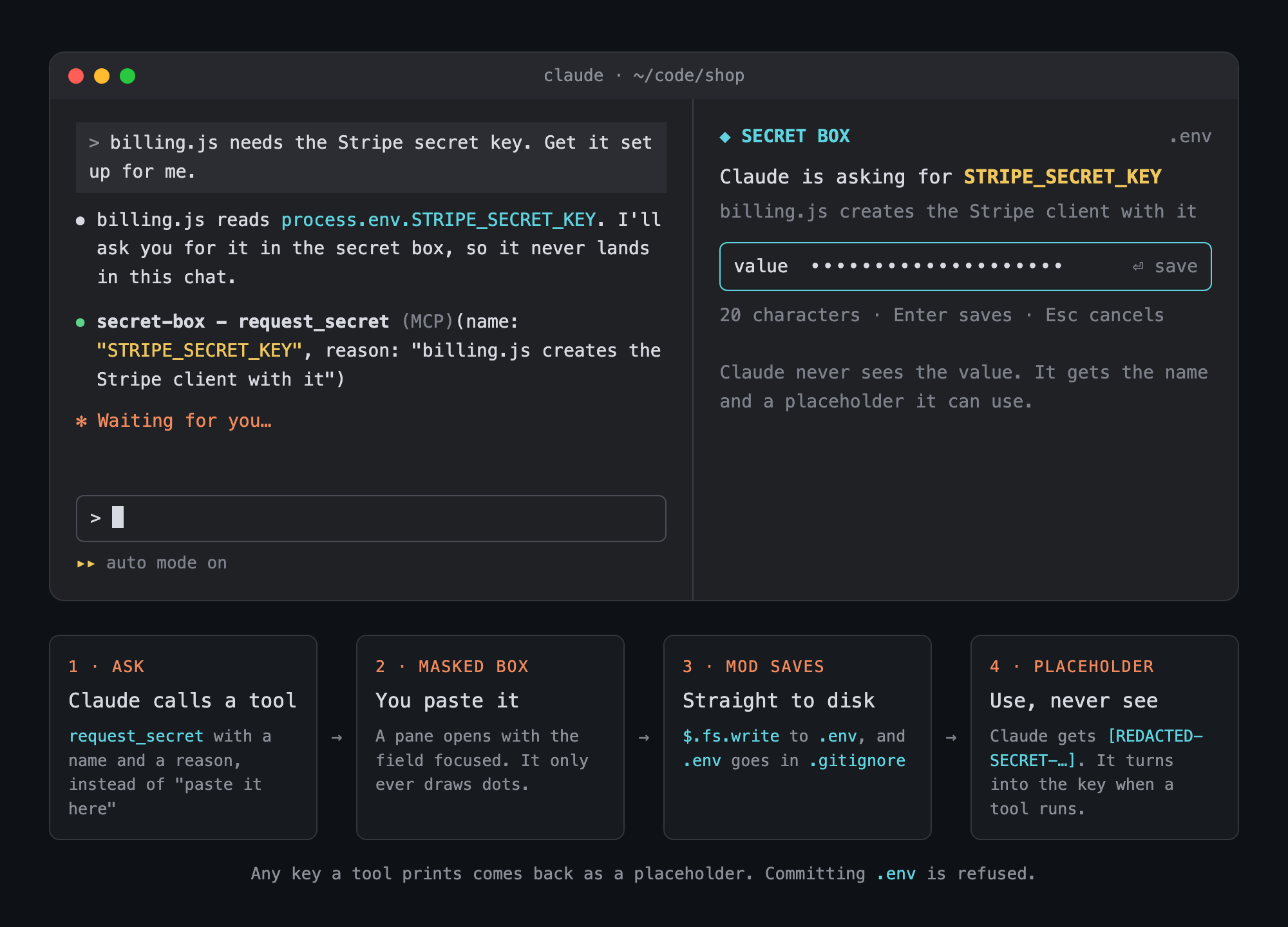
A key that reaches the conversation is in the transcript for good. It is sent to the model on every turn after, kept in the session file on disk, and replayed into every fork of the session. You can't take it back afterwards, so the only fix is to never send it. Keys get in two ways: you paste one, or a tool prints one (a cat .env, a config file, an API answer). secret-box closes both, and still lets Claude run the code that needs the key.
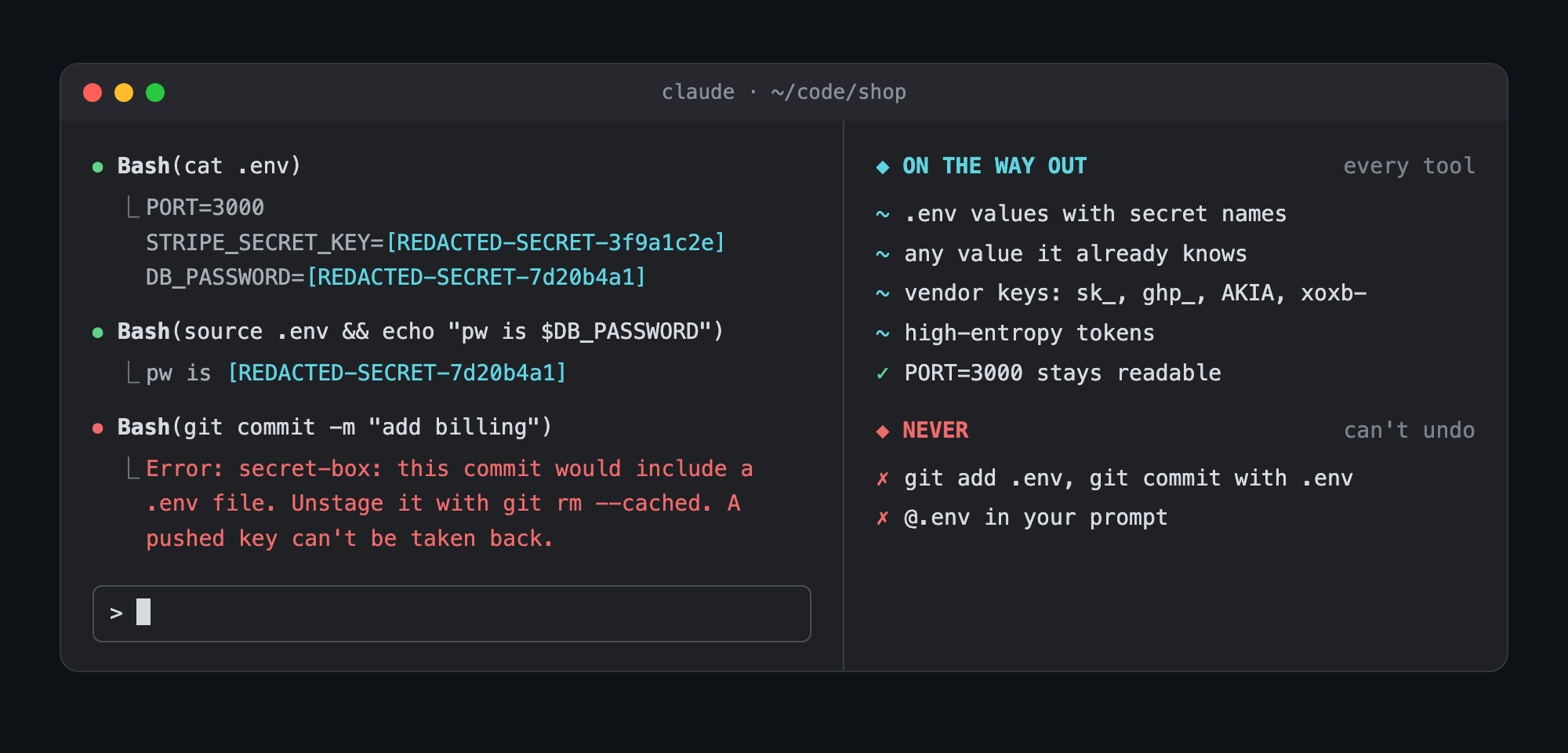
request_secret takes a variable name and a one-line reason. Its description tells Claude to use it instead of asking you to paste.NAME=value to .env (and makes sure .gitignore covers it), then tells Claude the name and a placeholder. Claude can put the placeholder in a command or a file: curl -u [REDACTED-SECRET-3f9a1c2e]: https://api.stripe.com/v1/balance runs with the real key.sk_live_, ghp_, AKIA, xoxb- and more), any key shaped like a short lowercase prefix and a long random body (imp_ and 40 hex), passwords on CLI flags and in connection strings, base64 that decodes to a key, high-entropy tokens, every .env value with a secret name, and every value the mod already knows come back as placeholders. cat .env still shows PORT=3000.git add .env and a git commit that would carry a .env file are refused, because a pushed key can't be taken back.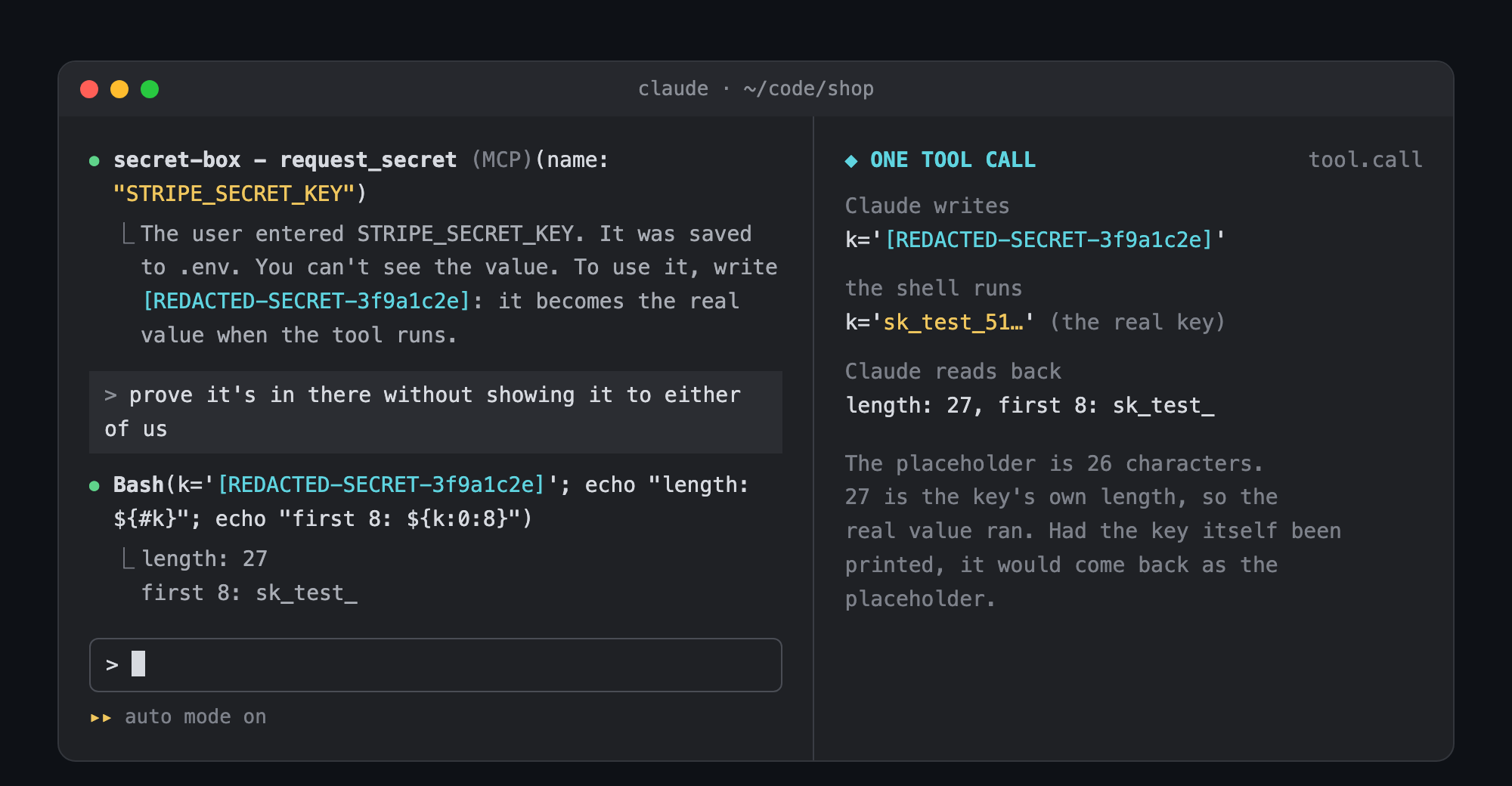
claude plugin marketplace add ray-amjad/claude-code-mods
claude plugin install secret-box@claude-code-mods
Or inside Claude Code: /plugin marketplace add ray-amjad/claude-code-mods, then /plugin install secret-box@claude-code-mods.
Ask for something that needs a secret, such as billing.js needs the Stripe secret key, get it set up. Claude calls secret-box - request_secret.
Then ask Claude to use it: check the key works. It writes the placeholder into a command and the real key is used. A tool row says secret-box: hid 1 value(s) whenever something was swapped on the way out.
If you'd rather not wait for Claude to think of the tool, say use the secret box to ask me for STRIPE_SECRET_KEY.
The example folder is a tiny app whose billing.js reads STRIPE_SECRET_KEY, with a .env.example beside it.
cp -R example /tmp/shop && cd /tmp/shop && git init
claude
Accept the trust prompt (mods don't load in an untrusted folder). Tell Claude billing.js needs the Stripe secret key, paste a fake key such as sk_test_123, and press Enter. Then ask prove the key is in .env without showing it to me, and cat .env to see the placeholder.
Set them with /plugin configure secret-box@claude-code-mods, or under pluginConfigs in your user settings.
| Option | Default | What it does | | :- | :- | :- | | secrets | true | Hide secrets in tool output and prompts | | pii | false | Hide email addresses and public IP addresses | | hideEmails | true | With pii on, also hide emails; turn off to hide only IPs | | redactPrivateIps | false | With pii on, also hide private and reserved IPs recognized by the detector | | restoreInToolInputs | true | Turn placeholders back into real values before a tool runs | | restoreTools | Bash,Write,Edit,MultiEdit,NotebookEdit | The tools that may receive a real value. Tools that send data off the machine are left out on purpose | | notify | true | A count on the tool row, a toast on a prompt | | minEntropy | 3.6 | Bits per character for the high-entropy test | | minLength | 24 | Shortest token the high-entropy test looks at | | contextMinEntropy | 3.0 | The floor when API_KEY=, "token": or Bearer sits in front | | allow | empty | Exact strings never to hide, comma separated | | allowEmails | empty | Addresses or @domain.com never to hide | | allowPrefixes | empty | Extra id prefixes to treat as public | | allowUrlHosts | empty | Hosts (app.todoist.com, localhost:3000, *.example.com) whose link paths are kept as written. A host covers itself only; *. covers its subdomains. The query string and fragment are still scanned, and a vendor-shaped key in the path is still hidden. Don't list a host that puts credentials in the path (Slack webhooks, Telegram bot links, presigned links): a random-looking secret there would be kept too | | denyPrefixes | empty | Prefixes to test even though they look like a public id |
Stripe object ids (price_, prod_, cus_, pk_live_ and so on) are public and are never hidden. Neither are git SHAs, file paths or names written in code.
session.start registers the tool with isDeferred: false, so Claude sees it on every turn, and reads .env in the working directory to learn which values are secret.$.ui.open and an Input. The element has no password mode, so the mod masks it itself: the field draws • repeated, and onInput works out what was typed, pasted or deleted and keeps the real value in a module variable. A hook may only run for 10 seconds of its own time, but time inside a mods API call doesn't count, so it waits for you in short $.process.run(['sleep', '0.3']) calls (on Windows, which has no sleep, a 300 ms node -e wait, or a ping of 1 second where node is not installed)..env with $.fs and hands the value to the vault, which answers with the placeholder. The vault maps each value to a random placeholder that stays stable within the session, and lives in memory only.hooks/redact.ts and hooks/detect.ts. register.jsx calls its register and adds only what secret-box needs, so the two can't drift. Its hooks hide keys in your prompt, CLAUDE.md, tool results, @ files, the engine's own attachments and subagent tasks, and put real values back into Bash, Write and Edit. A value restored into a command is hidden again if the command prints it..env file, a tool.call hook reads it too and gives every value whose name says secret (KEY, TOKEN, SECRET, PASSWORD and the like) to the vault. So even a weak value the detector would miss, like a word password, comes back as a placeholder.tool.call hook on Bash refuses git add of a .env file and runs git diff --cached --name-only before any git commit. A prompt.mention hook refuses @.env, which would attach the raw file..catch that fails closed: if a scan breaks, the output is withheld or the call is refused.base64, rev) or sends it somewhere, and the transformed output isn't recognized. This stops keys from landing in the transcript by accident. It is not a sandbox against a model that is trying to leak one.cat .env and source .env as credential access before secret-box sees them. Using the placeholder from the box still works. In default mode, approve the read and it comes back masked.git commit or gh issue, gh pr (and the like) gets no real values, so a commit message keeps the placeholder. A step that needs the key has to be its own command.Write or Edit lands on disk as the key..env value under 8 characters is hidden in .env reads, but not wherever else it turns up..env at the start of each session, so those values are hidden again..env is learned at session start. Other .env files are masked by name when they are read.claude -p has no one to type, so the tool answers that it needs an interactive session.claude --plugin-dir ./secret-box
claude plugin validate .
claude plugin test .
node --experimental-strip-types tests/detect.test.mtstests/secret-box.test.ts covers the guard, .env values and the round trip from placeholder to value. tests/detect.test.mts is transcript-redactor's detector test: 174 values that must be hidden and 114 that must be kept.
Tested with Claude Code 2.1.296.
Random placeholder tags were contributed by Ben Ellis (@benissimo). The hideEmails option was contributed by Cody Harris (@VibeCodyH). Both implementations are adapted to this mod's current vault and hooks.
To keep emails readable while hiding public IPs, set pii: true and hideEmails: false. PII hiding remains off by default. The restored IP detector recognizes IPv4 and full-form IPv6; compressed IPv6 is not comprehensively covered.
hooks/register.jsx 301 lines1// secret-box: Claude can use a secret without ever seeing it.
2//
3// Pattern: guard what you can't undo. A secret in the conversation is in the
4// transcript for good, so it must never get there:
5// - In: Claude calls request_secret, you paste the value into a masked box,
6// the mod writes it to .env and hands Claude a placeholder.
7// - Out: every secret a tool would show Claude (a `cat .env`, an API answer,
8// a key you paste) is swapped for a placeholder like [REDACTED-SECRET-1a2b3c4d].
9// - Use: a placeholder in a tool's input becomes the real value as the tool
10// runs, so `curl -H "Authorization: Bearer [REDACTED-SECRET-...]"` works.
11// - Never: committing .env is refused, since a pushed key can't be taken back.
12//
13// The redaction is transcript-redactor, unchanged (./redact.ts, ./detect.ts):
14// its hooks do the In, Out and Use. This file adds the box, teaches the vault
15// the values in .env, and guards commits. Nothing is written but .env.
16
17import { register as redactor, LIVE_TAG_TOOLS, brand } from './redact.ts'
18import { keepSecret } from './detect.ts'
19
20const TOOL = 'mcp__secret-box__request_secret'
21const PANE = 'secret-box'
22const DOT = '•'
23
24// The one request being collected right now. The real value lives only here,
25// in the mod's memory, until it is saved.
26let pending = null // { name, reason, value, answer, isInBand }
27
28// A .env key whose name says it holds a secret
29const SECRET_NAME = /KEY|TOKEN|SECRET|PASS|PWD|CREDENTIAL|AUTH|PRIVATE|DSN|SALT|SIGNING|WEBHOOK/i
30const ASSIGNMENT = /^(\s*(?:export\s+)?([A-Za-z_][A-Za-z0-9_]*)\s*=\s*)(.*)$/gm
31
32export function register(on, options) {
33 // request_secret answers with a live placeholder: keep it live
34 LIVE_TAG_TOOLS.add(TOOL)
35 brand.name = 'secret-box'
36 redactor(on, options || {})
37
38 // 1. Give Claude the tool, and teach the vault the secrets already in .env
39 on('session.start', async ($, e, next) => {
40 await $.tool.register({
41 name: 'request_secret',
42 description:
43 'Ask the user for a secret (API key, token, password) without it ever entering the conversation. ' +
44 'The user pastes it into a masked box and the mod saves it to the project .env. You get back the ' +
45 'variable name and a placeholder like [REDACTED-SECRET-1a2b3c4d]. Write that placeholder in a command ' +
46 'or file and it becomes the real value when the tool runs. Use this INSTEAD of asking the user to ' +
47 'paste a secret into chat.',
48 inputSchema: {
49 type: 'object',
50 properties: {
51 name: { type: 'string', description: 'Environment variable name, e.g. STRIPE_SECRET_KEY' },
52 reason: { type: 'string', description: 'One short line telling the user why it is needed' },
53 },
54 required: ['name', 'reason'],
55 },
56 isDeferred: false,
57 })
58 await learnDotenv($, ['.env'])
59 return next(e)
60 })
61
62 // 2. The guard: .env may be read (its secrets come back hidden), never committed
63 on('tool.call', { tool: 'Bash' }, async ($, e, next) => {
64 const why = await commitBlockReason($, String(e.command || ''))
65 return why ? { deny: `secret-box: ${why} A pushed key can't be taken back.` } : next(e)
66 }).catch(() => ({ deny: 'secret-box: the .env guard failed, so this call is blocked to be safe.' }))
67
68 // 3. A call that reads a .env file: learn its secret values before it runs,
69 // so the redactor hides them in the output even when they look weak
70 // (a word password). Reading .env is fine; its secrets come back hidden.
71 on('tool.call', { tool: /^(Bash|Read|Grep|Edit|MultiEdit|NotebookEdit)$/ }, async ($, e, next) => {
72 const files = envFiles(e)
73 if (files.length > 0) await learnDotenv($, files)
74 return next(e)
75 }).catch(($, e, next) => (next.called ? next(e) : { deny: 'secret-box: could not check this .env file, so the call is blocked to be safe.' }))
76
77 // @.env would attach the raw file to your prompt
78 on('prompt.mention', { path: /(^|[\\/])\.env(\.[\w.-]+)?$/ }, async ($, e, next) =>
79 isEnvFile(e.path) ? { deny: 'secret-box: ask Claude to read .env instead; its secrets come back hidden' } : next(e))
80 .catch(() => ({ deny: 'secret-box: the .env guard failed' }))
81
82 // 4. The box. Claude calls the tool: open it, wait for you, save, answer.
83 on('tool.call', { tool: TOOL }, async ($, e, next) => {
84 const name = String(e.name || '').trim()
85 if (!/^[A-Za-z_][A-Za-z0-9_]*$/.test(name)) {
86 return { result: `"${name}" is not a valid variable name. Use letters, digits and underscores.` }
87 }
88 // A plain -p run has no one to type into the box
89 if ((await $.session.surfaces()).length === 0) {
90 return { result: `secret-box needs an interactive session to collect ${name}. Ask the user to run Claude Code interactively.` }
91 }
92 if (pending) return { result: `secret-box is already waiting for ${pending.name}. Ask for one secret at a time.` }
93
94 // `answer` stays undefined until Enter (the value) or Escape (empty)
95 pending = { name, reason: String(e.reason || ''), value: '', answer: undefined, isInBand: false }
96 const opened = await $.ui.open({ id: PANE, title: 'secret-box', focus: true, closeOnEscape: true, holdToasts: true, rows: 7 })
97 // A narrow terminal (under 144 columns) keeps the pane undrawn: use the band above the prompt instead
98 if (!opened.isPlaced) {
99 pending.isInBand = true
100 await $.ui.close({ id: PANE })
101 $.ui.invalidate('ui.render')
102 $.ui.toast(`Claude wants ${name}: press ctrl+x then tab to type it in the box above the prompt`, { timeoutMs: 10000 })
103 }
104
105 // A hook's own run time is capped at 10 s, but time inside a mods API call
106 // is not counted, so wait for the person in short `sleep` processes.
107 const deadline = (await $.clock.now()) + 10 * 60_000
108 while (pending.answer === undefined && !next.signal.aborted && (await $.clock.now()) < deadline) {
109 await pause($)
110 }
111 const value = pending.answer
112 pending = null
113 await $.ui.close({ id: PANE })
114 $.ui.invalidate('ui.render')
115 if (!value) return { result: `The user cancelled. ${name} was not saved.` }
116
117 try {
118 const where = await saveToDotenv($, await $.session.cwd(), name, value)
119 const tag = keepSecret(value)
120 $.ui.toast(`${name} saved to ${where}`)
121 // The ONLY things Claude learns: the name, the place, and a placeholder
122 return { result: `The user entered ${name}. It was saved to ${where}. You can't see the value. To use it in a command or a file, write ${tag}: it becomes the real value when the tool runs and is hidden again in the output. Code should read it from the environment.` }
123 } catch (err) {
124 return { result: `Saving ${name} failed: ${String(err && err.message || err).slice(0, 300)}` }
125 }
126 }).catch(async ($, e, next) => {
127 // If the hook itself fails (or times out), drop the request, close the box and tell Claude plainly
128 pending = null
129 try { await $.ui.close({ id: PANE }) } catch {}
130 $.ui.invalidate('ui.render')
131 $.ui.log('request_secret failed: ' + JSON.stringify(next.error).slice(0, 500))
132 return { result: 'secret-box failed before anything was saved. Nothing was written.' }
133 })
134
135 // Draw the box, in our pane or (narrow terminal) in the band above the prompt
136 on('ui.render', { component: 'Pane' }, async ($, e, next) => {
137 if (e.requestId !== PANE || !pending) return next(e)
138 return drawBox($, e, pending)
139 })
140 on('ui.render', { component: 'AbovePrompt' }, async ($, e, next) => {
141 if (!pending || !pending.isInBand) return next(e)
142 return drawBox($, e, pending)
143 })
144
145 // Escape (or any close) on the pane before Enter means cancel
146 on('ui.close', async ($, e, next) => {
147 if (e.id === PANE && pending && !pending.isInBand) pending.answer = ''
148 return next(e)
149 }).catch(($, e, next) => next(e))
150}
151
152// One short wait, in a process, so it is not the hook's own time. Mac and
153// Linux have `sleep`. A native Windows terminal does not, so there node waits
154// where it is installed, else ping, which every Windows has (about 1 s).
155export const WAITS = {
156 unix: [['sleep', '0.3']],
157 windows: [['node', '-e', 'setTimeout(() => {}, 300)'], ['ping', '-n', '2', '127.0.0.1']],
158}
159let waits = null
160async function pause($) {
161 waits ||= [...((await $.env.get('OS')) === 'Windows_NT' ? WAITS.windows : WAITS.unix)]
162 for (;;) {
163 try {
164 return await $.process.run(waits[0])
165 } catch (err) {
166 // Only a command that is not there moves on to the next one
167 if (waits.length > 1 && isNotFound(err)) waits.shift()
168 else throw err
169 }
170 }
171}
172export function isNotFound(err) {
173 return /ENOENT|not found/i.test(String((err && err.message) || err))
174}
175
176// .env, .env.local, .env.production ... but not .env.example and friends
177export function isEnvFile(path) {
178 const base = String(path || '').split(/[\\/]/).pop()
179 return /^\.env(\.[\w.-]+)?$/.test(base) && !/\.(example|sample|template|dist)$/.test(base)
180}
181
182// The .env files a tool call reads or names, as written in the call
183function envFiles(e) {
184 const direct = [e.file_path, e.notebook_path, e.path].filter(isEnvFile)
185 const named = String(e.command || '').match(/(?:^|[^\w.\/-])((?:[\w.\/-]*\/)?\.env(?:\.[\w.-]+)?)(?![\w.-])/g) || []
186 return [...direct, ...named.map(m => m.replace(/^[^\w.\/-]/, '')).filter(isEnvFile)]
187}
188
189// Read .env files and hand every secret-named value to the vault, so it is
190// hidden wherever it turns up. Never throws: a file it can't read teaches it
191// nothing, and the redactor still scans the output.
192async function learnDotenv($, files) {
193 let cwd = ''
194 try { cwd = await $.session.cwd() } catch {}
195 for (const f of files) {
196 try {
197 const path = isAbsolute(f) ? f : f.startsWith('~/') ? f : cwd + '/' + f
198 if (path.startsWith('~/') || !(await $.fs.exists(path))) continue
199 for (const m of (await $.fs.read(path)).matchAll(ASSIGNMENT)) {
200 const value = m[3].trim().replace(/^["']|["']$/g, '')
201 if (value.length >= 6 && SECRET_NAME.test(m[2])) keepSecret(value)
202 }
203 } catch {}
204 }
205}
206
207// /x on Mac and Linux; C:\x, C:/x or \\server\share on Windows
208export function isAbsolute(path) {
209 return path.startsWith('/') || /^[A-Za-z]:[\\/]/.test(path) || path.startsWith('\\\\')
210}
211
212// The repositories a command's git calls run in: each `git -C <dir>`, and the
213// session's own repository for a plain `git`
214function gitDirs(cmd) {
215 const dirs = new Set()
216 for (const m of cmd.matchAll(/\bgit((?:[ \t]+-c[ \t]+\S+|[ \t]+-C[ \t]+(?:"[^"]*"|'[^']*'|\S+))*)/g)) {
217 const c = m[1].match(/-C[ \t]+("[^"]*"|'[^']*'|\S+)/g)
218 if (!c) dirs.add('')
219 else dirs.add(c.at(-1).replace(/^-C[ \t]+/, '').replace(/^["']|["']$/g, ''))
220 }
221 return [...dirs]
222}
223
224// Why a Bash command must be blocked: it stages or commits a .env file
225async function commitBlockReason($, cmd) {
226 if (/\bgit\b[^;&|]*\badd\b/.test(cmd) && /\.env\b(?!\.(example|sample|template|dist))/.test(cmd)) {
227 return 'staging a .env file is blocked.'
228 }
229 if (!/\bgit\b[^;&|]*\bcommit\b/.test(cmd)) return ''
230 // The index is read before the command runs. If the same command stages
231 // (git add ... && git commit, or commit -a), count what it could stage too:
232 // every changed or untracked file git does not ignore.
233 const stages = /\bgit\b[^;&|]*\b(add|stage)\b/.test(cmd) || /\bcommit\b[^;&|]*\s(-a|--all|-\w*a\w*)\b/.test(cmd)
234 for (const dir of gitDirs(cmd)) {
235 const git = (...args) => $.process.run(['git', ...(dir ? ['-C', dir] : []), ...args])
236 const checks = [git('diff', '--cached', '--name-only')]
237 if (stages) checks.push(git('ls-files', '--modified', '--others', '--exclude-standard'))
238 for (const r of await Promise.all(checks)) {
239 if (r.exitCode !== 0) return `could not check what this commit includes${dir ? ' in ' + dir : ''}, so it is blocked.`
240 const env = r.stdout.split('\n').find(isEnvFile)
241 if (env) {
242 return stages
243 ? `this command could stage and commit ${env}. Add it to .gitignore, or stage named files in a separate step.`
244 : 'this commit would include a .env file. Unstage it with git rm --cached.'
245 }
246 }
247 }
248 return ''
249}
250
251// The field shows dots; the real text is kept in `p.value`, never drawn.
252function drawBox($, e, p) {
253 const { Box, Text, Input } = $.ui.resolve(e)
254 return (
255 <Box flexDirection="column" paddingX={1}>
256 <Text bold>Claude is asking for <Text color="yellow">{p.name}</Text></Text>
257 {p.reason ? <Text dimColor>{p.reason}</Text> : null}
258 <Input
259 key="secret"
260 label="value "
261 placeholder="paste it here, it stays masked"
262 value={DOT.repeat(p.value.length)}
263 submitLabel="save"
264 autoFocus
265 onInput={text => {
266 // Everything up to the first non-dot is the part we already hold;
267 // the rest is what was just typed or pasted. Backspace shortens the dots.
268 let kept = 0
269 while (kept < text.length && text[kept] === DOT) kept++
270 p.value = p.value.slice(0, Math.min(kept, p.value.length)) + text.slice(kept)
271 $.ui.invalidate('ui.render')
272 }}
273 onSubmit={() => { p.answer = p.value }}
274 />
275 <Text dimColor>{p.value.length ? `${p.value.length} characters · ` : ''}Enter saves · {p.isInBand ? 'ctrl+x tab to focus, Enter on empty cancels' : 'Esc cancels'} · Claude never sees the value</Text>
276 </Box>
277 )
278}
279
280async function saveToDotenv($, cwd, name, value) {
281 const path = cwd + '/.env'
282 const old = (await $.fs.exists(path)) ? await $.fs.read(path) : ''
283 const line = `${name}=${quote(value)}`
284 const lines = old.split('\n').filter((l, i, all) => !(i === all.length - 1 && l === ''))
285 const at = lines.findIndex(l => l.startsWith(name + '='))
286 if (at >= 0) lines[at] = line
287 else lines.push(line)
288 await $.fs.write(path, lines.join('\n') + '\n')
289
290 const gi = cwd + '/.gitignore'
291 const ignore = (await $.fs.exists(gi)) ? await $.fs.read(gi) : ''
292 const isIgnored = ignore.split('\n').some(l => ['.env', '.env*', '*.env', '/.env'].includes(l.trim()))
293 if (!isIgnored) await $.fs.write(gi, ignore + (ignore && !ignore.endsWith('\n') ? '\n' : '') + '.env\n')
294 return '.env' + (isIgnored ? '' : ' (and added .env to .gitignore)')
295}
296
297// Plain values stay bare; anything with spaces, quotes or # gets double quotes.
298function quote(v) {
299 return /^[A-Za-z0-9_\-.\/:+=@]*$/.test(v) ? v : '"' + v.replace(/\\/g, '\\\\').replace(/"/g, '\\"').replace(/\n/g, '\\n') + '"'
300}
301hooks/redact.ts 258 lines1import type { Register, PromptContextBlock } from 'claude-code'
2import {
3 makeConfig,
4 scrubSecrets,
5 scrubPii,
6 restore,
7 mint,
8 walk,
9 collect,
10 escapeLiteralTags,
11 type WalkState,
12} from './detect.ts'
13
14// transcript-redactor: keeps secrets (and, if asked, email addresses) out of
15// the session transcript. Everything that decides what a secret is lives in
16// ./detect.ts; this file only wires it to the events where text enters the
17// conversation, and to the tools where a placeholder must become real again.
18//
19// Every hook fails closed. A hook that throws or runs past its budget is
20// skipped by the engine, and for a redactor that would mean the raw text goes
21// through. So each one has a `.catch` that withholds instead.
22
23// The scan is linear, but a string past this size could still run past the
24// hook's 10 s budget. It is withheld rather than passed on unscanned.
25const SCAN_CAP = 16_000_000
26
27const WITHHELD =
28 'transcript-redactor could not scan this result in time, so it was withheld. Narrow the output (head, grep, offset) and retry.'
29const BLOCK_WITHHELD = '[transcript-redactor withheld this text: the scan failed]'
30
31// Tools whose answer carries live placeholders, so they are not turned into
32// quoted (LITERAL) ones: the subagent tools, whose answer holds placeholders
33// the subagent used. A mod built on this one can add its own tool here.
34export const LIVE_TAG_TOOLS = new Set(['Agent', 'Task'])
35
36// The name on the toast and the tool row. A mod built on this one sets its own.
37export const brand = { name: 'transcript-redactor' }
38
39// Attachments that carry text from outside the engine's own prose: a file,
40// a diff of a file, a queued prompt. These get the full scrub, emails too.
41const OUTSIDE_TEXT = new Set(['file', 'edited_text_file', 'queued_command'])
42
43type Budget = { budget: { remainingMs: number } }
44
45// Throws before a scan that cannot finish: the `.catch` then withholds.
46function guard(text: string, next: Budget): void {
47 if (text.length > SCAN_CAP) throw new Error('transcript-redactor: text too large to scan')
48 const needMs = 300 + text.length / 4000
49 if (next.budget.remainingMs < needMs) throw new Error('transcript-redactor: out of time')
50}
51
52// A Bash command that writes text into git history or posts it to GitHub.
53// Its placeholders stay placeholders: a commit message or an issue body that
54// quotes one must not carry the real key off the machine. The whole command
55// is left as written, so a step that needs the key goes in its own call.
56const PUBLISHES =
57 /\bgit\b(?:[ \t]+-[cC][ \t]+\S+|[ \t]+--?[\w-]+(?:=\S+)?)*[ \t]+(?:commit|tag|notes|send-email)\b|\bgh[ \t]+(?:issue|pr|release|gist|discussion|api|repo[ \t]+(?:create|edit))\b/
58
59// A restored value goes into Bash as shell source. One holding any of these
60// (quotes, $, backticks, separators, globs) could run as code there, so it is
61// never put into a command. Most keys are letters, digits and -_.+/=:
62const SHELL_ACTIVE = /[\s$`"'\\;&|<>()*?[\]{}#~]|[\x00-\x1f\x7f]/
63
64// @-mentioned files the engine attaches as media or a page reference, never
65// as text. When one is too large for $.fs.read it holds no text to check.
66const MEDIA_FILE = /\.(?:png|jpe?g|gif|webp|bmp|tiff?|heic|pdf)$/i
67
68function looksBinary(text: string): boolean {
69 const head = text.slice(0, 8192)
70 return head.includes('\u0000') || (head.match(/�/g)?.length ?? 0) > 8
71}
72
73export const register: Register = (on, options) => {
74 const cfg = makeConfig(options as Record<string, unknown>)
75
76 const scrub = (text: string): string => {
77 let out = text
78 if (cfg.secrets) out = scrubSecrets(out, cfg)
79 if (cfg.pii) out = scrubPii(out, cfg)
80 return out
81 }
82 const secretsOnly = (text: string): string => (cfg.secrets ? scrubSecrets(text, cfg) : text)
83 // An `allowUrlHosts` entry that is not a host name is said once, not dropped silently.
84 let warnedHosts = cfg.allowUrlRejected.length === 0
85
86 // Counts the values hidden, not the placeholders that stand for quoted text.
87 const countHidden = (tags: Set<string>): number => [...tags].filter((t) => !t.startsWith('[REDACTED-LITERAL-')).length
88
89 // 1. What the user types. A pasted key never reaches the model as itself,
90 // and neither does the context a hook above attached to the prompt.
91 on('prompt.submit', async ($, e, next) => {
92 const { value, tags } = collect(() => {
93 guard(e.text, next)
94 return { text: scrub(e.text), context: e.context?.map((c) => (guard(c, next), scrub(c))) }
95 })
96 const n = countHidden(tags)
97 if (!warnedHosts) {
98 warnedHosts = true
99 $.ui.toast(`${brand.name}: allowUrlHosts ignored ${cfg.allowUrlRejected.join(', ')} (not a host name)`)
100 }
101 if (n > 0 && cfg.notify) $.ui.toast(`${brand.name}: hid ${n} value(s) from the prompt`)
102 if (tags.size === 0) return next(e)
103 return next({ ...e, text: value.text, ...(value.context ? { context: value.context } : {}) })
104 }).catch(($, e, next) => (next.called ? next(e) : { drop: 'transcript-redactor failed to scan this prompt, so it was not sent.' }))
105
106 // 2. Every tool call. On the way in, a placeholder becomes its real value,
107 // but only for a tool that runs on this machine. On the way out, the
108 // result, the text the model reads and any attached context are scanned.
109 on('tool.call', async ($, e, next) => {
110 const command = (e as { command?: unknown }).command
111 const publishes = e.tool === 'Bash' && typeof command === 'string' && PUBLISHES.test(command)
112 const isLocal = cfg.restore && cfg.restoreTools.has(e.tool) && !publishes
113 // The real values this call was handed. Whatever the tool prints of them
114 // comes back hidden, even bare and short, where no detector would fire.
115 const handed = new Set<string>()
116 const restoreTracked = (s: string): string =>
117 restore(s) === s
118 ? s
119 : s.replace(/\[REDACTED-SECRET-[0-9a-f]{8}\]/g, (t) => {
120 const v = restore(t)
121 if (v !== t) handed.add(v)
122 return v
123 })
124 const rehideHanded = (text: string): string => {
125 let out = text
126 for (const v of [...handed].sort((a, b) => b.length - a.length)) if (v.length >= 4 && out.includes(v)) out = out.split(v).join(mint('SECRET', v))
127 return out
128 }
129 const input = isLocal ? (walk({ ...e }, restoreTracked) as typeof e) : e
130 if (e.tool === 'Bash' && [...handed].some((v) => SHELL_ACTIVE.test(v))) {
131 return {
132 deny: `${brand.name}: a secret in this command holds shell characters, so its real value was not put into Bash, where it could run as code. Write it to a file with the Write tool and have the command read that file instead.`,
133 }
134 }
135 const r = await next(input)
136 if (r.deny !== undefined) {
137 // A refusal from beneath may quote the input it refused, real values
138 // and all, and the model reads it as the tool's answer.
139 const d = collect(() => (guard(r.deny, next), rehideHanded(scrub(escapeLiteralTags(r.deny)))))
140 return d.tags.size === 0 ? r : { deny: d.value }
141 }
142
143 const escape = !LIVE_TAG_TOOLS.has(e.tool)
144 const st: WalkState = { incomplete: false }
145 // The result and the text often hold the same string: scan it once.
146 const memo = new Map<string, string>()
147 const clean = (s: string): string => {
148 const done = memo.get(s)
149 if (done !== undefined) return done
150 guard(s, next)
151 const out = rehideHanded(scrub(escape ? escapeLiteralTags(s) : s))
152 memo.set(s, out)
153 return out
154 }
155 const { value, tags } = collect(() => ({
156 result: walk(r.result, clean, st),
157 text: r.text === undefined ? undefined : clean(r.text),
158 context: r.context?.map(clean),
159 }))
160 if (tags.size === 0) return r
161 // Something was hidden, and part of the result could not be rewritten:
162 // that part may hold the same secret, so the whole result is withheld.
163 if (st.incomplete) return { deny: 'transcript-redactor: a secret sits in a part of this result it cannot rewrite (too deep, or not plain data). Narrow the call and retry.' }
164
165 const n = countHidden(tags)
166 if (cfg.notify && n > 0) $.ui.notice(e.tool_use_id, `${brand.name}: hid ${n} value(s)`)
167 const context = value.context ? { context: value.context } : {}
168 if (r.isError) return { isError: true as const, result: value.result, text: value.text, ...context }
169 return { result: value.result, ...context } as typeof r
170 }).catch(async ($, e, next) => {
171 // Nothing ran yet: refuse the call. The tool answered: withhold it.
172 if (!next.called) return { deny: WITHHELD }
173 const r = await next(e)
174 if (r.deny !== undefined) return { deny: WITHHELD }
175 if (r.isError) return { isError: true as const, result: WITHHELD, text: WITHHELD }
176 return { deny: WITHHELD }
177 })
178
179 // 3. The blocks attached to the first message (CLAUDE.md and friends).
180 // Secrets only: the email in there is the user's own, and the engine
181 // puts it there so the model knows who it is talking to.
182 on('prompt.context', async ($, e, next) => {
183 const r = await next(e)
184 if (!cfg.secrets) return r
185 const blocks: PromptContextBlock[] = r.blocks.map((b) => {
186 guard(b.text, next)
187 return { ...b, text: secretsOnly(b.text) }
188 })
189 // The raw files behind a rewritten CLAUDE.md would carry the key on to
190 // the hooks above, so they are left out once any block changed.
191 if (blocks.every((b, i) => b.text === r.blocks[i].text)) return r
192 return { blocks }
193 }).catch(async ($, e, next) => {
194 // Keep the blocks, so the model sees that something was held back.
195 const r = await next(e)
196 return { blocks: r.blocks.map((b) => ({ ...b, text: BLOCK_WITHHELD })) }
197 })
198
199 // 4. What the engine injects on its own after the first message: a file
200 // named with @, a diff of a file that changed on disk, a nested
201 // CLAUDE.md, a settings hook's context. None of it passes tool.call.
202 on('prompt.attachment', async ($, e, next) => {
203 const r = await next(e)
204 if (r.text == null) return r
205 const text = r.text
206 guard(text, next)
207 const isOutside = e.origin.kind !== 'engine' || OUTSIDE_TEXT.has(e.type)
208 const isFile = e.type === 'file' || e.type === 'edited_text_file'
209 const out = isOutside ? scrub(isFile ? escapeLiteralTags(text) : text) : secretsOnly(text)
210 return out === text ? r : { text: out }
211 }).catch(() => ({ text: BLOCK_WITHHELD }))
212
213 // 5. A file named with @ is read with no tool call, and its raw text is
214 // stored in the transcript whatever the model is shown. So a file that
215 // holds a secret is refused here, before it is read, and the model is
216 // told to use the Read tool, whose result is scrubbed.
217 on('prompt.mention', async ($, e, next) => {
218 if (!cfg.secrets) return next(e)
219 let text: string
220 try {
221 const read = await $.fs.read(e.path)
222 if (typeof read !== 'string') return next(e)
223 text = read
224 } catch {
225 // Missing: the engine attaches nothing. An image or a PDF too large to
226 // read is attached as media, not text. A text file that is present
227 // but unreadable (too large, say) cannot be checked, so it is refused.
228 if (!(await $.fs.exists(e.path))) return next(e)
229 if (MEDIA_FILE.test(e.path)) return next(e)
230 return { deny: 'transcript-redactor: could not check this file for secrets; ask Claude to Read it instead' }
231 }
232 if (looksBinary(text)) return next(e)
233 guard(text, next)
234 const { tags } = collect(() => scrubSecrets(text, cfg))
235 if (tags.size > 0) return { deny: 'transcript-redactor: this file holds a secret; ask Claude to Read it instead, so the value is replaced by a placeholder' }
236 return next(e)
237 }).catch(($, e, next) => (next.called ? next(e) : { deny: 'transcript-redactor: could not check this file for secrets' }))
238
239 // 6. A subagent's task. The model only ever holds placeholders, and the
240 // Agent tool gets no restore, so this is a second layer: a value that
241 // slipped into the prompt some other way still reaches the subagent as
242 // a placeholder. A workflow agent's prompt cannot be rewritten, only
243 // refused, so one that holds a secret is not started.
244 on('agent.spawn', async ($, e, next) => {
245 if (!cfg.secrets) return next(e)
246 if (e.workflow) {
247 guard(e.prompt, next)
248 const { tags } = collect(() => secretsOnly(e.prompt))
249 if (tags.size === 0) return next(e)
250 return { deny: "transcript-redactor: this workflow agent's prompt holds a secret, and a workflow prompt cannot be rewritten. Pass the value by a file or an env var instead." }
251 }
252 guard(e.prompt, next)
253 const prompt = secretsOnly(e.prompt)
254 const description = secretsOnly(e.description)
255 return prompt === e.prompt && description === e.description ? next(e) : next({ ...e, prompt, description })
256 }).catch(($, e, next) => (next.called ? next(e) : { deny: 'transcript-redactor failed to scan this task, so the subagent was not started.' }))
257}
258hooks/detect.ts 1650 lines1// The pure half of transcript-redactor: the config, the vault, the detectors,
2// and the walkers. Nothing in here touches `$` or registers a hook, so another
3// mod can vendor this file as it is and the tests can run it under plain node.
4//
5// The value is not deleted. It is put in a vault that lives in this module,
6// in memory, for the session, and the transcript gets a placeholder in its
7// place: `[REDACTED-SECRET-1a2b3c4d]`. Within one session the same value always
8// mints the same placeholder, so the model can still tell one customer from
9// another, and the placeholder is swapped back for the real value on the way
10// into a tool that runs on this machine, so a `Bash` command or a `Write` still
11// carries the real key.
12//
13// Nothing is written to disk. The vault dies with the session.
14
15export type Kind = 'SECRET' | 'EMAIL' | 'IP' | 'LITERAL'
16
17export type Config = {
18 secrets: boolean
19 pii: boolean
20 emails: boolean
21 privateIps: boolean
22 restore: boolean
23 restoreTools: ReadonlySet<string>
24 notify: boolean
25 minEntropy: number
26 minLength: number
27 contextMinEntropy: number
28 allow: ReadonlySet<string>
29 allowEmails: readonly string[]
30 allowPrefix: readonly string[]
31 denyPrefix: readonly string[]
32 allowUrl: AllowUrl
33 // Entries of `allowUrlHosts` that are not a host name, shown once.
34 allowUrlRejected: readonly string[]
35}
36
37// The tools that run on this machine. A placeholder is only swapped back for
38// its real value in these: a tool that hands its input to another model or to
39// the network (Agent, WebFetch, WebSearch, SendMessage, an MCP tool) gets the
40// placeholder as written.
41export const DEFAULT_RESTORE_TOOLS = 'Bash,Write,Edit,MultiEdit,NotebookEdit'
42
43// ---------------------------------------------------------------- the vault
44
45const byValue = new Map<string, string>()
46const byTag = new Map<string, string>()
47let hidden = 0
48let minted: Set<string> | null = null
49
50const TAG = /\[REDACTED-(?:SECRET|EMAIL|IP|LITERAL)-[0-9a-f]{8}\]/g
51const WHOLE_TAG = /^\[REDACTED-(?:SECRET|EMAIL|IP|LITERAL)-[0-9a-f]{8}\]$/
52
53function randomHex8(): string {
54 const bytes = new Uint8Array(4)
55 const crypto = (globalThis as { crypto?: { getRandomValues?: (values: Uint8Array) => Uint8Array } }).crypto
56 if (crypto?.getRandomValues) crypto.getRandomValues(bytes)
57 else for (let index = 0; index < bytes.length; index++) bytes[index] = Math.floor(Math.random() * 256)
58 return Array.from(bytes, byte => byte.toString(16).padStart(2, '0')).join('')
59}
60
61// Swaps a value for its placeholder and remembers both. A value that already
62// holds a placeholder from an earlier pass (a key inside a URL password) is
63// stored with that placeholder put back, so one restore gives the real text.
64export function mint(kind: Kind, raw: string): string {
65 hidden++
66 const value = kind === 'LITERAL' ? raw : restore(unpark(raw))
67 const seen = byValue.get(value)
68 if (seen) {
69 if (kind === 'SECRET') remember(value)
70 minted?.add(seen)
71 return seen
72 }
73 let tag: string
74 do tag = `[REDACTED-${kind}-${randomHex8()}]`
75 while (byTag.has(tag))
76 byValue.set(value, tag)
77 byTag.set(tag, value)
78 if (kind === 'SECRET') remember(value)
79 minted?.add(tag)
80 return tag
81}
82
83// A secret is hidden again wherever it turns up later: across the session
84// when it is distinctive enough (echoable), and within the text being
85// scanned right now when it is shorter but still not a plain word.
86function remember(value: string): void {
87 const echoes = echoable(value)
88 if (echoes && !echo.has(value)) {
89 echo.add(value)
90 echoIndex = null
91 }
92 if (local && (echoes || localWorthy(value))) local.add(value)
93}
94
95// One pass, on purpose: a LITERAL placeholder gives back the placeholder text
96// it stands for, and that text must not then turn into the secret.
97export function restore(text: string): string {
98 if (byTag.size === 0 || !text.includes('[REDACTED-')) return text
99 return text.replace(TAG, (tag) => byTag.get(tag) ?? tag)
100}
101
102// Hides a value the caller knows is secret wherever it turns up for the rest
103// of the session, even one too short or too plain for the echo rule (a word
104// password from .env). Values under PREFIX characters can't be indexed.
105export function keepSecret(value: string): string {
106 const tag = mint('SECRET', value)
107 if (value.length >= PREFIX && !echo.has(value)) {
108 echo.add(value)
109 echoIndex = null
110 }
111 return tag
112}
113
114// How many times a value has been hidden this session. A hook reads it before
115// and after a scrub to learn whether anything changed.
116export function hiddenCount(): number {
117 return hidden
118}
119
120// Runs `fn` and hands back every placeholder it minted or reused, so a hook
121// can count the values it hid without counting one value twice.
122export function collect<T>(fn: () => T): { value: T; tags: Set<string> } {
123 const outer = minted
124 const tags = new Set<string>()
125 minted = tags
126 try {
127 return { value: fn(), tags }
128 } finally {
129 minted = outer
130 if (outer) for (const t of tags) outer.add(t)
131 }
132}
133
134// A placeholder read back from a file or a log is quoted text, not a handle.
135// Left alone it would turn into the real secret the next time the model
136// copied that text into a command. So a live placeholder found in a tool's
137// output is swapped for a LITERAL one, which restores to the placeholder text
138// and nothing more. Run this before the detectors, so a key the tool printed
139// still comes back as its live placeholder.
140export function escapeLiteralTags(text: string): string {
141 if (byTag.size === 0 || !text.includes('[REDACTED-')) return text
142 return text.replace(TAG, (t) => (byTag.has(t) && !t.startsWith('[REDACTED-LITERAL-') ? mint('LITERAL', t) : t))
143}
144
145// ------------------------------------------------------- known value echoes
146
147// A value hidden once because of where it sat (after `API_KEY=`, inside a
148// URL) is hidden again wherever it turns up, even bare, where no detector
149// would fire on it: a tool that echoes a restored key must not print it.
150const echo = new Set<string>()
151let echoIndex: EchoIndex | null = null
152// The values minted during the current scan, to hide at their other spots.
153let local: Set<string> | null = null
154
155// Short or all-letter values (`postgres`) are left out: hiding every later
156// `postgres` in unrelated output would make the session unreadable.
157function echoable(value: string): boolean {
158 if (countsUp(value)) return false
159 // A slug or a dated name hidden once beside a key name is not worth hiding
160 // everywhere: it would turn every path that holds it into a placeholder.
161 if (value.split(/[^A-Za-z0-9]+/).every((p) => p === '' || isSlugPart(p))) return false
162 if (value.includes('\n')) return value.length >= 40
163 return value.length >= 20 || (value.length >= 10 && /[0-9]/.test(value) && /[A-Za-z]/.test(value))
164}
165
166// A value too short to hide across the session is still hidden at its other
167// spots in the same text, unless it is a plain word or slug (`postgres`
168// hidden once in a URL must not turn every `postgres://` into a placeholder).
169function localWorthy(value: string): boolean {
170 if (value.length < PREFIX || value.length > 400 || value.includes('\n') || countsUp(value)) return false
171 if (value.split(/[^A-Za-z0-9]+/).every((p) => p === '' || isSlugPart(p))) return false
172 return /[0-9]/.test(value) || /[^A-Za-z0-9]/.test(value) || value.length >= 12
173}
174
175// The known values are found with a rolling hash over their first PREFIX
176// characters, so the cost of the scan does not grow with the vault. A regex
177// of every value joined by `|` took 40 s on 200 KB once a long session had
178// hidden a few thousand values.
179const PREFIX = 8
180// Under each prefix the values are kept by length, longest first, so a
181// prefix that thousands of values share costs one set lookup per length,
182// not a walk of the whole list.
183type ByLength = { lengths: number[]; values: Set<string> }
184type EchoIndex = { hashes: Set<number>; byPrefix: Map<string, ByLength>; top: number }
185
186function prefixHash(text: string, at: number): number {
187 let h = 0
188 for (let i = 0; i < PREFIX; i++) h = (Math.imul(h, 31) + text.charCodeAt(at + i)) >>> 0
189 return h
190}
191
192function buildEchoIndex(values: Iterable<string>): EchoIndex {
193 const byPrefix = new Map<string, ByLength>()
194 for (const v of values) {
195 const p = v.slice(0, PREFIX)
196 let entry = byPrefix.get(p)
197 if (!entry) byPrefix.set(p, (entry = { lengths: [], values: new Set() }))
198 if (!entry.lengths.includes(v.length)) entry.lengths.push(v.length)
199 entry.values.add(v)
200 }
201 for (const entry of byPrefix.values()) entry.lengths.sort((a, b) => b - a)
202 const hashes = new Set<number>()
203 for (const p of byPrefix.keys()) hashes.add(prefixHash(p, 0))
204 // 31 to the power PREFIX - 1, to take the oldest character out of the hash.
205 let top = 1
206 for (let i = 0; i < PREFIX - 1; i++) top = Math.imul(top, 31) >>> 0
207 return { hashes, byPrefix, top }
208}
209
210function rehideKnown(text: string): string {
211 if (echo.size === 0 || text.length < PREFIX) return text
212 return rehideWith(text, (echoIndex ??= buildEchoIndex(echo)))
213}
214
215// The values minted in one scan, hidden at their other spots in it. A few
216// values are found faster one by one than by the rolling hash.
217function rehideLocal(text: string, values: Set<string>): string {
218 if (values.size > 64) return rehideWith(text, buildEchoIndex(values))
219 let out = text
220 for (const v of [...values].sort((a, b) => b.length - a.length)) if (out.includes(v)) out = out.split(v).join(mint('SECRET', v))
221 return out
222}
223
224function rehideWith(text: string, ix: EchoIndex): string {
225 if (text.length < PREFIX) return text
226 const parts: string[] = []
227 let last = 0
228 let h = prefixHash(text, 0)
229 for (let i = 0; i + PREFIX <= text.length; ) {
230 if (ix.hashes.has(h)) {
231 const entry = ix.byPrefix.get(text.slice(i, i + PREFIX))
232 let found: string | undefined
233 if (entry) {
234 for (const n of entry.lengths) {
235 const v = text.slice(i, i + n)
236 if (v.length === n && entry.values.has(v)) {
237 found = v
238 break
239 }
240 }
241 }
242 if (found) {
243 parts.push(text.slice(last, i), mint('SECRET', found))
244 i += found.length
245 last = i
246 if (i + PREFIX <= text.length) h = prefixHash(text, i)
247 continue
248 }
249 }
250 if (i + PREFIX >= text.length) break
251 h = (Math.imul((h - Math.imul(text.charCodeAt(i), ix.top)) >>> 0, 31) + text.charCodeAt(i + PREFIX)) >>> 0
252 i++
253 }
254 if (last === 0) return text
255 parts.push(text.slice(last))
256 return parts.join('')
257}
258
259// ------------------------------------------------------------------ parking
260
261// Some spans are known not to be secrets and are big enough to drown the
262// transcript in placeholders: an image in a data: URI, a lockfile hash, a
263// thinking-block signature, a base64 attachment. They are parked behind a
264// marker for the scan and put back after it. The marker is a character the
265// text does not contain; if every candidate is taken, nothing is parked and
266// the scan simply hides more.
267type Parked = { mark: string; spans: string[]; re: RegExp }
268let parked: Parked | null = null
269const MARKS = ['\u0000', '\uE000', '\uE001', '\uFDD0']
270
271function startParking(text: string): Parked | null {
272 const mark = MARKS.find((m) => !text.includes(m))
273 return mark ? { mark, spans: [], re: new RegExp(`${mark}(\\d+)${mark}`, 'g') } : null
274}
275
276function park(span: string): string {
277 if (!parked) return span
278 parked.spans.push(span)
279 return `${parked.mark}${parked.spans.length - 1}${parked.mark}`
280}
281
282function unpark(text: string): string {
283 const p = parked
284 if (!p || !text.includes(p.mark)) return text
285 let out = text
286 for (let i = 0; i < 3 && out.includes(p.mark); i++) out = out.replace(p.re, (_m, n: string) => p.spans[Number(n)] ?? '')
287 return out
288}
289
290// ------------------------------------------------------------- small tools
291
292// Bits per character. Counted in a reused array for plain ASCII, since the
293// scan calls this for every candidate token.
294const COUNTS = new Int32Array(128)
295
296function entropy(text: string): number {
297 let ascii = true
298 for (let i = 0; i < text.length; i++) {
299 const c = text.charCodeAt(i)
300 if (c >= 128) {
301 ascii = false
302 break
303 }
304 }
305 if (!ascii) {
306 const counts = new Map<string, number>()
307 for (const ch of text) counts.set(ch, (counts.get(ch) ?? 0) + 1)
308 let h = 0
309 for (const n of counts.values()) h -= (n / text.length) * Math.log2(n / text.length)
310 return h
311 }
312 COUNTS.fill(0)
313 for (let i = 0; i < text.length; i++) COUNTS[text.charCodeAt(i)]!++
314 let h = 0
315 for (let c = 0; c < 128; c++) {
316 const n = COUNTS[c]!
317 if (n > 0) h -= (n / text.length) * Math.log2(n / text.length)
318 }
319 return h
320}
321
322const B64_TABLE = (() => {
323 const t = new Int16Array(128).fill(-1)
324 const abc = 'ABCDEFGHIJKLMNOPQRSTUVWXYZabcdefghijklmnopqrstuvwxyz0123456789+/'
325 for (let i = 0; i < abc.length; i++) t[abc.charCodeAt(i)] = i
326 t['-'.charCodeAt(0)] = 62
327 t['_'.charCodeAt(0)] = 63
328 return t
329})()
330
331// Decodes the start of a base64 text into one character per byte. The hooks
332// run with no Buffer and no atob, so this is done by hand.
333function decodeBase64Head(text: string, max = 8192): string {
334 let out = ''
335 let acc = 0
336 let bits = 0
337 for (let i = 0; i < text.length && out.length < max; i++) {
338 const c = text.charCodeAt(i)
339 if (c === 61) break
340 const v = c < 128 ? B64_TABLE[c]! : -1
341 if (v < 0) continue
342 acc = ((acc << 6) | v) & 0xffffff
343 bits += 6
344 if (bits >= 8) {
345 bits -= 8
346 out += String.fromCharCode((acc >> bits) & 0xff)
347 }
348 }
349 return out
350}
351
352// Ranges of the text that the token scan skips. A `soft` range is skipped
353// only when no key name stands in front of the token.
354type Span = [start: number, end: number, soft: boolean]
355
356class Spans {
357 private list: Span[] = []
358 private i = 0
359 add(start: number, end: number, soft = false): void {
360 if (end > start) this.list.push([start, end, soft])
361 }
362 seal(): this {
363 this.list.sort((a, b) => a[0] - b[0])
364 return this
365 }
366 // Offsets are asked in ascending order, so a cursor keeps this linear.
367 at(offset: number): 'hard' | 'soft' | null {
368 const l = this.list
369 while (this.i < l.length && l[this.i]![1] <= offset) this.i++
370 let found: 'hard' | 'soft' | null = null
371 for (let j = this.i; j < l.length && l[j]![0] <= offset; j++) {
372 if (l[j]![1] > offset) {
373 if (!l[j]![2]) return 'hard'
374 found = 'soft'
375 }
376 }
377 return found
378 }
379}
380
381// ------------------------------------------------------------ secret tests
382
383// Escapes that end in a letter or digit and may sit right before a key:
384// quoted-printable `=3D`, URL `%3D`, and the `\n` or `"` of escaped JSON.
385const ESC = String.raw`[%=]3D|\\[nrtfbv]|\\u[0-9A-Fa-f]{4}`
386const UUID = '[0-9a-f]{8}-[0-9a-f]{4}-[0-9a-f]{4}-[0-9a-f]{4}-[0-9a-f]{12}'
387
388// A vendor prefix only counts at the start of a word, or right after one of
389// those escapes. Without this, `task-runner-for-the-build` reads as `sk-`.
390// The prefix is written first and the boundary checked behind it, so the
391// regex engine can jump between occurrences of the prefix instead of
392// testing the boundary at every character of the text.
393function word(prefix: string, body: string, edge = 'A-Za-z0-9'): string {
394 return String.raw`${prefix}(?<=(?:^|[^${edge}]|${ESC})${prefix})${body}`
395}
396
397// Shapes that belong to one vendor and mean one thing. These are hidden on
398// sight, whatever their entropy. Each has a hint, a cheap test that the text
399// could hold one, so a 10 MB log pays only for the shapes it might contain.
400// Every quantifier is bounded: an open `{n,}` over a run of millions of
401// characters overflows the regex stack.
402type Shape = { hint: string | RegExp; re: string }
403const VENDOR_SHAPES: readonly Shape[] = [
404 { hint: 'sk-ant-', re: word('sk-ant-', '[A-Za-z0-9_-]{16,4096}') },
405 // A real OpenAI key has a digit or a capital early on; a kebab word does not.
406 { hint: 'sk-', re: word('sk-', '(?=[a-z_-]{0,200}[0-9A-Z])[A-Za-z0-9_-]{20,4096}') },
407 { hint: /gh[pousr]_/, re: word('gh[pousr]_', '[A-Za-z0-9]{20,4096}') },
408 { hint: 'github_pat_', re: word('github_pat_', '[A-Za-z0-9_]{20,4096}') },
409 { hint: 'xox', re: word('xox[baprse]-', '[A-Za-z0-9-]{10,4096}') },
410 { hint: 'xapp-', re: word('xapp-', '[0-9]-[A-Za-z0-9-]{10,4096}') },
411 { hint: /A[KS]IA/, re: word('A(?:KIA|SIA)', '[0-9A-Z]{16}(?![A-Za-z0-9])') },
412 { hint: /[sr]k_(?:live|test)_/, re: word('[sr]k_(?:live|test)_', '[A-Za-z0-9]{16,4096}') },
413 { hint: 'whsec_', re: word('whsec_', '[A-Za-z0-9]{16,4096}') },
414 { hint: 'AIza', re: word('AIza', '[0-9A-Za-z_-]{30,4096}') },
415 { hint: 'ya29.', re: word(String.raw`ya29\.`, '[A-Za-z0-9_-]{20,4096}') },
416 { hint: 'npm_', re: word('npm_', '[A-Za-z0-9]{30,4096}') },
417 { hint: 'dop_v1_', re: word('dop_v1_', '[a-f0-9]{40,4096}') },
418 { hint: 'glpat-', re: word('glpat-', '[A-Za-z0-9_-]{16,4096}') },
419 { hint: 'shpat_', re: word('shpat_', '[a-f0-9]{32,4096}') },
420 { hint: 'SG.', re: word(String.raw`SG\.`, String.raw`[A-Za-z0-9_-]{16,4096}\.[A-Za-z0-9_-]{16,4096}`) },
421 { hint: 'hooks.slack.com', re: String.raw`https://hooks\.slack\.com/services/[A-Za-z0-9/+_-]{16,4096}` },
422 { hint: '/api/webhooks/', re: String.raw`https://discord(?:app)?\.com/api/webhooks/[0-9]{1,30}/[A-Za-z0-9_-]{16,4096}` },
423 // Prefixes built from words, which the name test would otherwise excuse.
424 { hint: 'vercel_blob_rw_', re: word('vercel_blob_rw_', '[A-Za-z0-9]{16}_[A-Za-z0-9]{30}') },
425 { hint: 'tskey-', re: word('tskey-', '[a-z]{1,20}-[A-Za-z0-9_-]{20,4096}') },
426 { hint: 'pscale_', re: word('pscale_', '(?:tkn|pw|oauth)_[A-Za-z0-9_-]{32,4096}') },
427 { hint: 'pdl_', re: word('pdl_', '(?:live|sdbx)_apikey_[A-Za-z0-9_-]{20,4096}') },
428 { hint: 'pypi-AgE', re: word('pypi-AgE', '[A-Za-z0-9_-]{50,4096}') },
429 { hint: 'sntrys_eyJ', re: word('sntrys_eyJ', '[A-Za-z0-9+/=_-]{50,4096}') },
430 { hint: 'pcsk_', re: word('pcsk_', '[A-Za-z0-9_-]{40,4096}') },
431 { hint: 'HRKU-AA', re: word('HRKU-AA', '[A-Za-z0-9_-]{40,4096}') },
432 { hint: 'dckr_', re: word('dckr_', '(?:pat|oat)_[A-Za-z0-9_-]{20,4096}') },
433 { hint: 'figd_', re: word('figd_', '[A-Za-z0-9_-]{30,4096}') },
434 { hint: 'GOCSPX-', re: word('GOCSPX-', '[A-Za-z0-9_-]{20,4096}') },
435 { hint: /gl(?:rt|dt|ptt|cbt|imt|ft|soat|oas|agent)-/, re: word('gl(?:rt|dt|ptt|cbt|imt|ft|soat|oas|agent)-', '[A-Za-z0-9_-]{20,4096}') },
436 { hint: 'bb_live_', re: word('bb_live_', '[A-Za-z0-9_-]{20,4096}') },
437 { hint: 'sb_secret_', re: word('sb_secret_', '[A-Za-z0-9_-]{20,4096}') },
438 { hint: 'ATATT3', re: word('ATATT3', '[A-Za-z0-9_=-]{100,4096}') },
439 // Keys whose secret half sits after a `.`, `:` or `/`.
440 { hint: 'pat', re: word('pat', String.raw`[A-Za-z0-9]{14}\.[a-f0-9]{64}`) },
441 { hint: /[st]k\.eyJ/, re: word(String.raw`[st]k\.eyJ`, String.raw`[A-Za-z0-9_-]{10,4096}\.[A-Za-z0-9_-]{20,4096}`) },
442 { hint: 'st.', re: word(String.raw`st\.`, String.raw`(?:[0-9a-f]{24}|${UUID})\.[0-9a-f]{32}\.[0-9a-f]{32}`) },
443 { hint: /\/[0-9]{8}[0-9/]*:[0-9a-f]{32}/, re: String.raw`(?<![0-9])[0-9]/[0-9]{8,30}(?:/[0-9]{8,30})?:[0-9a-f]{32}` },
444 { hint: /-[0-9a-f]{12}:[0-9a-f]{32}/, re: String.raw`(?<![0-9A-Fa-f])${UUID}:[0-9a-f]{32}` },
445 // Hugging Face tokens are letters only, so no entropy rule can see them.
446 { hint: /(?:hf|api_org)_/, re: word('(?:hf|api_org)_', '[A-Za-z0-9]{34}(?![A-Za-z0-9_])') },
447 { hint: 'ops_eyJ', re: word('ops_eyJ', '[A-Za-z0-9+/=_-]{50,4096}') },
448 { hint: /fm[12][ar]?_/, re: word('fm[12][ar]?_', '[A-Za-z0-9+/=,_-]{50,4096}') },
449 { hint: 'sig=', re: String.raw`(?<=[?&]sig=)[A-Za-z0-9%+/]{30,4096}` },
450 { hint: 'AAAAAAAAAAAAAAAAAAAAA', re: word('AAAAAAAAAAAAAAAAAAAAA', '[A-Za-z0-9]{0,200}%[A-Za-z0-9%]{30,4096}') },
451 { hint: 'Q~', re: String.raw`[A-Za-z0-9_~.-]{3}[0-9][A-Za-z0-9_~.-]Q~[A-Za-z0-9_~.-]{31,34}` },
452 // Lowercase and hex shapes that one vendor owns.
453 { hint: 'e2b_', re: word('e2b_', String.raw`[a-f0-9]{40}(?![\w-])`) },
454 { hint: 'lsv2_', re: word('lsv2_', String.raw`(?:pt|sk)_[a-f0-9]{32}_[a-f0-9]{10}(?![\w-])`) },
455 { hint: /[0-9a-f]-us[0-9]/, re: String.raw`(?:(?<=${ESC})|(?<![A-Za-z0-9]))[a-f0-9]{32}-us[0-9]{1,2}(?![\w-])` },
456 { hint: /-[a-f0-9]{8}-[a-f0-9]{8}(?![\w-])/, re: String.raw`(?:(?<=${ESC})|(?<![A-Za-z0-9]))[a-f0-9]{32}-[a-f0-9]{8}-[a-f0-9]{8}(?![\w-])` },
457 { hint: /xa[ap]t-/, re: word('xa[ap]t-', String.raw`${UUID}(?![\w-])`) },
458 { hint: 'SK', re: word('SK', String.raw`[0-9a-f]{32}(?![\w-])`) },
459 { hint: 'tvly-', re: word('tvly-', '(?:dev-|prod-)?[A-Za-z0-9]{32,4096}') },
460 { hint: 'tr_', re: word('tr_', '(?:dev|prod|stg|pat)_[A-Za-z0-9]{20,4096}', 'A-Za-z0-9_') },
461 { hint: ':AA', re: String.raw`(?<![0-9])[0-9]{8,10}:AA[A-Za-z0-9_-]{33}(?![A-Za-z0-9_-])` },
462 { hint: /a[ks]-/, re: word('a[ks]-', '[A-Za-z0-9]{22}(?![A-Za-z0-9_-])', 'A-Za-z0-9_-') },
463 // Keys that reuse a Stripe id prefix: Resend `re_`, Stripe client secrets.
464 { hint: 're_', re: word('re_', '[A-Za-z0-9]{8}_[A-Za-z0-9]{24}(?![A-Za-z0-9_])', 'A-Za-z0-9_') },
465 { hint: '_secret_', re: word('(?:pi|seti)_', '[A-Za-z0-9]{14,64}_secret_[A-Za-z0-9]{16,4096}', 'A-Za-z0-9_') },
466 // A Klaviyo private key is `pk_` and 34 alnum. Stripe and Clerk publishable
467 // keys always carry `live_` or `test_` after `pk_`, so they do not match.
468 { hint: 'pk_', re: word('pk_', '[A-Za-z0-9]{34}(?![A-Za-z0-9_])', 'A-Za-z0-9_') },
469 // An age identity (SOPS reads it from keys.txt) is upper case and digits.
470 { hint: 'AGE-SECRET-KEY-1', re: word('AGE-SECRET-KEY-1', '[0-9A-Z]{58}') },
471 { hint: 'AGE-PLUGIN-', re: word('AGE-PLUGIN-[A-Z0-9]{1,40}-1', '[0-9A-Z]{20,4096}') },
472 // Tokens that are not mixed case, so no entropy rule sees them alone.
473 { hint: /NR(?:AK|II|JS|AA|RA)-/, re: word('NR(?:AK|II|JS|AA|RA)-', '[A-Za-z0-9_-]{27,40}') },
474 { hint: 'dt0c01.', re: word(String.raw`dt0c01\.`, String.raw`[A-Z0-9]{24}\.[A-Z0-9]{64}`) },
475 { hint: /pat-(?:na|eu|ap)[0-9]-/, re: word('pat-(?:na|eu|ap)[0-9]-', String.raw`${UUID}(?![\w-])`) },
476 { hint: /(?:sdk|api)-[0-9a-f]{8}-/, re: word('(?:sdk|api)-', String.raw`${UUID}(?![\w-])`) },
477 { hint: 'lin_oauth_', re: word('lin_oauth_', '[a-f0-9]{64}') },
478 { hint: 'shippo_', re: word('shippo_(?:live|test)_', '[a-f0-9]{40}') },
479 { hint: 'dapi', re: word('dapi', String.raw`[a-f0-9]{32}(?:-[0-9]{1,2})?(?![\w-])`) },
480 { hint: ':fx', re: String.raw`(?<![0-9a-f-])${UUID}:fx(?!\w)` },
481 { hint: 'access_token$', re: String.raw`access_token\$(?:production|sandbox)\$[a-z0-9]{16}\$[a-f0-9]{32}` },
482 // A Twilio auth token is plain hex; it is known by the account SID beside it.
483 { hint: /AC[0-9a-f]{32}["']?[ \t]*[,:]/, re: String.raw`(?<=\bAC[0-9a-f]{32}["']?[ \t]*[,:][ \t]*["']?)[0-9a-f]{32}(?![0-9A-Za-z])` },
484]
485
486// Each shape also takes in the rest of its token, so a match that stops at a
487// `-` or `_` inside a key cannot leave the tail of the key on screen.
488const VENDOR = VENDOR_SHAPES.map((s) => ({ hint: s.hint, re: new RegExp(`(?:${s.re})[A-Za-z0-9_-]{0,4096}`, 'g') }))
489
490function scrubVendors(text: string, cfg: Config): string {
491 let out = text
492 for (const { hint, re } of VENDOR) {
493 if (typeof hint === 'string' ? !out.includes(hint) : !hint.test(out)) continue
494 out = out.replace(re, (m) => (cfg.allow.has(m) || m.includes('[REDACTED-') ? m : mint('SECRET', m)))
495 }
496 return out
497}
498
499// A private key block, up to its END line (never past the next BEGIN, so a
500// file of BEGIN lines is not scanned again for each one). When the END line
501// is missing (`head key.pem`), the base64 lines that follow the BEGIN line
502// are still taken, and only those.
503const PRIVATE_KEY =
504 /-----BEGIN[^\n-]{0,40}PRIVATE KEY(?: BLOCK)?-----(?:(?:(?!-----BEGIN)[\s\S]){0,65536}?-----END[^\n-]{0,40}PRIVATE KEY(?: BLOCK)?-----|(?:\r?\n(?:[A-Za-z][A-Za-z-]{0,40}: [^\n]*|[ \t]*))*(?:\r?\n[A-Za-z0-9+/=]{4}[A-Za-z0-9+/=]*(?=\r?\n|$))+)/g
505const PUTTY_PRIVATE = /(Private-Lines: \d+\r?\n)((?:[A-Za-z0-9+/=]{1,80}(?:\r?\n|$))+)/g
506
507// A run of dot-separated parts, where a JWT may hide. It has one starting
508// point per run, so a long run is scanned once. A JWT regex of its own went
509// quadratic on base64 JSON, where every row starts with `eyJ`.
510const DOTTED = /(?<![A-Za-z0-9_-])[A-Za-z0-9_-]+(?:\.[A-Za-z0-9_-]+)(?:\.[A-Za-z0-9_-]+)+/g
511
512// The password inside a connection string: postgres://user:REDACTED@host.
513// The user may be empty (redis://:pw@host), and the password may hold `/` or
514// `@`: it ends at the `@` that is followed by a host.
515const URL_PASSWORD =
516 /\b([a-z][a-z0-9+.-]{1,20}:\/\/[^\s/@:[\]]{0,80}):(?!\d{1,5}(?:[/?#]|$))([^\s"'`<>]{3,200}?)@(?=[A-Za-z0-9.-]{1,253}(?::\d{1,5})?(?:[/?#\s"'`<>]|$))/gi
517
518// A token used alone as the userinfo: `https://<token>@dev.azure.com/...`,
519// the documented clone form for Azure DevOps, GitHub and Bitbucket tokens.
520const URL_USERINFO = /\b([a-z][a-z0-9+.-]{1,20}:\/\/)([A-Za-z0-9_-]{20,200})@(?=[A-Za-z0-9.-]{1,253}(?::\d{1,5})?[/:])/g
521
522// A credential in a URL query: ?api_key=, &sig=, ?accessToken=. The value may
523// be percent-encoded, so it is decoded before it is judged.
524const URL_KEYWORD =
525 '(?:[Aa]pi[_-]?[Kk]ey|API[_-]?KEY|[Aa]pikey|[Kk]ey|KEY|[Tt]oken|TOKEN|[Ss]ecret|SECRET|[Ss]ig|SIG|[Ss]ignature|SIGNATURE|[Pp]assword|PASSWORD|[Pp]asswd|[Pp]wd|PWD|[Aa]uth|AUTH|[Cc]redential|CREDENTIAL)'
526const URL_PARAM = new RegExp(
527 String.raw`([?&;](?:[A-Za-z0-9._-]*[_.-]|[a-z0-9]+(?=[A-Z]))?${URL_KEYWORD}=)((?:[A-Za-z0-9+_~-]|%[0-9A-Fa-f]{2}){8,400}={0,2})(?=[&#\s"'<>)\]]|$)`,
528 'g',
529)
530
531// Values after a password-like key, judged by the key and not by entropy:
532// a human password (`Summer2024!`, `hunter2hunter2`) has too little.
533const PW_WORD = String.raw`(?:password|passwd|passphrase|secret|secret[_-]?key|client[_-]?secret|api[_-]?key|apikey|private[_-]?key|secret[_-]?access[_-]?key|access[_-]?key|auth[_-]?token)`
534// Short password names (`pass`, `pw`, `pwd`, `passcode`). They count only as
535// the whole key or after a separator, so `compass` and `bypass` are left.
536const SHORT_PW = String.raw`(?:pass(?:[_-]?code)?|pwd?)`
537const SHORT_KEY = new RegExp(String.raw`(?:^|[_.-])${SHORT_PW}$`, 'i')
538// A short key (`pass:`) with a number or a short word after it is a count
539// or a status, not a password.
540const shortKeyStatus = (key: string, v: string): boolean => SHORT_KEY.test(key) && (/^[0-9]+$/.test(v) || /^[a-z]{1,8}$/.test(v))
541const STRONG_QUOTED = new RegExp(
542 String.raw`((?:^|[\s{,;(\[])(\\?["']?)((?:[A-Za-z0-9._-]*[_.-]|pg)?${PW_WORD}|(?:[A-Za-z0-9._-]*[_.-])?${SHORT_PW})\2[ \t]*[:=][ \t]*)(\\?["'])([^\n]{3,200}?)\4`,
543 'gim',
544)
545// A YAML list item (`- password: x`, compose `- DB_PASS=x`) counts too.
546const STRONG_LINE = new RegExp(
547 String.raw`^([ \t]*(?:-[ \t]+)?(?:export[ \t]+)?([A-Za-z0-9._-]*${PW_WORD}|(?:[A-Za-z0-9._-]*[_.-])?${SHORT_PW})[ \t]*[:=][ \t]*)([^\s"'#;][^\s"';]{2,199})[ \t]*$`,
548 'gim',
549)
550// `DB_PASS=`: upper case with a separator only, so prose `Pass:` is left.
551const ENV_PASS = /^([ \t]*(?:-[ \t]+)?(?:export[ \t]+)?()[A-Z0-9_]*_PASS[ \t]*[:=][ \t]*)([^\s"'#;][^\s"';]{2,199})[ \t]*$/gm
552// A Gmail app password written unquoted: four groups of four letters.
553const APP_PASSWORD = new RegExp(
554 String.raw`^([ \t]*(?:-[ \t]+)?(?:export[ \t]+)?[A-Za-z0-9._-]*${PW_WORD}[ \t]*[:=][ \t]*)([a-z]{4}(?: [a-z]{4}){3})[ \t]*$`,
555 'gim',
556)
557// The line after a YAML block indicator: `password: |` then the value.
558const BLOCK_PASSWORD = new RegExp(
559 String.raw`^([ \t]*(?:-[ \t]+)?["']?[A-Za-z0-9._-]*${PW_WORD}["']?[ \t]*:[ \t]*[|>][-+]?[0-9]?[ \t]*\r?\n[ \t]+)(\S[^\n]{2,199}?)[ \t]*(?=\r?$)`,
560 'gim',
561)
562// SQL: `CREATE USER x WITH PASSWORD '...'`, MySQL `IDENTIFIED BY '...'`.
563const SQL_PASSWORD =
564 /(\b(?:(?:with|encrypted|unencrypted)[ \t]+password|identified[ \t]+(?:with[ \t]+\S+[ \t]+)?by(?:[ \t]+password)?)[ \t]+)'([^'\n]{3,200})'/gi
565// Terraform: the default of a variable whose name says it is a password.
566const HCL_DEFAULT = new RegExp(String.raw`(\bvariable[ \t]+"[\w-]*${PW_WORD}"[ \t]*\{[^{}]{0,400}?\bdefault[ \t]*=[ \t]*")([^"\n]{3,200})"`, 'gi')
567// Terraform state: the result of a random_password (usually a database
568// master password), and an output that sits under a password-like name.
569const TF_RESULT = /("result"\s*:\s*")((?:[^"\\\n]|\\.){3,400})"/g
570const TF_OUTPUT = new RegExp(
571 String.raw`("([\w.-]{1,100})"\s*:\s*\{\s*(?:"(?:sensitive|type)"\s*:\s*[^,{}]{1,40},\s*){0,4}"value"\s*:\s*")((?:[^"\\\n]|\\.){3,400})"`,
572 'g',
573)
574// A name and its value as sibling fields: a HAR header or form field, a
575// Kubernetes env entry. The name decides; the value sits apart from it.
576const JSON_NAME_VALUE = /("name"\s*:\s*"([^"\n]{1,100})"\s*,\s*"value"\s*:\s*")((?:[^"\\\n]|\\.){3,400})"/g
577const JSON_VALUE_NAME = /("value"\s*:\s*")((?:[^"\\\n]|\\.){3,400})("\s*,\s*"name"\s*:\s*"([^"\n]{1,100})")/g
578const YAML_NAME_VALUE =
579 /^([ \t]*)(-[ \t]+name:[ \t]*["']?([\w.-]{1,100})["']?[ \t]*\r?\n\1[ \t]+value:[ \t]*(["']?))([^\n"']{3,200}?)\4[ \t]*(?=\r?$)/gm
580const PW_NAME = new RegExp(String.raw`^[\w.-]*${PW_WORD}$|^(?:[\w.-]*[_.-])?${SHORT_PW}$`, 'i')
581// SQL: an INSERT whose column list names a key or a password.
582const SQL_INSERT = /\bINSERT[ \t]+INTO[ \t]+[\w."`[\]]{1,100}[ \t]*\(([^()\n]{1,1000})\)\s*VALUES\s*/gi
583// `PGPASSWORD=x psql` is the one common env name with no separator.
584const KV_PASSWORD = /((?:^|[\s;&?,])-{0,2}(?:[A-Za-z0-9._-]*[_.-]|pg)?(?:password|passwd)=|[;&?]pwd=)([^\s"'&;,]{3,200})/gim
585
586// A generated password in quotes, with no name beside it: upper, lower,
587// digit and a symbol from the Terraform and password-manager sets, no space,
588// no path or regex characters. The token scan cuts such a value at each
589// symbol, so it is judged whole here.
590// The opening quote must follow a space, `=`, `:`, `(`, `,`, `[` or `{`, so
591// the text between two strings (`"0"=20cellpadding=3D"`) is not taken.
592const QUOTED_VALUE = /(?<=^|[\s:=(,[{])(["'])([^\s"'\\/.,;`]{12,128})\1/gm
593const PW_SYMBOL = /[!#$%&*()=+[\]{}<>:?@^~]/
594
595function looksGenerated(v: string): boolean {
596 if (!/[A-Z]/.test(v) || !/[a-z]/.test(v) || !/[0-9]/.test(v) || !PW_SYMBOL.test(v)) return false
597 if (/\$\{|\{\{|%\(|^\^|\$$|[A-Za-z]-[A-Za-z]\]|=>|::|\(\)|<\/?[a-z]|=[0-9A-F]{2}|[0-9]{6}/.test(v)) return false
598 // Real words in it: code, a format, a shortcut (`Ctrl+Alt+F12`), a payee
599 // with an order number (`Merchant#a12345`).
600 const words = v.match(/[A-Za-z]{4,}/g)?.filter((w) => WORDY.test(w)) ?? []
601 if (words.length >= 2 || words.some((w) => w.length >= 6)) return false
602 // Mostly letters and digits: a run of symbols is binary or markup.
603 if ((v.match(/[A-Za-z0-9]/g)?.length ?? 0) * 5 < v.length * 3) return false
604 return entropy(v) >= 3.5
605}
606
607// Things that stand in for a value without being one: a variable, a call, a
608// template, a placeholder, a type, the key's own name, a path.
609// A call has to close (`getSecret("x")`), and a YAML tag is a word
610// (`!Ref DbPassword`), so a generated password that starts `ab(` or `!` is
611// not taken for one.
612const REFERENCE =
613 /^[A-Za-z_$][\w$.]*\(.*\)[,;]?$|^\$|^\{\{|^<.*>$|^%\(|^!!?[A-Za-z][\w:]*(?:[ \t]|$)|^\*+$|^(?:true|false|null|none|nil|undefined|required|optional|string|str|bool|int|number)$|^(?:process\.env|os\.environ|env\.|config\.|settings\.)|^[A-Za-z_$][\w$]*(?:\.[A-Za-z_$][\w$]*)+$/i
614const SELF_REF =
615 /^[{`(]?(?:[a-z][A-Za-z0-9]*)?(?:Password|Passwd|Secret|Key|Token|Pwd)[A-Za-z0-9]*[)},`]*$|^(?:password|passwd|secret|apikey|api_key|pwd|token)[),}]*,?$/
616const PLACEHOLDER = /^(?:x{3,}|\.{3,}|…|(?:your|my|<)[_ -]?[a-z_ -]*(?:key|password|secret|token)[a-z_ -]*>?)$/i
617
618function isStandIn(v: string): boolean {
619 return (
620 REFERENCE.test(v) ||
621 SELF_REF.test(v) ||
622 PLACEHOLDER.test(v) ||
623 /^(?:[/~]|\.\.?\/)/.test(v) ||
624 /^\{[\w$.]+\}$/.test(v) ||
625 // A test fixture made of words: `test-internal-key`, `fake_secret`.
626 (/^(?:[a-z]+[_-])*(?:test|fake|dummy|mock|sample|example|placeholder|changeme)(?:[_-][a-z]+)*$/.test(v) && /[_-]/.test(v)) ||
627 // `password: pw,` in an object literal is code, not a value.
628 /^[A-Za-z_$][\w$]*,$/.test(v)
629 )
630}
631
632// Credentials on a command line: `--password x`, `curl -u user:pw`,
633// `mysql -pPW`, a .pgpass line, a .netrc entry, `gh secret set --body`.
634const CLI_FLAG =
635 /((?:^|\s)--?(?:password|passwd|pass|api-key|apikey|api_key|token|client-secret|auth-token|access-token)(?:=|[ \t]+)(["']?))(?![$<{%])([^\s"'=-][^\s"']{2,200})\2/g
636const CLI_USERPASS =
637 /(\b(?:curl|wget|http|https|xh|httpie|lftp|ftp)\b[^\n|;&]*?\s(?:-u|-U|--user|--proxy-user)(?:[ \t]+|=)["']?[^\s:"'$]+:)(?!\$)([^\s"'`]{3,200})/g
638const MYSQL_P =
639 /(\b(?:mysql(?:dump|admin|import|sh|check|slap|binlog)?|mariadb(?:-dump|-admin)?)\b[^\n|;&]*?\s-p)(?!\$)([^\s`-][^\s`]{2,200})/g
640const PGPASS =
641 /^((?:\*|[A-Za-z0-9.-]+|\[[0-9A-Fa-f:]+\]):(?:\d{1,5}|\*):(?![0-9]+:)[A-Za-z0-9_$*.-]+:[A-Za-z0-9_$*.@-]+:)(?!\/\/)(\S{3,200})$/gm
642const NETRC =
643 /((?:^|\n)[ \t]*(?:machine[ \t]+\S+|default)(?:\s+(?:login|account|port)[ \t]+\S+)*\s+password[ \t]+)(\S{3,200})(?=[ \t]*(?:\r?\n|$)|\s+(?:machine|default|login|account|macdef)\b)/g
644const GH_SECRET = /(\bgh[ \t]+secret[ \t]+set\b[^\n;&|]*?[ \t](?:-b|--body)(?:[ \t]+|=)(["']?))([^\s"']{3,400})(?=\2)/g
645// Short password flags that only mean a password for one command:
646// `sshpass -p`, `docker login -p`, `mongosh -p`, `7z -pPW`, `sqlcmd -P`,
647// `zip -P`, `redis-cli -a`, `ldapsearch -w`. Each is anchored at its command.
648const CMD_PW_TOOLS: [cmd: string, flag: string][] = [
649 [String.raw`sshpass|(?:docker|podman|nerdctl|helm[ \t]+registry)[ \t]+login|mongo(?:sh|dump|restore|import|export)?`, String.raw`-p[ \t]*`],
650 [String.raw`7za?|7zz`, '-p'],
651 [String.raw`sqlcmd|zip`, String.raw`-P[ \t]+`],
652 [String.raw`redis-cli|valkey-cli`, String.raw`-a[ \t]+`],
653 [String.raw`ldap[a-z]+`, String.raw`-w[ \t]+`],
654]
655const CMD_PW = CMD_PW_TOOLS.map(
656 ([cmd, flag]) => new RegExp(String.raw`(\b(?:${cmd})\b[^\n|;&]*?[ \t]${flag}(["']?))(?![$-])([^\s"']{3,200})\2`, 'g'),
657)
658const CMD_PW_GATE = /sshpass|login|mongo|7z|sqlcmd|zip|redis-cli|valkey-cli|ldap/
659// `openssl ... -passout pass:PW`, `smbclient -U user%PW`, `htpasswd -b file
660// user PW`, `rabbitmqctl add_user user PW`.
661const OPENSSL_PASS = /(-pass(?:in|out)?[ \t]+pass:)([^\s"']{3,200})/g
662const SMB_USER = /(\bsmbclient\b[^\n|;&]*?[ \t]-U[ \t]+["']?[^\s%"']+%)([^\s"']{3,200})/g
663const HTPASSWD = /(\bhtpasswd[ \t]+-[a-zA-Z]*b[a-zA-Z]*[ \t]+(?:-[a-zA-Z]+[ \t]+)*\S+[ \t]+\S+[ \t]+)(["']?)([^\s"']{3,200})\2/g
664const NET_USER = /(\bnet[ \t]+user[ \t]+(?:"[^"\n]{1,64}"|\S+)[ \t]+)(["']?)((?!\/)[^\s"'*]{3,200})\2/gi
665const RABBIT_USER = /(\brabbitmqctl[ \t]+(?:add_user|change_password)[ \t]+\S+[ \t]+)(["']?)([^\s"']{3,200})\2/g
666
667// Cookies: every value in a Cookie header, curl -b, or cookies.txt.
668const COOKIE = /((?:^|["'\s])(?:(?:set-)?cookie["']?[ \t]*:|-b|--cookie)[ \t]*["']?)([^"'\n]*)/gim
669const COOKIE_PAIR = /(^|;[ \t]*)([^=;\s]+=)([^;\s]{16}[^;\s]*)/g
670const COOKIE_ATTR = /^(?:path|domain|expires|max-age|samesite|priority)=$/i
671const COOKIE_VALUE = /^(?:s%3A)?([A-Za-z0-9_+%-]{16}[A-Za-z0-9_+%-]*)(?:\.[A-Za-z0-9_+%/-]{16}[A-Za-z0-9_+%/-]*)?={0,2}$/i
672const COOKIES_TXT =
673 /^((?:#HttpOnly_)?\.?[\w.-]+\t(?:TRUE|FALSE)\t\S+\t(?:TRUE|FALSE)\t\d+\t[^\t\n]+\t)([^\t\r\n]{16}[^\t\r\n]*)$/gm
674const HAR_COOKIE = /("name"\s*:\s*"[^"]*(?:sess|sid|token|auth)[^"]*"\s*,\s*"value"\s*:\s*")([^"]{16}[^"]*)"/gi
675
676// Basic auth and Docker `auth`: base64 of `user:password`, often short.
677const BASIC_AUTH = /((?:["']auth["'][ \t]*:[ \t]*["']|\b[Bb]asic[ \t]+))([A-Za-z0-9+/]{8,200}={0,2})(?![A-Za-z0-9+/=])/g
678// A Kubernetes bootstrap token: `abcdef.0123456789abcdef`.
679const BOOTSTRAP = /\b([a-z0-9]{6})\.([a-z0-9]{16})\b/g
680
681// Inline media in a data: URI. Only media types: a key put in a JSON or text
682// data URI is still scanned. The length floor stops a short key placed after
683// a fake image prefix from being excused.
684const DATA_URI =
685 /data:(?:(?:image|font|audio|video)\/[\w.+-]+|application\/(?:x-)?font-[\w.+-]+|application\/vnd\.ms-fontobject)(?:;[\w-]+=[\w.-]+)*;base64,[A-Za-z0-9+/]{64}[A-Za-z0-9+/]*={0,2}/g
686
687// A base64 blob: one long run, or three or more wrapped lines (a PEM bundle,
688// a MIME part). A trailing short line is only taken when a blank line, a
689// `--boundary` or the end of the text follows it.
690const B64_LINE = String.raw`[A-Za-z0-9+/]{40}[A-Za-z0-9+/]*={0,2}\r?\n`
691const BLOB = new RegExp(
692 String.raw`(?<![A-Za-z0-9+/=])(?:(?:${B64_LINE}){3}(?:${B64_LINE})*(?:[A-Za-z0-9+/]+={0,2}(?=\r?\n[\r\n-]|\r?\n?$))?|[A-Za-z0-9+/]{256}[A-Za-z0-9+/]*={0,2})`,
693 'g',
694)
695const BLOB_NAME =
696 /(?:key|token|secret|password|passwd|credential|auth|private|signature|session|cookie|dsn|cert[_-]?key)[\w.-]*["'\]\s]{0,4}[:=]{1,2}\s*["'`]?\s*$/i
697const BLOB_INNER = /PRIVATE KEY|OPENSSH|"private_key"|"client_secret"|"refresh_token"|"password"|"auths"/
698
699// A Claude thinking-block signature, and a redacted thinking block: opaque
700// to everyone and useless as a credential. Only the value is parked; the
701// thinking text beside it is still scanned.
702const THINKING_SIG =
703 /("type"\s*:\s*"thinking"\s*,\s*"thinking"\s*:\s*"[^"\\]*(?:\\.[^"\\]*)*"\s*,\s*"signature"\s*:\s*")([A-Za-z0-9+/]{200}[A-Za-z0-9+/]*={0,2})(?=")/g
704const REDACTED_THINKING = /("type"\s*:\s*"redacted_thinking"\s*,\s*"data"\s*:\s*")([A-Za-z0-9+/]{100}[A-Za-z0-9+/]*={0,2})(?=")/g
705
706// A lockfile or SRI integrity hash: exact digest lengths only, so a key
707// glued after `sha256-` is still judged.
708const SRI = /\bsha(?:1-[A-Za-z0-9+/]{27}=|256-[A-Za-z0-9+/]{43}=|384-[A-Za-z0-9+/]{64}|512-[A-Za-z0-9+/]{86}==)(?![A-Za-z0-9+/=])/g
709
710// Links whose path is kept as written: public font files (the file name is
711// a hash, not a secret) and the hosts of the `allowUrlHosts` option (a task
712// link like `/app/task/<slug>-<id>`). The host has to follow the scheme and be
713// followed by a port or `/`, so `evil.com/<host>/`, `<host>.evil.com` and
714// `<host>@evil.com` don't match. The slashes may be JSON-escaped (`\/`). Path
715// characters only, so a query string or fragment is still scanned.
716type AllowUrl = { hint: RegExp; re: RegExp }
717const BUILT_IN_URL_HOSTS = ['fonts.gstatic.com']
718const HOST_NAME = /^(?:\*\.)?[a-z0-9_](?:[a-z0-9_.-]*[a-z0-9])?$/
719const IPV6_HOST = /^\[[0-9a-f:.]+\]$/
720
721// `https://Host:8080/path` becomes `host`. An IPv6 literal keeps its brackets.
722function cleanHost(entry: string): string {
723 const h = entry.toLowerCase().replace(/^[a-z][a-z0-9+.-]*:\/\//, '').replace(/[/?#].*$/, '').replace(/^[^@]*@/, '')
724 return h.startsWith('[') ? h.replace(/\](?::\d+)?$/, ']') : h.replace(/:\d*$/, '')
725}
726
727function allowUrlHosts(entries: string[]): { hosts: string[]; rejected: string[] } {
728 const hosts: string[] = []
729 const rejected: string[] = []
730 for (const e of entries) {
731 const h = cleanHost(e)
732 if (HOST_NAME.test(h) || IPV6_HOST.test(h)) hosts.push(h)
733 else rejected.push(e)
734 }
735 return { hosts, rejected }
736}
737
738const reEscape = (s: string): string => s.replace(/[.*+?^${}()|[\]\\]/g, '\\$&')
739
740// `*.example.com` stands for any subdomain of example.com, not example.com.
741function allowUrlPattern(hosts: string[]): AllowUrl {
742 const all = [...new Set([...BUILT_IN_URL_HOSTS, ...hosts])]
743 const alt = all.map((h) => (h.startsWith('*.') ? String.raw`(?:[a-z0-9_-]+\.)+${reEscape(h.slice(2))}` : reEscape(h))).join('|')
744 const hint = new RegExp(all.map((h) => reEscape(h.replace(/^\*\./, ''))).join('|'), 'i')
745 const slash = String.raw`(?:\/|\\\/)`
746 return { hint, re: new RegExp(String.raw`https?:${slash}${slash}(?:${alt})(?::\d{1,5})?${slash}(?:[A-Za-z0-9_.~%-]|${slash})*`, 'gi') }
747}
748
749// Parks the path of each allowed link before anything else runs, so neither
750// the token scan nor a value hidden elsewhere in the text can touch it. A path
751// holding a vendor-shaped key is not parked; the passes judge it as usual.
752// Parking also ends the path cleanly: in `/x/ab+<key>` only `/x/ab` is
753// parked, and `<key>` is judged on its own.
754function parkAllowedUrls(text: string, cfg: Config): string {
755 if (!text.includes(':') || !cfg.allowUrl.hint.test(text)) return text
756 return text.replace(cfg.allowUrl.re, (m) => (scrubVendors(m, cfg) === m ? park(m) : m))
757}
758
759// Mail: an optional `cat -n`, Read or `grep -n` prefix on each line.
760const PFX = String.raw`(?:[ \t]*\d+\t|[^\s:]+:\d+[:-])?`
761const PFX_RE = new RegExp(`^${PFX}`)
762const CTE = new RegExp(String.raw`^${PFX}Content-Transfer-Encoding:[ \t]*base64[ \t]*\r?$`, 'gim')
763const CONTENT_TYPE = new RegExp(String.raw`^${PFX}Content-Type:[ \t]*(?:\r?\n${PFX}[ \t]+)?([^;\s]+)`, 'im')
764const MAIL_HEADER_NAMES =
765 'DKIM-Signature|X-Google-DKIM-Signature|ARC-Seal|ARC-Message-Signature|ARC-Authentication-Results|Authentication-Results|Message-I[Dd]|References|In-Reply-To|Feedback-ID|X-SG-EID|X-SG-ID|X-MSFBL|X-Gm-Message-State|X-Google-Smtp-Source|X-Gm-Gg|X-Gm-Features|X-Received|Received-SPF|Return-Path|Received'
766const MAIL_HEADER = new RegExp(String.raw`^${PFX}(?:${MAIL_HEADER_NAMES}):[^\n]*(?:\r?\n${PFX}[ \t][^\n]*){0,12}`, 'gm')
767const HEADER_LINE = new RegExp(String.raw`^${PFX}[A-Z][A-Za-z0-9-]*:`)
768const ENCODED_WORD = /=\?[\w-]+\?[Bb]\?[A-Za-z0-9+/=]{4}[A-Za-z0-9+/=]*\?=/g
769const BOUNDARY = /Content-Type:[ \t]*multipart\/[^\n]*?(?:\r?\n[ \t][^\n]*?)?\bboundary="?([^"\s;]+)"?/gi
770
771// The generic scan. A slash-bearing base64 run (an AWS secret, `openssl rand
772// -base64`) is judged whole first; anything else is cut into candidate
773// tokens. `/` and `.` are left out of a candidate on purpose: with them in,
774// every long file path becomes one. A token never starts inside a `%XX`
775// escape, and `=` only counts as padding when nothing follows it.
776const CAND_BODY = String.raw`[A-Za-z0-9+_-]{12,200}(?:={1,2}(?![A-Za-z0-9=]))?`
777const CANDIDATE_SRC = String.raw`(?<=%[0-9A-Fa-f]{2})(?<!%25)${CAND_BODY}|(?<=%25[0-9A-Fa-f]{2})${CAND_BODY}|(?<!%[0-9A-Fa-f]?|%25[0-9A-Fa-f]?)${CAND_BODY}`
778const SLASHED_SRC = String.raw`(?<![A-Za-z0-9+/_.%~-])[A-Za-z0-9+/]{20,300}={0,2}(?![A-Za-z0-9+/=_.%~-])`
779const CANDIDATE = new RegExp(CANDIDATE_SRC, 'g')
780const SCAN = new RegExp(`(${SLASHED_SRC})|${CANDIDATE_SRC}`, 'g')
781
782// A name to the left of the candidate that says the candidate is a key:
783// `API_KEY=`, `"token":`, an escaped `\"token\":`, `"token":`,
784// `Authorization: Bearer `, `Authorization: <any scheme> `, `--api-key `, a
785// table cell, a YAML block, a Go header map `X-Api-Key:[`, a Python header
786// tuple `('X-Api-Key', '`. `PAT` is a personal access token, not `PATH`.
787const NAME_WORDS =
788 'key|token|secret|password|passwd|pwd|credential|auth|bearer|private|signature|session|cookie|dsn|salt|nonce|otp|sess(?:ion)?[_-]?id|(?<![A-Za-z])sid|(?<![A-Za-z])sig|(?<![A-Za-z])pat(?![a-z])'
789const Q = String.raw`(?:\\{0,3}["'${'`'}]|&(?:quot|apos|#0*3[49]|#x0*2[27]);|\\u00(?:22|27))`
790const NAMED = new RegExp(
791 '(?:' +
792 String.raw`(?:${NAME_WORDS})(?:(?<=key)[_-]?id)?(?:${Q}|\]|\s){0,6}[:=]{1,2}(?:${Q}|\s){0,4}\[?` +
793 String.raw`|(?:${NAME_WORDS})[\w-]{0,20}${Q}[ \t]*,[ \t]*${Q}` +
794 String.raw`|\bbearer[ \t]+["']?` +
795 String.raw`|authorization["']?[ \t]*[:=][ \t]*["']?(?:[A-Za-z][\w-]{0,31}[ \t]+)?` +
796 String.raw`|(?:^|\s)--?(?![a-z_-]*(?:public|pub|cache|idempotency|signing|recv)[_-]?key)[a-z_-]*(?:key|token|secret|password|passwd|pw|auth)[ \t]+["']?` +
797 String.raw`|\|[ \t]*[\w.-]*(?:key|token|secret|password)[ \t]*\|[ \t]*` +
798 String.raw`|(?:key|token|secret|password|passwd|pwd|credential|auth)[\w-]*["']?[ \t]*:[ \t]*[>|][-+1-9]{0,2}[ \t]*\r?\n[ \t]+` +
799 ')$',
800 'i',
801)
802
803// A sibling field name that makes its value a key: the value is then
804// judged as if the name stood right before it.
805const KEY_NAME = new RegExp(String.raw`(?:${NAME_WORDS}|authorization)`, 'i')
806
807const HEX_ONLY = /^[0-9a-f]+$/i
808const PREFIXED_KEY = /^[a-z]{2,12}(?:_v[0-9])?[_-]([a-z0-9]{32,})$/
809const DIGITS_ONLY = /^[0-9]+$/
810const LETTERS_ONLY = /^[A-Za-z]+$/
811
812// Public ids with a shape rather than a prefix: a YouTube channel or
813// playlist, a Monzo transaction, a Vercel deployment, team or project, an
814// OpenAI org, a Claude Code session, environment or server tool call. Exact
815// lengths only, and the Anthropic ids start `01`, so any other token after
816// the same prefix is still judged.
817const PUBLIC_SHAPE =
818 /^(?:UC[A-Za-z0-9_-]{22}|PL[A-Za-z0-9_-]{16,32}|(?:tx|mm|acc|pot|merch|user)_0000[A-Za-z0-9]{18}|dpl_[A-Za-z0-9]{24,32}|org-[A-Za-z0-9]{24}|team_[A-Za-z0-9]{24}|prj_[A-Za-z0-9]{28}|(?:session|env|srvtoolu)_01[A-Za-z0-9]{22})$/
819
820// Prefixes that name a PUBLIC object id, not a key. Stripe hands these out in
821// dashboards, invoices and source code; hiding them makes a session useless
822// and protects nothing. `pk_live_` is Stripe's publishable key, also public.
823const PUBLIC_PREFIX =
824 /^(?:price|prod|cus|sub|sched|in|ch|pi|cs|py|re|txn|il|si|seti|evt|acct|promo|coupon|plan|card|ba|src|dp|du|iv|ii|rcpt|file|link|pm|tok|pk|test|toolu|msg|req|run|wf)_/i
825// A public id is the prefix, maybe `live_` or `test_`, then one alnum body.
826// `prod_api_key_<random>` is not that shape, so it is judged like any token.
827const PUBLIC_ID_BODY = /^(?:(?:live|test)_)?[A-Za-z0-9]+$/
828// A WooCommerce consumer secret reuses Stripe's `cs_`; Stripe's never is
829// 40 lowercase hex.
830// A Klaviyo private key reuses `pk_`, with no `live_` or `test_` after it.
831const NOT_PUBLIC = /^cs_[a-f0-9]{40}$|^pk_(?!live_|test_)[A-Za-z0-9]{34}$/
832// Generic prefixes a key name in front may override (`API_KEY=test_...`).
833const SOFT_PUBLIC = /^(?:test|tok)_/i
834
835// A name written in code (`archived-modules-marker`, `handleCheckoutSession`,
836// `lesson_article_outline_open_v1`) reads as high entropy but is a word list.
837// A key is not built out of words.
838const WORD_PART = /^(?:[a-z]+[0-9]{0,3}|[A-Z][a-z]+[0-9]{0,3}|[A-Z]{2,})$/
839const ALNUM_ONLY = /^[A-Za-z0-9]+$/
840const SEGMENTS = /[A-Z]+(?![a-z])|[A-Z]?[a-z]+|[0-9]+/g
841const WORDY = /^[A-Za-z]?[a-z]{2,}$/
842const SLASH_WORD = /^(?:[a-z]+[0-9]{0,3}|[A-Z][a-z]+[0-9]{0,3})$/
843const STRICT_CAMEL = /^(?:[a-z]{2,}|[A-Z][a-z]{2,})(?:[A-Z][a-z]{2,})+[0-9]{0,3}$/
844
845// `playerEventBatchV1Schema` splits into six segments of which four are
846// words; a random key splits into many segments of which almost none are.
847// A camel name has a capital in it: an all-lowercase token with a digit run
848// in the middle is a random value more often than a name.
849function isCamelName(token: string): boolean {
850 if (!ALNUM_ONLY.test(token) || !/[A-Z]/.test(token)) return false
851 const segs = token.match(SEGMENTS)
852 if (!segs || segs.join('') !== token) return false
853 const words = segs.filter((seg) => WORDY.test(seg)).length
854 return words >= 2 && words >= segs.length - 2
855}
856
857// Every character used once AND mostly in alphabet order: a charset constant.
858// The order test matters: a random 24-character key has all distinct
859// characters about 1% of the time.
860function isAlphabet(token: string): boolean {
861 if (token.length < 20) return false
862 let runs = 0
863 for (let i = 1; i < token.length; i++) if (token.charCodeAt(i) === token.charCodeAt(i - 1) + 1) runs++
864 return runs * 2 >= token.length && new Set(token).size === token.length
865}
866
867// Half or more of the characters follow the one before in code order:
868// `0123456789abcdef`, the base64 alphabet. A sample in docs, never a key.
869function countsUp(s: string): boolean {
870 let runs = 0
871 for (let i = 1; i < s.length; i++) if (s.charCodeAt(i) === s.charCodeAt(i - 1) + 1) runs++
872 return runs * 2 >= s.length
873}
874
875function isMixed(s: string): boolean {
876 return /[a-z]/.test(s) && /[A-Z]/.test(s) && /[0-9]/.test(s)
877}
878
879// One word, or a number of up to four digits (a year, a month, a day).
880function isSlugPart(part: string): boolean {
881 return WORD_PART.test(part) || /^[0-9]{1,4}$/.test(part)
882}
883
884// A part made only of words, short acronyms and short numbers: `expenseID`,
885// `2026`, `v2Final`. It names something; it is not a random remainder.
886function isWordish(part: string): boolean {
887 const segs = part.match(SEGMENTS)
888 if (!segs || segs.join('') !== part) return false
889 return segs.every((seg) => WORDY.test(seg) || /^[A-Z]{2,4}$/.test(seg) || /^[0-9]{1,4}$/.test(seg))
890}
891
892function looksLikeName(token: string, named: boolean): boolean {
893 if (isCamelName(token)) return true
894 // A name beside the token outweighs the alphabet rule.
895 if (!named && isAlphabet(token)) return true
896 const parts = token.split(/[_-]/)
897 if (parts.length < 2) return false
898 // Beside a key's name, one key-like part makes the whole token a key:
899 // `django-insecure-<random>`, `live-secret-<random>`.
900 if (named && parts.some((p) => p.length >= 16 && /[0-9]/.test(p) && /[A-Za-z]/.test(p) && entropy(p) >= 3.0)) return false
901 // A long random remainder outweighs any words in front of it
902 // (`vercel_blob_rw_<random>`, `dckr_pat_<random>`). Mixed case is asked
903 // for, so a hex cache key or a timestamp is not a remainder.
904 const residue = parts.filter((p) => !WORD_PART.test(p) && !isCamelName(p) && !isWordish(p)).join('')
905 // Words plus one long number (a LinkedIn post slug, a Zoom recording, an
906 // Amazon ref tag): the number is an id, not part of a random remainder.
907 // Only the parts that are neither words, numbers nor date stamps count,
908 // and camel parts are not excused here, since a random string can pass
909 // the camel test.
910 const longNumber = !named && parts.some((p) => /^[A-Z]{0,4}[0-9]{6,}$/.test(p))
911 const randomPart = longNumber ? parts.filter((p) => !WORD_PART.test(p) && !/^[0-9]{1,4}$/.test(p) && !DIGITS_ONLY.test(p) && !DATE_STAMP.test(p)).join('') : ''
912 if ((longNumber ? (randomPart.length >= 8 ? 16 : 0) : residue.length) >= 16 && isMixed(residue)) return false
913 // Words, dates and short numbers only (`2025-08-26-lesson`): a slug.
914 if (parts.every(isSlugPart)) return true
915 // Three or more separated parts, two of them plain words: a naming
916 // convention (`META_Conv_Lookalike-Customers_FreeTrial_2024Q1`), not a key.
917 if (parts.length >= 3 && parts.filter((p) => /^[A-Za-z]{4,}$/.test(p)).length >= 2) return true
918 return longNumber && randomPart.length < 8
919}
920const DATE_STAMP = /^[A-Z]{0,4}(?:19|20)[0-9]{6}$/
921
922function isPublicId(token: string, named: boolean, cfg: Config): boolean {
923 if (PUBLIC_SHAPE.test(token)) return true
924 if (cfg.allowPrefix.some((p) => token.startsWith(p))) return true
925 if (!PUBLIC_PREFIX.test(token) || NOT_PUBLIC.test(token)) return false
926 if (cfg.denyPrefix.some((p) => token.startsWith(p))) return false
927 if (named && SOFT_PUBLIC.test(token)) return false
928 return PUBLIC_ID_BODY.test(token.replace(PUBLIC_PREFIX, ''))
929}
930
931// A letters-only key (no digit at all) splits into many short camel
932// segments; a camel name of the same length splits into a few long ones.
933function lettersLookRandom(token: string, named: boolean, h: number): boolean {
934 if (!LETTERS_ONLY.test(token) || !/[a-z]/.test(token) || !/[A-Z]/.test(token)) return false
935 const segs = token.match(SEGMENTS) ?? []
936 if (named && token.length >= 20 && h >= 3.6 && segs.length * 4 >= token.length) return true
937 return token.length >= 24 && h >= 4.0 && segs.length * 3 >= token.length
938}
939
940// Claude Code transcripts and most analytics put a `sessionId` UUID on every
941// line. A UUID beside that name is an identifier, not a credential; a real
942// session cookie is random text, and the cookie rules hide it on their own.
943const SESSION_UUID = new RegExp(`^${UUID}$`, 'i')
944const SESSION_ID_NAME = new RegExp(String.raw`sess(?:ion)?[_-]?id(?:${Q}|\s){0,6}[:=]{1,2}(?:${Q}|\s){0,4}$`, 'i')
945
946function looksSecret(token: string, before: string, cfg: Config): boolean {
947 if (token.startsWith('REDACTED-')) return false
948 if (cfg.allow.has(token) || DIGITS_ONLY.test(token)) return false
949 const named = NAMED.test(before)
950 if (isPublicId(token, named, cfg)) return false
951 // `invoice+statements+acct_<id>`: a mail sender address made of words and
952 // a public id. Each `+` part has to be one, so base64 is still judged.
953 if (token.includes('+') && token.split('+').every((p) => p === '' || WORD_PART.test(p) || isPublicId(p, named, cfg))) return false
954 if (named && SESSION_UUID.test(token) && SESSION_ID_NAME.test(before)) return false
955 if (looksLikeName(token, named)) return false
956
957 const h = entropy(token)
958
959 // A bare hex run is a git SHA or a checksum far more often than it is a
960 // key, so hex needs a name beside it before it is hidden.
961 if (HEX_ONLY.test(token)) return named && token.length >= 24 && h >= cfg.contextMinEntropy
962
963 // A short lowercase prefix and a long random body (imp_ and 40 hex): a
964 // vendor key no rule names. A git SHA has no prefix, so it is not caught here.
965 const prefixed = token.match(PREFIXED_KEY)
966 if (prefixed && /[0-9]/.test(prefixed[1]!) && /[a-z]/.test(prefixed[1]!) && entropy(prefixed[1]!) >= cfg.contextMinEntropy) return true
967
968 if (isMixed(token) && token.length >= cfg.minLength && h >= cfg.minEntropy) return true
969 if (lettersLookRandom(token, named, h)) return true
970 // Next to a key's name the bar is lower, but the token still has to look
971 // like a key: letters and digits together, not a word.
972 const alnum = /[0-9]/.test(token) && /[A-Za-z]/.test(token)
973 return named && alnum && token.length >= 16 && h >= cfg.contextMinEntropy
974}
975
976// A slash-bearing base64 run, judged on the parts that are not words, so a
977// path like `uploads/2026/10/12/Report2Final` stays a path.
978function slashedSecret(run: string, named: boolean, cfg: Config): boolean {
979 if (cfg.allow.has(run)) return false
980 const body = run.replace(/=+$/, '').replace(/^\/+/, '')
981 if (!body.includes('/') || !isMixed(body) || countsUp(body)) return false
982 const parts = body.split('/').filter(Boolean)
983 const isWord = (p: string): boolean => SLASH_WORD.test(p) || STRICT_CAMEL.test(p) || DIGITS_ONLY.test(p)
984 const words = parts.filter(isWord).length
985 if (words * 2 >= parts.length) return false
986 if (!isMixed(parts.filter((p) => !isWord(p)).join(''))) return false
987 const h = entropy(body)
988 return (body.length >= 32 && h >= 4.3) || (named && body.length >= 16 && h >= 3.6)
989}
990
991// -------------------------------------------------------------- the passes
992
993// Mints `value` unless it is already a placeholder, allowed, or a stand-in.
994function pairOut(cfg: Config, head: string, value: string, tail = ''): string {
995 if (WHOLE_TAG.test(value) || cfg.allow.has(value) || isStandIn(value)) return head + value + tail
996 return head + mint('SECRET', value) + tail
997}
998
999function parkOpaque(text: string): string {
1000 let out = text
1001 if (out.includes('"signature"')) out = out.replace(THINKING_SIG, (_m, head: string, sig: string) => head + park(sig))
1002 if (out.includes('redacted_thinking')) out = out.replace(REDACTED_THINKING, (_m, head: string, data: string) => head + park(data))
1003 if (out.includes('sha')) out = out.replace(SRI, (m) => park(m))
1004 return out
1005}
1006
1007function scrubKeyBlocks(text: string, cfg: Config): string {
1008 let out = text
1009 if (out.includes('PRIVATE KEY')) out = out.replace(PRIVATE_KEY, (m) => (cfg.allow.has(m) ? m : mint('SECRET', m)))
1010 if (out.includes('Private-Lines:')) out = out.replace(PUTTY_PRIVATE, (_m, head: string, body: string) => head + mint('SECRET', body))
1011 return out
1012}
1013
1014// Walks the dot-separated parts of a run: a part holding `eyJ` and the two
1015// parts after it are a JWT, when each is long enough.
1016function scrubJwtChain(chain: string, cfg: Config): string {
1017 if (!chain.includes('eyJ')) return chain
1018 const segs = chain.split('.')
1019 const out: string[] = []
1020 let k = 0
1021 while (k < segs.length) {
1022 const i = k + 2 < segs.length ? segs[k]!.indexOf('eyJ') : -1
1023 if (i >= 0 && segs[k]!.length - i >= 11 && segs[k + 1]!.length >= 8 && segs[k + 2]!.length >= 8) {
1024 const jwt = `${segs[k]!.slice(i)}.${segs[k + 1]}.${segs[k + 2]}`
1025 out.push(segs[k]!.slice(0, i) + (cfg.allow.has(jwt) ? jwt : mint('SECRET', jwt)))
1026 k += 3
1027 } else {
1028 out.push(segs[k]!)
1029 k += 1
1030 }
1031 }
1032 return out.join('.')
1033}
1034
1035// `postgres://user:REDACTED@host` in docs: the word itself stands in for one.
1036const URL_PASSWORD_WORD = /^(?:password|passwd|pass|pw|pwd|secret|<[^>]*>)$/i
1037
1038function scrubUrls(text: string, cfg: Config): string {
1039 let out = text
1040 if (out.includes('://')) {
1041 out = out.replace(URL_PASSWORD, (m, head: string, password: string) =>
1042 WHOLE_TAG.test(password) || cfg.allow.has(password) || URL_PASSWORD_WORD.test(password) ? m : `${head}:${mint('SECRET', password)}@`,
1043 )
1044 out = out.replace(URL_USERINFO, (m, head: string, user: string) => {
1045 if (cfg.allow.has(user) || !/[0-9]/.test(user) || !/[A-Za-z]/.test(user) || looksLikeName(user, true)) return m
1046 return entropy(user) >= cfg.contextMinEntropy ? `${head}${mint('SECRET', user)}@` : m
1047 })
1048 }
1049 if (out.includes('=')) {
1050 out = out.replace(URL_PARAM, (m, head: string, value: string) => (urlParamSecret(value, cfg) ? head + mint('SECRET', value) : m))
1051 }
1052 return out
1053}
1054
1055function urlParamSecret(raw: string, cfg: Config): boolean {
1056 if (cfg.allow.has(raw)) return false
1057 let v = raw
1058 try {
1059 v = decodeURIComponent(raw)
1060 } catch {
1061 // A broken escape: judge it as it stands.
1062 }
1063 if (cfg.allow.has(v) || v.length < 12) return false
1064 if ([/[a-z]/, /[A-Z]/, /[0-9]/, /[^A-Za-z0-9]/].filter((r) => r.test(v)).length < 2) return false
1065 if (looksLikeName(v, true)) return false
1066 return entropy(v) >= cfg.contextMinEntropy
1067}
1068
1069function scrubCommandLines(text: string, cfg: Config): string {
1070 let out = text
1071 if (/-(?:pass|api|token|client|auth|access)/.test(out)) {
1072 out = out.replace(CLI_FLAG, (m, head: string, quote: string, v: string) => {
1073 if (/^[A-Z][A-Z0-9_]*$/.test(v) || /^[A-Za-z_]+=/.test(v) || /^[A-Za-z]+(?:[-_][A-Za-z]+)+$/.test(v)) return m
1074 return pairOut(cfg, head, v, quote)
1075 })
1076 }
1077 if (/\s-(?:u|U|-user|-proxy-user)\b/.test(out)) {
1078 out = out.replace(CLI_USERPASS, (m, head: string, v: string) => (DIGITS_ONLY.test(v) ? m : pairOut(cfg, head, v)))
1079 }
1080 if (/mysql|mariadb/.test(out)) out = out.replace(MYSQL_P, (_m, head: string, v: string) => pairOut(cfg, head, v))
1081 if (out.includes(':')) out = out.replace(PGPASS, (_m, head: string, v: string) => pairOut(cfg, head, v))
1082 if (out.includes('password')) out = out.replace(NETRC, (_m, head: string, v: string) => pairOut(cfg, head, v))
1083 if (out.includes('gh')) out = out.replace(GH_SECRET, (_m, head: string, _q: string, v: string) => pairOut(cfg, head, v))
1084 if (CMD_PW_GATE.test(out)) {
1085 for (const re of CMD_PW) out = out.replace(re, (_m, head: string, q: string, v: string) => pairOut(cfg, head, v, q))
1086 }
1087 if (out.includes('pass:')) out = out.replace(OPENSSL_PASS, (_m, head: string, v: string) => pairOut(cfg, head, v))
1088 if (out.includes('smbclient')) out = out.replace(SMB_USER, (_m, head: string, v: string) => pairOut(cfg, head, v))
1089 if (out.includes('htpasswd')) out = out.replace(HTPASSWD, (_m, head: string, q: string, v: string) => pairOut(cfg, head, v, q))
1090 if (/net[ \t]+user/i.test(out)) out = out.replace(NET_USER, (_m, head: string, q: string, v: string) => pairOut(cfg, head, v, q))
1091 if (out.includes('rabbitmqctl')) out = out.replace(RABBIT_USER, (_m, head: string, q: string, v: string) => pairOut(cfg, head, v, q))
1092 return out
1093}
1094
1095function scrubAssignments(text: string, cfg: Config): string {
1096 let out = text
1097 // A value under a key that says it is public is left: a publishable key.
1098 const value = (head: string, key: string, v: string, tail = ''): string => {
1099 if (/public|publishable/i.test(key)) return head + v + tail
1100 if (PUBLIC_PREFIX.test(v) && !/secret|private/i.test(key) && isPublicId(v, false, cfg)) return head + v + tail
1101 if (shortKeyStatus(key, v)) return head + v + tail
1102 return pairOut(cfg, head, v, tail)
1103 }
1104 // A value whose name sits in a sibling field.
1105 const sibling = (head: string, name: string, v: string, tail = ''): string => {
1106 if (PW_NAME.test(name)) return value(head, name, v, tail)
1107 if (KEY_NAME.test(name) && !/public|publishable/i.test(name) && looksSecret(v, 'key=', cfg)) return head + mint('SECRET', v) + tail
1108 return head + v + tail
1109 }
1110 if (/pass|secret|key|token|pw/i.test(out)) {
1111 out = out.replace(STRONG_QUOTED, (_m, head: string, _q: string, key: string, quote: string, v: string) => value(head + quote, key, v, quote))
1112 out = out.replace(APP_PASSWORD, (_m, head: string, v: string) => pairOut(cfg, head, v))
1113 out = out.replace(STRONG_LINE, (_m, head: string, key: string, v: string) => value(head, key, v))
1114 out = out.replace(ENV_PASS, (_m, head: string, _k: string, v: string) => value(head, '', v))
1115 out = out.replace(BLOCK_PASSWORD, (_m, head: string, v: string) => pairOut(cfg, head, v))
1116 out = out.replace(KV_PASSWORD, (_m, head: string, v: string) => pairOut(cfg, head, v))
1117 }
1118 if (PW_SYMBOL.test(out)) {
1119 out = out.replace(QUOTED_VALUE, (m, q: string, v: string, offset: number, whole: string) => {
1120 if (!looksGenerated(v) || isStandIn(v) || cfg.allow.has(v)) return m
1121 // A MIME boundary is random by design and public.
1122 if (/boundary=$/i.test(whole.slice(Math.max(0, offset - 9), offset))) return m
1123 return q + mint('SECRET', v) + q
1124 })
1125 }
1126 if (/password|identified/i.test(out)) out = out.replace(SQL_PASSWORD, (_m, head: string, v: string) => pairOut(cfg, head + "'", v, "'"))
1127 if (out.includes('variable')) out = out.replace(HCL_DEFAULT, (_m, head: string, v: string) => pairOut(cfg, head, v, '"'))
1128 if (out.includes('"value"')) {
1129 out = out.replace(JSON_NAME_VALUE, (_m, head: string, name: string, v: string) => sibling(head, name, v, '"'))
1130 out = out.replace(JSON_VALUE_NAME, (_m, head: string, v: string, tail: string, name: string) => sibling(head, name, v, tail))
1131 out = out.replace(TF_OUTPUT, (_m, head: string, name: string, v: string) => (PW_NAME.test(name) ? value(head, name, v, '"') : _m))
1132 }
1133 if (/"random_(?:password|string)"/.test(out)) {
1134 out = out.replace(TF_RESULT, (m, head: string, v: string) => (WHOLE_TAG.test(v) || cfg.allow.has(v) ? m : `${head}${mint('SECRET', v)}"`))
1135 }
1136 if (/-[ \t]+name:/.test(out)) {
1137 out = out.replace(YAML_NAME_VALUE, (_m, indent: string, head: string, name: string, q: string, v: string) => sibling(indent + head, name, v, q))
1138 }
1139 if (/INSERT[ \t]+INTO/i.test(out)) out = scrubSqlInserts(out, cfg)
1140 return out
1141}
1142
1143// The VALUES rows after an INSERT whose columns name a key or a password:
1144// the value in that column is hidden. Bounded to 100 rows and 20,000
1145// characters per INSERT. Quoted values only; a number is never a key.
1146function scrubSqlInserts(text: string, cfg: Config): string {
1147 const ranges: [number, number][] = []
1148 for (const m of text.matchAll(SQL_INSERT)) {
1149 const names = m[1]!.split(',').map((c) => c.trim().replace(/^[`"[]|[`"\]]$/g, ''))
1150 const kinds = names.map((n) => (PW_NAME.test(n) ? 'pw' : KEY_NAME.test(n) && !/(?:^|_)id$|public/i.test(n) ? 'key' : ''))
1151 if (!kinds.some(Boolean)) continue
1152 const limit = Math.min(text.length, m.index! + m[0].length + 20_000)
1153 let i = m.index! + m[0].length
1154 const skipSpace = (): void => {
1155 while (i < limit && /\s/.test(text[i]!)) i++
1156 }
1157 for (let row = 0; row < 100 && text[i] === '('; row++) {
1158 i++
1159 for (let col = 0; i < limit && text[i] !== ')'; col++) {
1160 skipSpace()
1161 if (text[i] === "'") {
1162 const from = ++i
1163 while (i < limit && !(text[i] === "'" && text[i + 1] !== "'")) i += text[i] === "'" ? 2 : 1
1164 const v = text.slice(from, i)
1165 i++
1166 const kind = kinds[col]
1167 if (kind && v.length >= 3 && !cfg.allow.has(v) && (kind === 'pw' ? !isStandIn(v) : looksSecret(v, 'key=', cfg))) ranges.push([from, from + v.length])
1168 } else {
1169 while (i < limit && text[i] !== ',' && text[i] !== ')') i++
1170 }
1171 skipSpace()
1172 if (text[i] === ',') i++
1173 else break
1174 }
1175 if (text[i] !== ')') break
1176 i++
1177 skipSpace()
1178 if (text[i] !== ',') break
1179 i++
1180 skipSpace()
1181 }
1182 }
1183 if (ranges.length === 0) return text
1184 const parts: string[] = []
1185 let last = 0
1186 for (const [from, to] of ranges) {
1187 if (from < last) continue
1188 parts.push(text.slice(last, from), mint('SECRET', text.slice(from, to)))
1189 last = to
1190 }
1191 parts.push(text.slice(last))
1192 return parts.join('')
1193}
1194
1195function cookieSecret(raw: string, cfg: Config): boolean {
1196 if (cfg.allow.has(raw) || raw.includes('[REDACTED-')) return false
1197 const m = raw.match(COOKIE_VALUE)
1198 if (!m) return false
1199 const body = m[1]!
1200 if (looksLikeName(body, true)) return false