cache-battery
Shows the prompt cache as a draining battery above the prompt: 5m or 1h tier, seconds in the last minute, a snowflake when cold
newbandtimer

Shows the prompt cache as a draining battery above the prompt: 5m or 1h tier, seconds in the last minute, a snowflake when cold
A prompt-cache timer you read at a glance: the cache is a battery that drains until it goes cold. It works in Claude Code (status line and mod) and in pi.
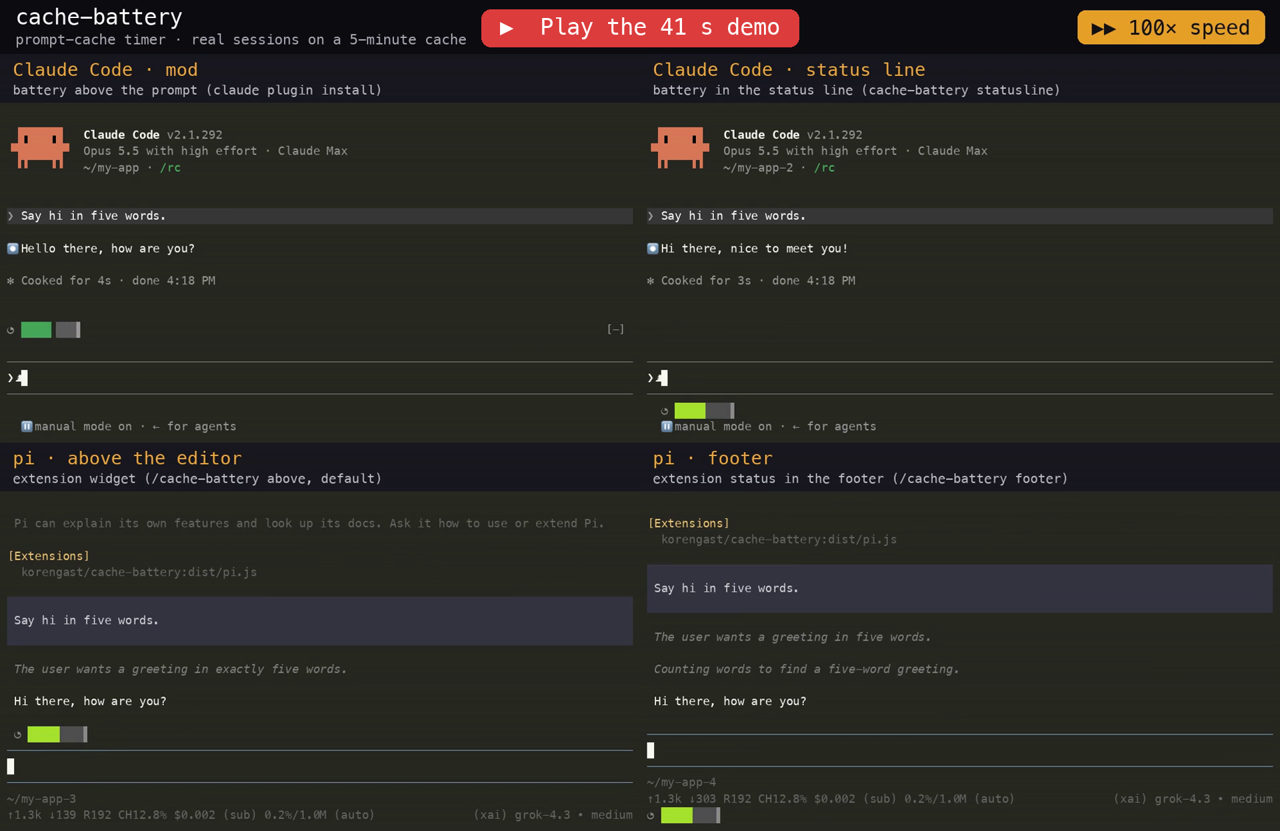
The demo shows four real sessions on a 5-minute cache: the Claude Code mod, the Claude Code status line, and pi with the battery above the editor and in the footer. The drain runs at 100× speed and the last 5 seconds at 4×. pi runs on xAI Grok here.
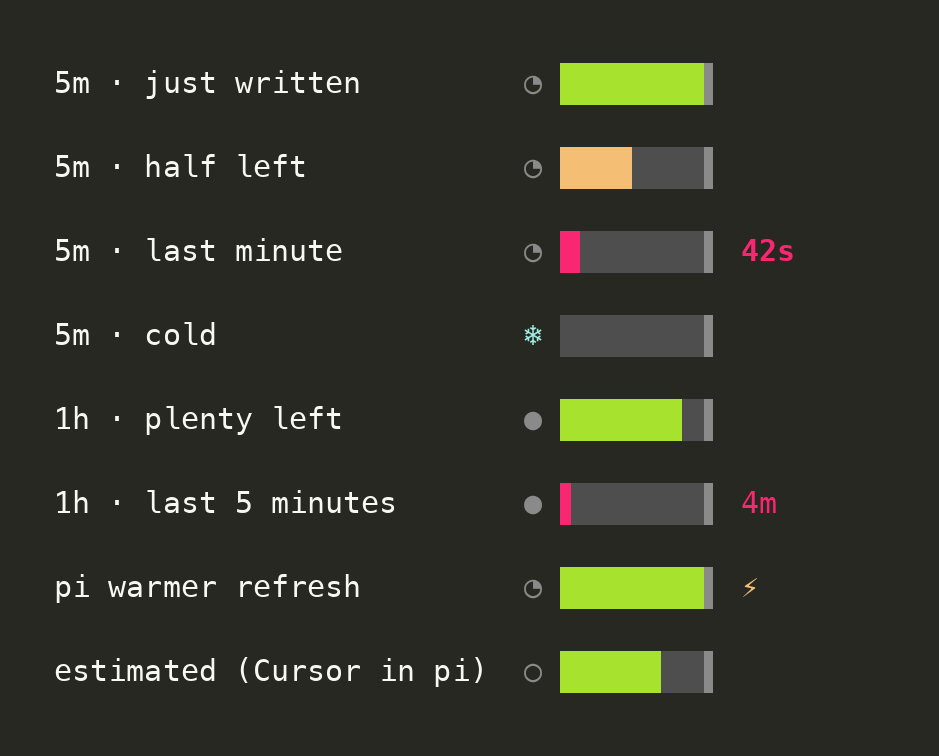
| Glyph | Meaning |
|---|---|
◔ | 5-minute cache tier |
● | 1-hour cache tier |
○ | estimated: the provider reports no cache numbers per request (Cursor in pi) |
| green / yellow / red | more than 50% / 20–50% / under 20% of the cache lifetime left |
42s | seconds, in the last minute only |
4m | minutes, in the last 5 minutes of a 1-hour cache only |
❄ + empty battery | the cache is cold: the next message rewrites the whole prompt |
⚡ | pi's cache warmer just refreshed the cache (no message from you) |
When the cache state is unknown (before the first request, or on a provider that reports no cache use), nothing is drawn. A request that fails or is cancelled does not clear the battery: the cache from the request before it is still warm.
The battery above the prompt is the mod; the one in the status line is the status-line command.



npm install -g https://codeload.github.com/korengast/cache-battery/tar.gz/mainIf you have no status line yet, or want one setup:
{
  "statusLine": {
    "type": "command",
    "command": "cache-battery statusline --wrap ~/.claude/scripts/statusline.sh",
    "refreshInterval": 1
  }
}
--wrap runs your current status line with the same input and appends the battery to its last line. Leave it out to print only the battery. A wrapped command that takes longer than 2 seconds is stopped, and the battery still prints.
If you already have your own script, add the segment to it instead:
CACHE_BATTERY=$(printf '%s' "$INPUT" | cache-battery segment)refreshInterval makes the battery drain between events. Use 1 for a smooth countdown; use a larger value if your status line script is slow.
The status line reads Claude Code's built-in prompt_cache field (Claude Code 2.1.251+): ttl gives the tier and expires_at the deadline. On older versions it reads the tail of the session transcript and takes the tier from the newest request that wrote to the cache (ephemeral_5m_input_tokens / ephemeral_1h_input_tokens).
claude plugin marketplace add korengast/cache-battery
claude plugin install cache-battery@cache-battery
Start a new session afterwards. The mod draws the battery above the prompt and updates it every second. It times the cache from every main-conversation request (turn.step). Claude Code does not tell mods which tier a request wrote, so the mod follows Claude Code's own rule: FORCE_PROMPT_CACHING_5M, then CLAUDE_CODE_PROMPT_CACHE_TTL, then ENABLE_PROMPT_CACHING_1H, then 1 hour on a subscription and 5 minutes on an API key or a cloud provider. It cannot see the promptCacheTtl setting or a subscription in overage; set CACHE_BATTERY_TTL if your tier differs. The status line reads the real tier.
When the mod does not load. Claude Code rolls mods out with a remote feature flag. That flag service is off when the session uses a third-party provider (Bedrock, Vertex, Foundry, or a custom ANTHROPIC_BASE_URL) or when telemetry is off, and then no mod loads. Use the status line in those setups. A first-party session with telemetry off can still use the flag cached from an earlier session with CLAUDE_CODE_GB_DISK_CACHE_WHEN_TELEMETRY_OFF=1. claude --debug logs why a mod did not load.
pi has no separate mod system; its extensions do the same job. The extension draws the battery above the editor by default, or in the footer below it.



pi install git:github.com/korengast/cache-batteryChoose where it shows (saved in ~/.pi/agent/cache-battery.json):
/cache-battery above    # default: above the editor
/cache-battery footer   # in the footer below the editor (also: below)
/cache-battery off
The extension reads the cache usage pi stores on each assistant message. The tier comes from the cacheWrite1h share of the newest cache write; when no write says which, it follows pi's own retention: the model's long lifetime with PI_CACHE_RETENTION=long, else the short one. When pi's cache warmer (cacheWarming) refreshes the cache, the battery refills and shows ⚡.
<a id="cursor-estimated"></a>
With the pi-cursor-sdk provider, the battery is an estimate and shows ○ instead of ◔.
Cursor reports token usage once per agent run, not per model request. The SDK sends it only on turn-ended, the cursor-agent CLI only in its final result event, and the Cursor dashboard lists one usage event per run. Inside a run, pi gets one assistant message per model request, but with no cache numbers.
The extension uses what it does know: each Cursor reply is a model request, so it restarts a 5-minute timer at that reply. What the battery cannot know is whether Cursor's backend kept the cache warm. In practice Cursor sometimes writes the whole prompt again on a new run even a few minutes after the last one, and sometimes reads it back after ten. Read ○ as "time since the last request", not as a promise that the next message is cheap.
When a Cursor reply does carry real cache numbers (some run-final replies do), the battery uses them and shows the normal badge.
| Variable | Default | Effect |
|---|---|---|
CACHE_BATTERY_NUMBERS | end | end: numbers near the end only; always; never |
CACHE_BATTERY_CELLS | 8 | battery width in cells |
CACHE_BATTERY_TTL | auto | force the tier (5m or 1h) where it cannot be read (the mod, old Claude Code, pi when no cache write names it) |
CACHE_BATTERY_PLACES | saved choice, else above | pi only: above, footer (or below), off |
NO_COLOR | unset | plain glyphs, no colour |
The status line also takes --numbers and --cells.
In the mod and in pi the battery stays full while a request is in flight, because the request keeps its cached prefix alive; it starts to drain when the reply ends. On Cursor in pi it stays full for the whole agent run, because Cursor's own model calls inside the run never reach pi. The status line cannot see a request start: it keeps draining during a reply and refills when Claude Code reports the new deadline.
The cache lifetime restarts when a request is sent. The mod anchors on the request start and the status line on Claude Code 2.1.251+ uses Claude Code's own deadline; the transcript fallback and pi anchor on the time the response is recorded, so they can read up to one response long. That is negligible against an hour and worth knowing against five minutes.
The element had to read without text, fit in one line next to other status items, and show both how much is left and how urgent it is. Options considered:
⏳ → ⌛): only two or three states, so no sense of how much is left.The battery uses eighth-block glyphs (▏▎▍▌▋▊▉█), so 8 cells give 64 levels: on a 5-minute cache it moves every ~5 seconds. Numbers appear only when they change a decision: the last minute, and the last five minutes of a 1-hour cache. The tier is one glyph before the battery, so the battery keeps the same width for both tiers.
npm install
npm run build   # tsc to dist/, then copies the mod's helpers to hooks/lib/*.mjs
npm test
src/core is host-free: cache state from usage samples or the prompt_cache field, and the battery as coloured segments. src/cli.ts, hooks/register.mjs and src/pi.ts adapt it to the Claude Code status line, the Claude Code mod and pi.
Claude Code scans a mod's source before it loads it: every hook is a function literal in the module itself, every host call is spelled $.noun.event(...) there, and $.env.get takes a literal name. That is why hooks/register.mjs holds all host calls and imports only pure helpers.
MIT
hooks/register.mjs 94 lines1// Claude Code scans this file before loading it: every hook must be a function
2// literal here and every host call spelled $.noun.event(...), so the host API
3// stays in this file and ./lib holds only pure helpers.
4import { modOptions, toInk } from './lib/cc-mod.mjs'
5import { renderBattery } from './lib/core/render.mjs'
6import { defaultTier, fromSamples, sampleFromAnthropicUsage, tierOf } from './lib/core/state.mjs'
7
8export function register(on) {
9 let state
10 let tier = '1h'
11 let now = 0
12 let lastKey = ''
13 let options = modOptions({})
14 let ticking = false
15 // Main-conversation requests in flight keep their cached prefix alive.
16 let inFlight = 0
17
18 const shown = () => (inFlight > 0 && state ? { ...state, anchorAt: now, chargingUntil: undefined } : state)
19
20 on('session.start', async ($, e, next) => {
21 // Claude Code does not pass the 5m/1h write split to mods, so the tier follows its own
22 // settings. ANTHROPIC_API_KEY and ANTHROPIC_AUTH_TOKEN are only tested for presence.
23 const env = {
24 CACHE_BATTERY_TTL: await $.env.get('CACHE_BATTERY_TTL'),
25 CACHE_BATTERY_NUMBERS: await $.env.get('CACHE_BATTERY_NUMBERS'),
26 CACHE_BATTERY_CELLS: await $.env.get('CACHE_BATTERY_CELLS'),
27 FORCE_PROMPT_CACHING_5M: await $.env.get('FORCE_PROMPT_CACHING_5M'),
28 CLAUDE_CODE_PROMPT_CACHE_TTL: await $.env.get('CLAUDE_CODE_PROMPT_CACHE_TTL'),
29 ENABLE_PROMPT_CACHING_1H: await $.env.get('ENABLE_PROMPT_CACHING_1H'),
30 ANTHROPIC_API_KEY: await $.env.get('ANTHROPIC_API_KEY'),
31 ANTHROPIC_AUTH_TOKEN: await $.env.get('ANTHROPIC_AUTH_TOKEN'),
32 CLAUDE_CODE_USE_BEDROCK: await $.env.get('CLAUDE_CODE_USE_BEDROCK'),
33 CLAUDE_CODE_USE_VERTEX: await $.env.get('CLAUDE_CODE_USE_VERTEX'),
34 CLAUDE_CODE_USE_FOUNDRY: await $.env.get('CLAUDE_CODE_USE_FOUNDRY'),
35 }
36 tier = defaultTier(env)
37 options = modOptions(env)
38 now = await $.clock.now()
39 if (!ticking) {
40 ticking = true
41 $.clock.every(1000, async () => {
42 now = await $.clock.now()
43 const key = JSON.stringify(renderBattery(shown(), now, options))
44 if (key === lastKey) return
45 lastKey = key
46 $.ui.invalidate('ui.render')
47 })
48 }
49 return next(e)
50 })
51
52 on('classic.SessionStart', { source: ['clear', 'resume', 'fork'] }, async ($, e, next) => {
53 state = undefined
54 return next(e)
55 })
56
57 on('turn.step', async function* ($, e, next) {
58 const startedAt = await $.clock.now()
59 if (!e.agentId) {
60 inFlight++
61 $.ui.invalidate('ui.render')
62 }
63 let result
64 try {
65 result = yield* next(e)
66 } finally {
67 if (!e.agentId) {
68 inFlight--
69 $.ui.invalidate('ui.render')
70 }
71 }
72 if (e.agentId || !result || !result.usage) return result
73 const sample = sampleFromAnthropicUsage(result.usage, startedAt)
74 tier = tierOf(sample) ?? tier
75 // A failed or cancelled step throws or has no usage and keeps the state above; a
76 // finished step with no cache use means a model that does not cache.
77 state = fromSamples([sample], tier)
78 $.ui.invalidate('ui.render')
79 return result
80 })
81
82 on('ui.render', { component: 'AbovePrompt' }, async ($, e, next) => {
83 const below = await next(e)
84 if (e.props && e.props.hasSurvey) return below
85 now = await $.clock.now()
86 const segments = renderBattery(shown(), now, options)
87 if (!segments.length) return below
88 const { Box, Text } = $.ui.resolve(e)
89 const battery = Box({ flexDirection: 'row', flexGrow: 0, flexShrink: 0, children: segments.map((s) => toInk(s, Text)) })
90 const row = Box({ flexDirection: 'row', children: [battery, Box({ flexGrow: 1 })] })
91 return Box({ flexDirection: 'column', children: below ? [row, below] : [row] })
92 })
93}
94hooks/lib/cc-mod.mjs 19 lines1import { parseNumbers } from './core/render.mjs';
2const TRACK = '#5c5c5c';
3const TRACK_GLYPH = '█';
4const INK_COLOR = { green: 'green', yellow: 'yellow', red: 'red', cyan: 'cyan' };
5export function modOptions(env) {
6 const cells = Number(env.CACHE_BATTERY_CELLS ?? 8);
7 return { cells: Number.isInteger(cells) && cells > 0 ? cells : 8, numbers: parseNumbers(env.CACHE_BATTERY_NUMBERS) };
8}
9/** No backgroundColor: in the band a background fills the cell's whole flex area, so empty cells are a track glyph instead. */
10export function toInk(segment, Text) {
11 if (segment.kind === 'empty')
12 return Text({ color: TRACK, children: [TRACK_GLYPH.repeat(segment.count)] });
13 const tone = segment.tone;
14 const style = tone === 'dim' ? { dimColor: true } : tone ? { color: INK_COLOR[tone] } : {};
15 if (segment.kind === 'fill')
16 return Text({ ...style, children: [segment.text] });
17 return Text({ ...style, bold: segment.bold, children: [segment.text] });
18}
19hooks/lib/core/render.mjs 74 lines1import { fraction, remainingMs } from './state.mjs';
2const EIGHTHS = ['', '▏', '▎', '▍', '▌', '▋', '▊', '▉'];
3const BADGE = { '5m': '◔', '1h': '●' };
4const ESTIMATED_BADGE = '○';
5const CAP = '▌';
6const EMPTY_GLYPH = '░';
7const MINUTE = 60_000;
8export function renderBattery(state, now, options = {}) {
9 if (!state)
10 return [];
11 const cells = options.cells ?? 8;
12 const left = remainingMs(state, now);
13 const cap = { kind: 'text', text: CAP, tone: 'dim' };
14 if (left <= 0) {
15 return [{ kind: 'text', text: '❄ ', tone: 'cyan' }, { kind: 'empty', count: cells }, cap];
16 }
17 const level = fraction(state, now);
18 const tone = level > 0.5 ? 'green' : level > 0.2 ? 'yellow' : 'red';
19 const eighths = Math.min(cells * 8, Math.ceil(level * cells * 8));
20 const full = Math.floor(eighths / 8);
21 const partial = EIGHTHS[eighths % 8];
22 const used = full + (partial ? 1 : 0);
23 const segments = [
24 { kind: 'text', text: `${state.estimated ? ESTIMATED_BADGE : BADGE[state.tier]} `, tone: 'dim' },
25 { kind: 'fill', text: '█'.repeat(full) + partial, tone },
26 ];
27 if (used < cells)
28 segments.push({ kind: 'empty', count: cells - used });
29 segments.push(cap);
30 const label = countdownLabel(left, state.ttlMs, options.numbers ?? 'end');
31 if (label)
32 segments.push({ kind: 'text', text: ` ${label}`, tone, bold: left <= MINUTE });
33 if (state.chargingUntil !== undefined && now < state.chargingUntil)
34 segments.push({ kind: 'text', text: ' ⚡', tone: 'yellow' });
35 return segments;
36}
37function countdownLabel(left, ttlMs, mode) {
38 if (mode === 'never')
39 return undefined;
40 if (left <= MINUTE)
41 return `${Math.ceil(left / 1000)}s`;
42 const nearEnd = ttlMs > 5 * MINUTE && left <= 5 * MINUTE;
43 if (mode === 'always' || nearEnd)
44 return `${Math.ceil(left / MINUTE)}m`;
45 return undefined;
46}
47export function toPlain(segments) {
48 return segments.map((s) => (s.kind === 'empty' ? EMPTY_GLYPH.repeat(s.count) : s.text)).join('');
49}
50/** `dim` is an explicit grey: SGR 2 is nearly invisible in some hosts' footers. */
51const FG = { green: '32', yellow: '33', red: '31', dim: '38;5;245', cyan: '36' };
52const TRACK_BG = '48;5;239';
53const TRACK_FG = '38;5;239';
54/** Empty cells are solid blocks in the track colour, not spaces: pi's footer collapses runs of spaces. */
55export function toAnsi(segments, color) {
56 if (!color)
57 return toPlain(segments);
58 const out = segments.map((s) => {
59 if (s.kind === 'empty')
60 return `\x1b[${TRACK_FG}m${'█'.repeat(s.count)}\x1b[0m`;
61 if (s.kind === 'fill')
62 return `\x1b[${FG[s.tone]};${TRACK_BG}m${s.text}\x1b[0m`;
63 const codes = [s.tone ? FG[s.tone] : '', s.bold ? '1' : ''].filter(Boolean).join(';');
64 return codes ? `\x1b[${codes}m${s.text}\x1b[0m` : s.text;
65 });
66 return out.join('');
67}
68export function colorEnabled(env) {
69 return !env.NO_COLOR && env.FORCE_COLOR !== '0';
70}
71export function parseNumbers(value) {
72 return value === 'always' || value === 'never' ? value : 'end';
73}
74hooks/lib/core/state.mjs 83 lines1export const TTL_MS = { '5m': 5 * 60_000, '1h': 60 * 60_000 };
2const CHARGING_MS = 5000;
3export function sampleFromAnthropicUsage(usage, at) {
4 return {
5 at,
6 cacheRead: usage.cache_read_input_tokens ?? 0,
7 cacheWrite: usage.cache_creation_input_tokens ?? 0,
8 write1h: usage.cache_creation?.ephemeral_1h_input_tokens,
9 write5m: usage.cache_creation?.ephemeral_5m_input_tokens,
10 };
11}
12export function tierOf(sample) {
13 if ((sample.write1h ?? 0) > 0)
14 return '1h';
15 if ((sample.write5m ?? 0) > 0)
16 return '5m';
17 return undefined;
18}
19/**
20 * A newest request with no cache use means a provider that does not cache, so the
21 * state is unknown; adapters drop failed and cancelled requests before this. Cache-reading
22 * requests record empty write buckets, so the tier comes from the newest request that wrote.
23 */
24export function fromSamples(samples, fallback) {
25 const newest = samples.at(-1);
26 if (newest?.estimated)
27 return { tier: '5m', anchorAt: newest.at, ttlMs: TTL_MS['5m'], estimated: true };
28 if (!newest || newest.cacheRead + newest.cacheWrite <= 0)
29 return undefined;
30 let tier = fallback;
31 for (let i = samples.length - 1; i >= 0; i--) {
32 const found = tierOf(samples[i]);
33 if (found) {
34 tier = found;
35 break;
36 }
37 }
38 const state = { tier, anchorAt: newest.at, ttlMs: TTL_MS[tier] };
39 if (newest.refresh)
40 state.chargingUntil = newest.at + CHARGING_MS;
41 return state;
42}
43export function fromPromptCache(field) {
44 if (!field?.caching_observed)
45 return undefined;
46 const tier = field.ttl === '1h' ? '1h' : '5m';
47 const ttlMs = TTL_MS[tier];
48 const anchorAt = typeof field.expires_at === 'number' ? field.expires_at * 1000 - ttlMs : 0;
49 return { tier, anchorAt, ttlMs };
50}
51const isTier = (value) => value === '5m' || value === '1h';
52const truthy = (value) => /^(1|true|yes|on)$/i.test(value?.trim() ?? '');
53/**
54 * Mirrors Claude Code's TTL choice in its order: FORCE_PROMPT_CACHING_5M, then
55 * CLAUDE_CODE_PROMPT_CACHE_TTL, then ENABLE_PROMPT_CACHING_1H (or its Bedrock variant),
56 * then 1h on a subscription and 5m on API keys and cloud providers. The promptCacheTtl
57 * setting and subscription overage are not visible here.
58 */
59export function defaultTier(env) {
60 if (isTier(env.CACHE_BATTERY_TTL))
61 return env.CACHE_BATTERY_TTL;
62 if (truthy(env.FORCE_PROMPT_CACHING_5M))
63 return '5m';
64 if (isTier(env.CLAUDE_CODE_PROMPT_CACHE_TTL))
65 return env.CLAUDE_CODE_PROMPT_CACHE_TTL;
66 if (truthy(env.ENABLE_PROMPT_CACHING_1H))
67 return '1h';
68 if (truthy(env.CLAUDE_CODE_USE_BEDROCK) && truthy(env.ENABLE_PROMPT_CACHING_1H_BEDROCK))
69 return '1h';
70 const metered = env.ANTHROPIC_API_KEY ||
71 env.ANTHROPIC_AUTH_TOKEN ||
72 truthy(env.CLAUDE_CODE_USE_BEDROCK) ||
73 truthy(env.CLAUDE_CODE_USE_VERTEX) ||
74 truthy(env.CLAUDE_CODE_USE_FOUNDRY);
75 return metered ? '5m' : '1h';
76}
77export function remainingMs(state, now) {
78 return state.anchorAt + state.ttlMs - now;
79}
80export function fraction(state, now) {
81 return Math.min(1, Math.max(0, remainingMs(state, now) / state.ttlMs));
82}
83