great-cto
You already have the agent. This is everything around it. great_cto runs Claude Code as a pipeline of 72 specialist agents — an independent model checks each…
panecommandtoaststatusnetworktimer

You already have the agent. This is everything around it. great_cto runs Claude Code as a pipeline of 72 specialist agents — an independent model checks each…
<img src="docs/screenshots/logo.svg" alt="great_cto" width="280" />
See the work. Trace the decisions.



<img src="docs/screenshots/execution.png" alt="Controller-recorded execution graph in the actual 3.70 interface. Isolated synthetic project with offline stub responses, not live models." width="900" />
Actual 3.70 interface. The graph uses an offline controller run with stub responses, not live models.
npx great-cto initWebsite · One real run → · Blog · Changelog
Русский · 简体中文 · 繁體中文 · 日本語 · 한국어 · Español · Português · Deutsch · Français
Keep the task, its checks and your next decision connected.
great_cto coordinates Claude Code workflows and experimental controlled Codex runs through explicit stages, review and gates. The local board brings tasks, recorded execution, project documents and consumption into one workspace. Missing evidence stays unknown; a successful worker is not proof that a task was accepted, merged or deployed. You use your own provider account; great_cto is MIT and bills nothing.
Project focus presents eight core roles plus the selected project's required reviewers. The full catalog of 72 agents remains available. Catalog availability is not proof of execution or expertise.
npx great-cto initRestart Claude Code. Day to day there are three things:
| In Claude Code | In the terminal | |
|---|---|---|
| Start work | /start "add Google login" | great-cto run "add Google login" |
| See what needs you | /inbox | great-cto status |
| Continue | /resume | great-cto resume |
/start takes a new product or a task in an existing project and picks the workflow itself. /resume continues only what you already approved; a pending decision still waits for you. Everything else — /review, /spec, /save, /digest and the rest — is there when you need it: all commands.
Run great-cto board to open the local board, normally at localhost:3141. Readings such as unverifiable, unmeasured and unavailable are not passes.
| View | What you can inspect |
|---|---|
| Work | Tasks, acceptance criteria, the next supported action, and Overview / Execution / Evidence tabs |
| Decisions | Pending decisions and existing gate controls, without broadening their authority |
| Knowledge | Read-only project Markdown, ADRs and a bounded diagram viewer with Mermaid source fallback |
| Insights | Recorded task outcomes, project-scoped token consumption, estimates and budgets kept separate |
| Settings | Executors, Runtime, Capabilities and General controls |
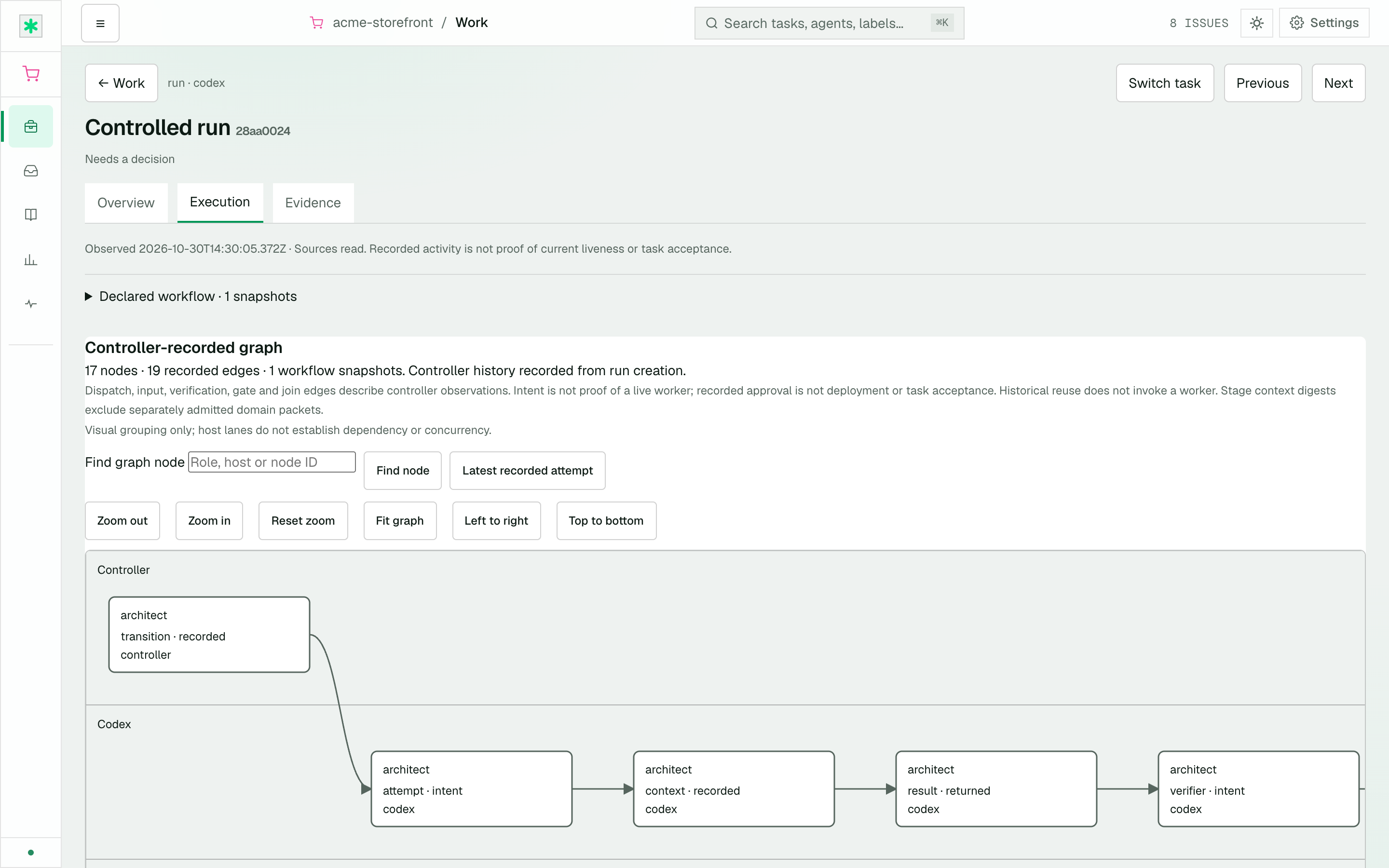
Execution shows controller-recorded causal history for controlled runs, including attempts, checks, verification, gates and repair. Native and legacy sessions stay partial or unavailable; missing edges are not inferred. This is not a live terminal or workflow editor. The sample graph comes from offline stub responses, not models.
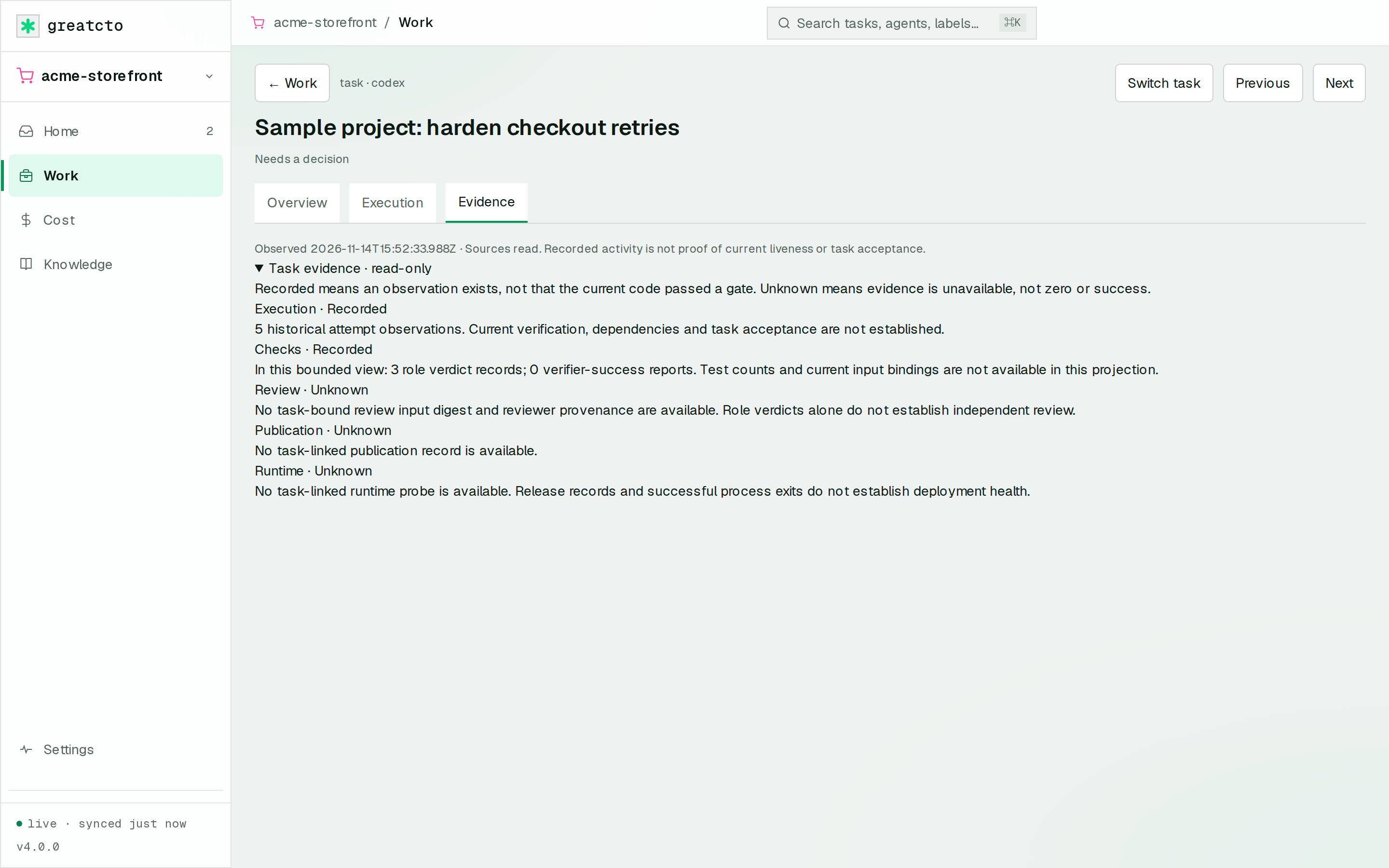
A role verdict is not independent-review proof. Merge, release and deployment need their own evidence; unknown is not zero or pass.
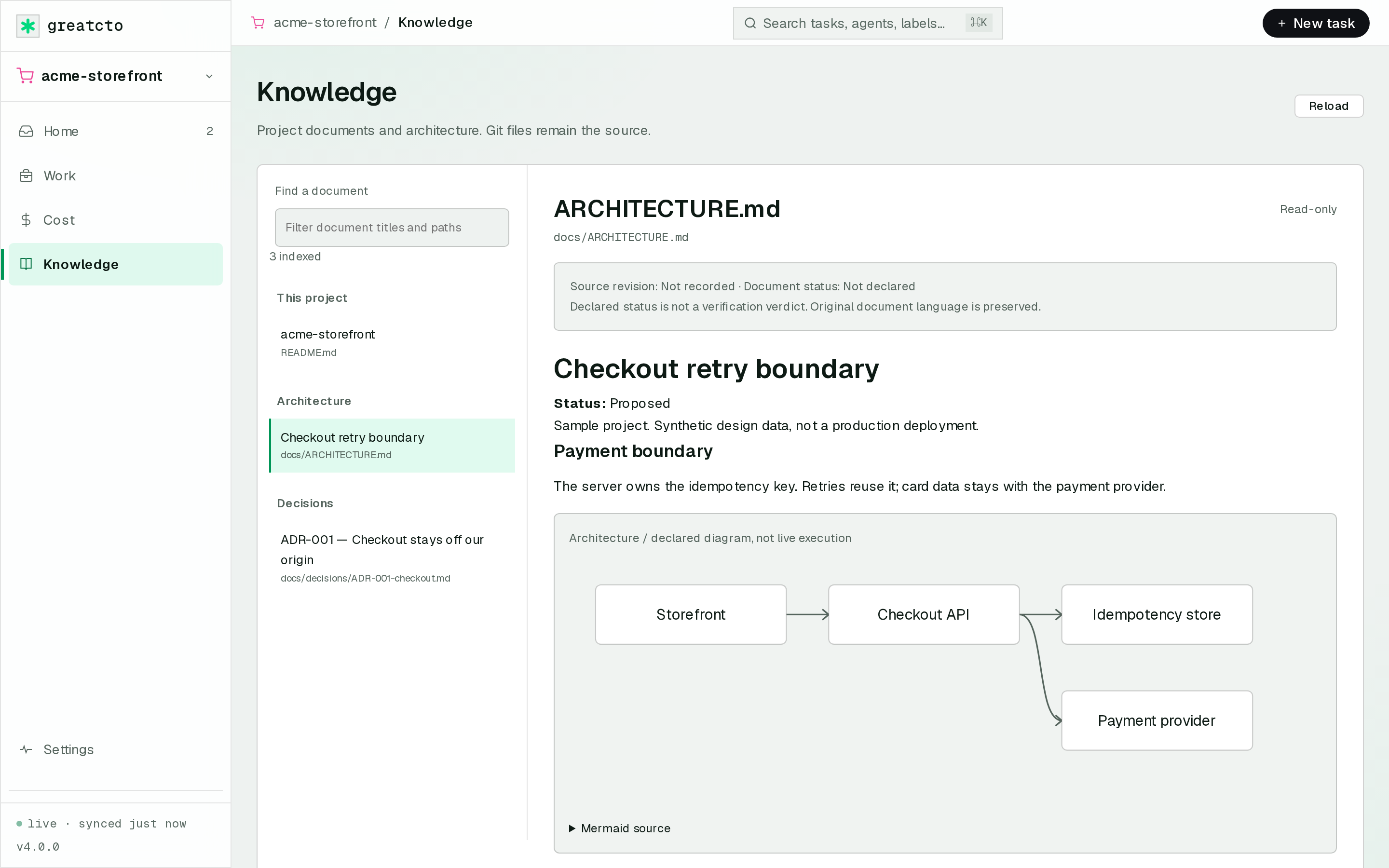
Documents keep their original language. The application interface is English. The diagram describes declared architecture, not a running task.
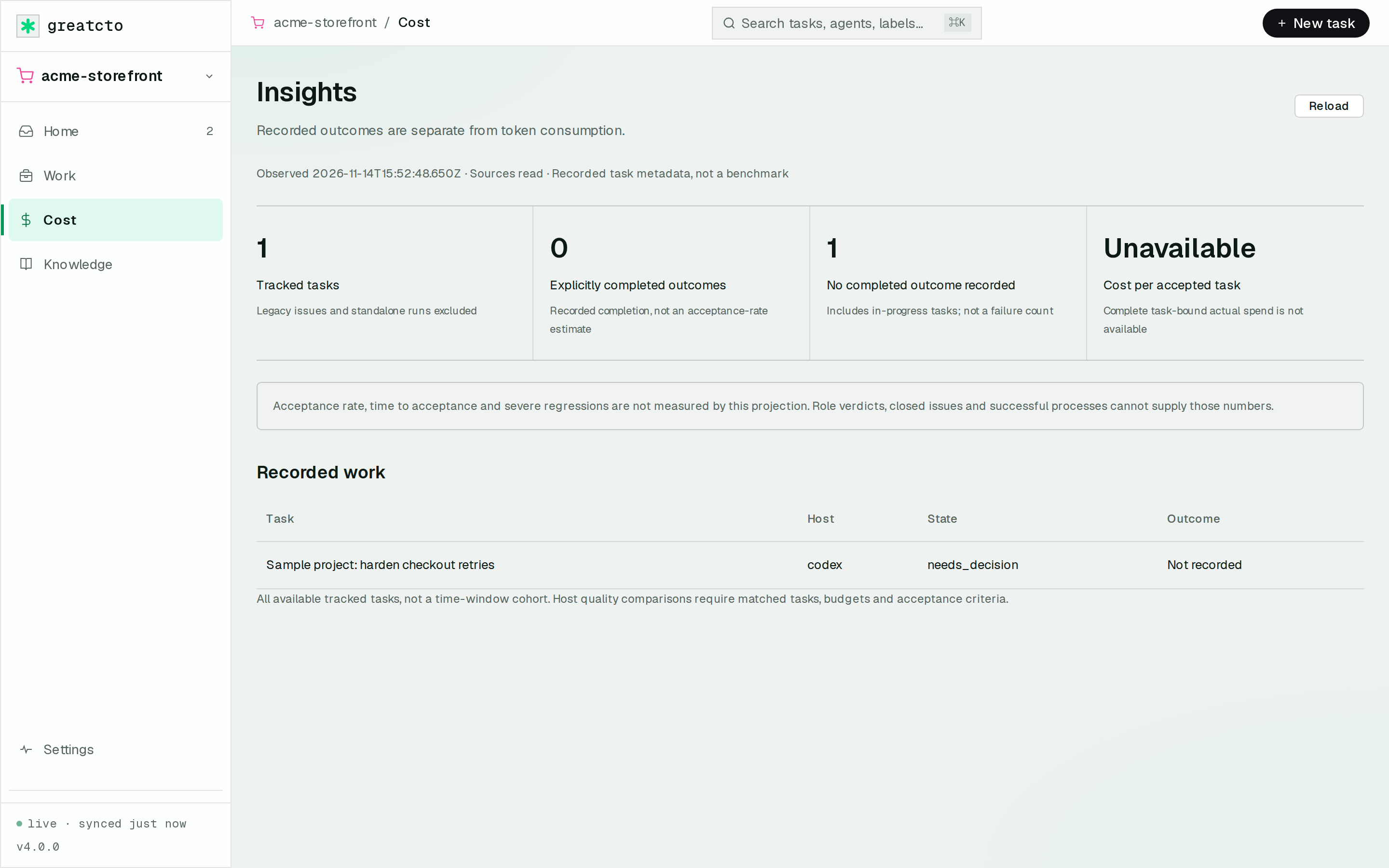
These screenshots use isolated synthetic ACME records. They do not measure host quality, acceptance rate or quality uplift. Capture contract.
| Responsibility | Role |
|---|---|
| Problem and acceptance | product-owner |
| System design and tradeoffs | architect |
| Plan and dependencies | pm |
| Implementation | senior-dev |
| Independent code review | code-reviewer |
| Verification and regressions | qa-engineer |
| Risk and ship gate | security-officer |
| Authorized deployment | devops |
These are responsibility contracts, not eight mandatory model calls or eight concurrent agents. Project focus is a presentation view; it does not remove specialists, change dispatch or waive required checks. Risk-specific reviewers remain governed by project policy.
Five versioned, opt-in domain pack candidates cover four focus areas:
| Area | Engineering invariants | Boundary |
|---|---|---|
| Money & crypto execution | Payment idempotency, ambiguous sends, scoped authority; signing boundaries, paper/live separation and chain finality | Two technical packs; no investment-performance claim |
| Telemedicine workflows | Clinician authority, prescription state transitions and evidence integrity | No clinical efficacy or certification claim |
| Venture evidence | Claim provenance, entity lineage and quarantine of unverified assertions | No investment-outcome claim |
| Mental wellbeing safety | Subject isolation, crisis escalation precedence and clinical-claim boundaries | Separate from diagnosis, treatment and clinical validation |
Packs add engineering context. They do not broaden permissions or change required-reviewer routing. Their presence does not prove invocation, expertise or better outcomes. No quality uplift from matched core-versus-pack trials is established. Private project overlays are not part of the public showcase.
There are three distinct modes, not identical native integrations:
| Mode | Execution and authority |
|---|---|
| Claude Code native pipeline | Native commands, specialist roles and hooks; decisions stay in the linked host |
| Controlled Codex / mixed-host pipeline (experimental) | Controller-owned role routing, validated text proposals, verifier and explicit gates |
| Codex plugin in an ordinary session | Skills, MCP and safety hooks; installation alone does not start the controlled pipeline |
Mixed runs can assign roles to either CLI. Eligible review joins can inspect the same frozen tree concurrently; this is not two writers editing the same worktree. Both CLIs must be installed and authenticated. See the host guide for routing, recovery and manual-action boundaries.
npx great-cto init --host codex gives Codex the skills, the MCP server and six safety guards as plugin hooks (approve them once: run codex in a terminal and choose Trust all and continue). An ordinary Codex plugin session does not automatically run this project's native Claude command/role lifecycle. The Codex installation has no native plugin surface for these slash commands or role agents. The remaining Claude workflow hooks do not silently run there. Start the controlled pipeline through the CLI instead:
great-cto run "add Google login" --host codex --allow src,tests,docs
great-cto status --host codex
great-cto resume --host codex
Plugin refresh is explicit by default (great-cto upgrade codex). On macOS, sh scripts/codex-auto-update.sh enable opts into a six-hour per-user timer; status inspects it and disable removes it. Each tick validates the Git marketplace origin before asking Codex to upgrade. It follows the configured Git ref, not npm releases, and changed hooks still need host review in a new session. Details, mixed runs and Codex as the second reviewer: Codex host guide.
One line in .great_cto/PROJECT.md:
approval-level | Stops you at | Stops |
|---|---|---|
ship-only | the deploy — and briefs you on what gets built | 1 |
product-only | what we build · whether it ships | 2 |
gates-only (default) | what we build · the design · the deploy | 3 |
strict | the design · code review · the deploy | 3 |
auto | nothing in the pipeline | 0 |
Regulated products — fintech, healthcare, gov — keep their security, compliance and ship gates at every level. How the gates work.
| One feature, end to end, fully traced | 1h 26m · $3.40 in tokens — the receipts |
| A whole product — 7 built in the open benchmark | median $171 in tokens · 70/100 quality, measured 2026-07-10 — reproduce it |
These are historical observations, not a benchmark of the current two-host pipeline or domain packs. No quality-uplift percentage is established. Domain packs remain opt-in; their presence does not prove expertise or better outcomes.
For one builder, not a team; not a hosted app builder — it needs your coding agent; not a CI/CD system; compliance scaffolds are starting points, not certifications; LLM output is not deterministic. The honest version of each, and what it refuses to claim: docs/DETAILS.md.
Docs · Getting started · Commands · Gates · Agents · FAQ · Everything else · Issues · Security · Contributing · Privacy — telemetry is off by default
MIT — LICENSE. Built by @avelikiy. If it saved you time, a star helps other solo builders find it.
hooks/gates-pane.tsx 174 lines1import { atom, read, update } from 'claude-code'
2import type { Register } from 'claude-code'
3
4import type { Gate, View } from '../types'
5
6// The gates waiting on the person, in the session they are working in.
7//
8// The board stays the one door an approval goes through: this reads the gates and
9// their ADR-024 tokens from the board's /api/inbox and posts a decision to its
10// /api/gates/<id>, so the token check, the binding to the tree as it is, the
11// decision log and the wake-up all stay where they are. Nothing here writes a gate.
12//
13// A gate that is expensive to undo (or unclassified) keeps the board's ritual: the
14// person types the gate's name, and the text goes to the board as `confirm`, where
15// the server compares it. The pane never fills it in, and a button is never offered
16// in its place: a second press is not the same act as typing what you are approving.
17
18// The board's address: BOARD_PORT, as packages/board/lib/config.mjs reads it, else 3141.
19let BOARD = 'http://127.0.0.1:3141'
20async function locate($: any): Promise<void> {
21 const port = Number(await $.env.get('BOARD_PORT'))
22 BOARD = `http://127.0.0.1:${Number.isInteger(port) && port > 0 ? port : 3141}`
23}
24const PANE = 'great-cto-gates'
25const view = atom({ plugin: 'great-cto', key: 'view' } as const, { state: 'loading' } as View)
26const busy = atom({ plugin: 'great-cto', key: 'busy' } as const, null as string | null)
27const seen = atom({ plugin: 'great-cto', key: 'seen' } as const, 0)
28
29const basename = (p: string) => p.replace(/\/+$/, '').split('/').pop() || p
30
31// The project travels as the session root's absolute path, which the board resolves
32// for any project under HOME — registered or not, and never confused with another
33// project whose directory has the same name. A path the board cannot honour comes
34// back from /api/inbox as a fallback, and the pane then offers no decision at all.
35async function projectOf($: any): Promise<string> {
36 return await $.session.root()
37}
38
39function gatesOf(body: any): Gate[] {
40 return (body?.pending_gates || []).map((g: any) => ({
41 id: String(g.id),
42 title: String(g.title || g.id),
43 gate: g.reversibility?.gate ? `gate:${g.reversibility.gate}` : String(g.id),
44 guarded: ['expensive', 'unclassified'].includes(g.reversibility?.state),
45 token: g.token ?? null,
46 }))
47}
48
49async function refresh($: any): Promise<void> {
50 const project = await projectOf($)
51 let next: View
52 try {
53 const r = await $.http.fetch(`${BOARD}/api/inbox?project=${encodeURIComponent(project)}`)
54 if (r.headers['x-project-resolved'] === 'fallback') next = { state: 'not-on-board', project: basename(project) }
55 else if (!r.ok) next = { state: 'error', why: `board answered ${r.status}` }
56 else next = { state: 'ok', project: basename(project), gates: gatesOf(JSON.parse(r.text)), at: new Date().toISOString() }
57 } catch (err) {
58 next = { state: 'board-down', why: String((err as Error)?.message || err) }
59 }
60 await update($, view, () => next)
61
62 const count = next.state === 'ok' ? next.gates.length : 0
63 $.ui.status(count ? `great_cto: ${count} gate${count === 1 ? '' : 's'} waiting — /gates` : undefined)
64 const before = await read($, seen)
65 if (count > before) {
66 $.ui.toast(`great_cto: ${count - before} new gate${count - before === 1 ? '' : 's'} waiting on you`)
67 void $.ui.open({ id: PANE, title: 'Gates' })
68 }
69 await update($, seen, () => count)
70}
71
72async function decide($: any, gate: Gate, action: 'approve' | 'reject', confirm?: string): Promise<void> {
73 if ((await read($, busy)) !== null) return
74 await update($, busy, () => gate.id)
75 try {
76 const project = await projectOf($)
77 const r = await $.http.fetch(`${BOARD}/api/gates/${encodeURIComponent(gate.id)}`, {
78 method: 'POST',
79 headers: { 'Content-Type': 'application/json' },
80 body: JSON.stringify({ action, token: gate.token, project, ...(confirm !== undefined ? { confirm } : {}) }),
81 })
82 let body: any = {}
83 try { body = JSON.parse(r.text) } catch { /* the status still says what happened */ }
84 $.ui.toast(r.ok
85 ? `${gate.gate} ${action === 'approve' ? 'approved' : 'rejected'}`
86 : `${gate.gate} not ${action}d: ${body.error || `board answered ${r.status}`}`,
87 { timeoutMs: 8000 })
88 } catch (err) {
89 $.ui.toast(`${gate.gate}: the board could not be reached — ${String((err as Error)?.message || err)}`, { timeoutMs: 8000 })
90 } finally {
91 await update($, busy, () => null)
92 await refresh($)
93 }
94}
95
96export const register: Register = on => {
97 on('session.start', async ($, e, next) => {
98 await $.command.register({ name: 'gates', description: 'great_cto gates waiting on you, in a pane' })
99 await locate($)
100 $.clock.every(30_000, () => { void refresh($) })
101 void refresh($)
102 return next(e)
103 })
104
105 // Asked for, the pane takes the keyboard: 1 / 2 press at once, Esc goes back to the
106 // prompt. Opened by a new gate, it does not — it must not catch keys being typed.
107 on('command.run', { command: 'gates' }, async $ => {
108 await $.ui.open({ id: PANE, title: 'Gates', focus: true })
109 await refresh($)
110 return { text: 'Gates pane opened.' }
111 })
112
113 on('turn.complete', async ($, e, next) => {
114 const done = await next(e)
115 void refresh($)
116 return done
117 })
118
119 on('ui.render', { component: 'Pane', requestId: PANE }, async ($, e) => {
120 const { Box, Text, Button, Input } = $.ui.resolve(e)
121 const v = await read($, view)
122 const working = await read($, busy)
123
124 if (v.state === 'loading') return <Text dimColor>Asking the board…</Text>
125 if (v.state === 'board-down') {
126 return (
127 <Box flexDirection="column">
128 <Text color="yellow">The board is not answering at {BOARD} — gates not checked.</Text>
129 <Text dimColor>Start it with /board. This is not the same as no gates.</Text>
130 </Box>
131 )
132 }
133 if (v.state === 'not-on-board') {
134 return <Text color="yellow">{v.project} is not a project the board knows — gates not checked.</Text>
135 }
136 if (v.state === 'error') return <Text color="red">Gates not checked: {v.why}</Text>
137 if (!v.gates.length) return <Text dimColor>No gates waiting on you in {v.project}.</Text>
138
139 const one = v.gates.length === 1
140 return (
141 <Box flexDirection="column" gap={1}>
142 <Text dimColor>{v.project} · {v.gates.length} waiting · checked {v.at.slice(11, 19)} UTC</Text>
143 {v.gates.map(g => (
144 <Box flexDirection="column">
145 <Text bold>{g.gate} — {g.title}</Text>
146 <Text dimColor>{g.id}</Text>
147 {!g.token
148 ? <Text color="yellow">The board issued no approval token for it — decide on the board ({BOARD}).</Text>
149 : working === g.id
150 ? <Text dimColor>Sending…</Text>
151 : g.guarded
152 ? (
153 <Box flexDirection="column">
154 <Text color="yellow">Expensive to undo. To approve, type {g.gate} and press Enter.</Text>
155 <Input key={`confirm-${g.id}`} label="approve:" placeholder={g.gate} submitLabel="approve"
156 onSubmit={value => { void decide($, g, 'approve', value) }} />
157 <Button key={`reject-${g.id}`} onPress={() => { void decide($, g, 'reject') }}>Reject</Button>
158 </Box>
159 )
160 : (
161 <Box flexDirection="row" gap={2}>
162 <Button key={`approve-${g.id}`} variant="primary" hotkey={one ? '1' : undefined}
163 onPress={() => { void decide($, g, 'approve') }}>Approve</Button>
164 <Button key={`reject-${g.id}`} hotkey={one ? '2' : undefined}
165 onPress={() => { void decide($, g, 'reject') }}>Reject</Button>
166 </Box>
167 )}
168 </Box>
169 ))}
170 </Box>
171 )
172 })
173}
174types/index.d.ts 26 lines1/** A gate as the board's /api/inbox serves it, cut to what the pane draws. */
2export type Gate = {
3 id: string;
4 title: string;
5 /** `gate:ship`, `gate:plan`, … — what the board's typed-name ritual asks for. */
6 gate: string;
7 /** Expensive to undo, or unclassified: the board asks for the typed name. */
8 guarded: boolean;
9 /** ADR-024 token bound to the project as it is now; null when none was issued. */
10 token: string | null;
11};
12
13/** What the board said, never collapsed: "no gates" and "could not ask" differ. */
14export type View =
15 | { state: 'loading' }
16 | { state: 'ok'; project: string; gates: Gate[]; at: string }
17 | { state: 'board-down'; why: string }
18 | { state: 'not-on-board'; project: string }
19 | { state: 'error'; why: string };
20
21declare module 'claude-code' {
22 interface PluginState {
23 'great-cto': { view: View; busy: string | null; seen: number };
24 }
25}
26