session-meter
Shows a live session pane (/ctx): context breakdown, usage limits with pace, tool calls and model requests; sends the model a one-time note when limits or…
paneguardcommandtoastprompttool

Shows a live session pane (/ctx): context breakdown, usage limits with pace, tool calls and model requests; sends the model a one-time note when limits or…
A docked pane that shows what is happening in a Claude Code session while you work.
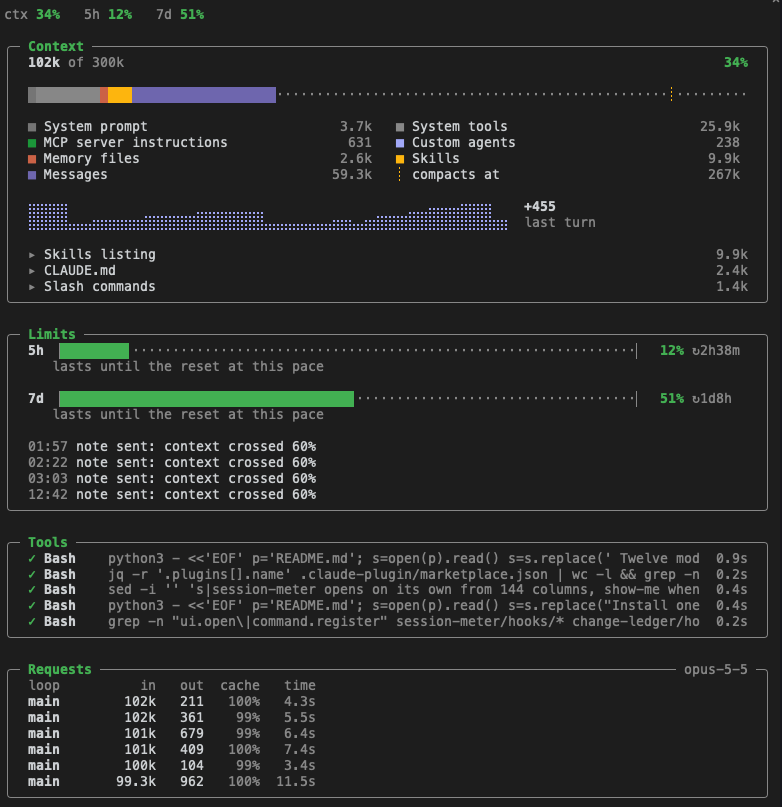
↳.It also sends the model one hidden note when a threshold is crossed, and again only after the figure drops 10 points below it:
| Threshold | What the model is told |
|---|---|
| 5h window at 80% | Mention it in one line and keep going |
| 7d window at 80% and 90% | Warn clearly and ask before starting a large task |
Context at contextAt (60%) | When new work starts, suggest /compact, a fresh session, or a short handoff, whichever fits |
The note goes in as prompt context, not as a system prompt change, so the prompt cache is not invalidated. The pane lists the last five notes it sent.
By default the model only suggests a reset and you decide. Two options in /config change that:
| Option | Values | What it does |
|---|---|---|
contextAction | suggest (default) | The model suggests /compact or a fresh session. |
compact | The model gets a context_reset tool. At a natural break it calls the tool. When the turn ends, the mod compacts the conversation and sends the model its next step, so the work goes on. A message you send while it compacts carries that step instead, and the mod drops its own step message, so the step never arrives after the work it names. The mod hands the step on only once its compact call (/compact in the desktop app) has returned. A message that runs before that, such as a note from another session queued ahead of it, gets no step, and the step message still follows. When the next step is yours, such as a decision, the model sets wait and the mod compacts, then waits for you. With wait, the model's next holds what it wants to remember: the mod sends no message of its own and adds it, hidden, to the next message you send. The model writes its whole reply, question included, before it calls the tool, so you answer from what it wrote. When the compaction waits for you, the tool refuses the call until the turn has shown you some text: a model can write its reply only in its thinking, which is hidden or summarized. The refused compaction is kept: the model ends its turn with its reply as text, and the compaction runs after it. If the turn's last message has no text, or you stop it, nothing runs. | |
compact-or-clear | As compact. The model can also choose a clear when the next work does not build on the conversation. A clear needs a handoff of at least 200 characters. The mod saves the handoff to ~/.claude/handoffs/, runs /clear, then sends the handoff as the first message of the new session. A message you send while it clears carries the handoff instead, and the mod drops its own handoff message. | |
contextAt | 10 to 95, default 60 | The context percentage that sends the note. |
The tool refuses a call below contextAt and a call from a subagent. A plain headless run (claude -p) gets no tool and only the suggestion, since it ends with the turn. The desktop app also runs Claude Code headless, but it stays open: there the mod compacts by queueing a bare /compact once the turn ends, so a hook that vetoes the compaction shows no "skipped" toast. The step goes only in the message that follows, so you see it, and the model reads it, once. When you interrupt the turn, no reset runs. The old conversation stays available with /resume.
How this differs from Claude Code's own auto-compact:
| Built-in auto-compact | contextAction | |
|---|---|---|
| Who decides | A fixed threshold near the window limit | The model, at a natural break after contextAt |
| When it runs | Whenever the threshold is crossed, even mid-task | When the turn that called the tool ends |
| What carries over | The engine's summary | The summary, steered by the model's next step, which is also sent as the next prompt; with wait, the mod waits for you and adds next to your next message |
| A fresh start | No | With compact-or-clear, a /clear that needs a written handoff |
Auto-compact stays on. The mod only resets earlier, at a moment the model chooses.
Claude Code can also compact a long conversation on its own while the session is idle, before the one-hour prompt cache expires. The transcript then shows "Compacted while idle, before the prompt cache expired". Anthropic turns this on from its side; no setting turns it on.
Idle compaction does not know about contextAction, and the two can overlap:
contextAt or for a natural break. It can compact between two steps of a task you paused, and it sends no next step.contextAt, context_reset refuses until the context fills again.To leave resets to the model and to the built-in auto-compact, turn idle compaction off in ~/.claude/settings.json:
{ "idleCompaction": false }Setting it to true does not turn it on. Checked in Claude Code 2.1.300.
claude plugin marketplace add arasovic/claude-code-mods
claude plugin install session-meter@claude-code-mods
Restart Claude Code. The pane opens on its own in a terminal 144 columns or wider; otherwise type /ctx. In the desktop app it does not open on its own, since the app shows context in its own sidebar; /ctx opens it there too. It docks beside the transcript in fullscreen mode, from 110 columns.
To keep the screen clear, turn off Open the pane at start in /config (the autoOpen option). /ctx still opens the pane, and the notes to the model still go out.
/context, so they follow CLAUDE_CODE_AUTO_COMPACT_WINDOW if you set it.claude plugin validate .
claude plugin test .
../typecheck.sh session-meterhooks/register.tsx 746 lines1import { atom, read, update } from 'claude-code'
2import type { EngineInterface, Register, SessionContextBreakdown } from 'claude-code'
3
4import type { MeterBreakdown, MeterItem, MeterNote, MeterReading, MeterRequest, MeterReset, MeterResume, MeterSample, MeterTool } from '../types'
5
6const PANE = 'ctx'
7// A level fires again only once its figure has fallen this far below it: a window reset or a /compact.
8const REARM = 10
9// Pace needs this much history in the current window before it projects anything.
10const PACE_MIN_MS = 10 * 60_000
11const EIGHTHS = ' ▏▎▍▌▋▊▉'
12const KEEP = 30
13
14export const levels = (contextAt: number) => [
15 { id: 'five_hour:80', kind: 'five_hour', at: 80 },
16 { id: 'seven_day:80', kind: 'seven_day', at: 80 },
17 { id: 'seven_day:90', kind: 'seven_day', at: 90 },
18 { id: `context:${contextAt}`, kind: 'context', at: contextAt },
19]
20type Level = ReturnType<typeof levels>[number]
21// The tool the model calls to compact or clear on its own; registered only when contextAction is not `suggest`.
22const RESET = 'context_reset'
23const RESET_TOOL = 'mcp__session-meter__context_reset'
24// After a clear the model has only the handoff, so one shorter than this cannot carry the goal, state and next step.
25const HANDOFF_MIN = 200
26const ACTIONS = ['suggest', 'compact', 'compact-or-clear'] as const
27export type ContextAction = (typeof ACTIONS)[number]
28
29// A value outside the manifest's choices or range falls back to the default, so a typo can never turn the tool on.
30export const readOptions = (options: Readonly<Record<string, unknown>>) => {
31 const action = ACTIONS.find(a => a === options.contextAction) ?? 'suggest'
32 const at = Number(options.contextAt)
33 return { action, contextAt: Number.isFinite(at) && at >= 10 && at <= 95 ? at : 60 }
34}
35
36const WINDOWS = [
37 { kind: 'five_hour', label: '5h' },
38 { kind: 'seven_day', label: '7d' },
39]
40
41const reading = atom({ plugin: 'session-meter', key: 'reading' } as const, { context: null, limits: [] } as MeterReading)
42const fired = atom({ plugin: 'session-meter', key: 'fired' } as const, [] as string[])
43const breakdown = atom({ plugin: 'session-meter', key: 'breakdown' } as const, null as MeterBreakdown | null)
44const history = atom({ plugin: 'session-meter', key: 'history' } as const, [] as number[])
45const samples = atom({ plugin: 'session-meter', key: 'samples' } as const, [] as MeterSample[])
46const notes = atom({ plugin: 'session-meter', key: 'notes' } as const, [] as MeterNote[])
47const tools = atom({ plugin: 'session-meter', key: 'tools' } as const, [] as MeterTool[])
48const requests = atom({ plugin: 'session-meter', key: 'requests' } as const, [] as MeterRequest[])
49// The reset the model asked for, run when its turn ends, and the next step it leaves behind. Held by the host, so a
50// hot reload of this module between the call, the reset and the Continue's dequeue keeps them.
51const pending = atom({ plugin: 'session-meter', key: 'pending' } as const, null as MeterReset | null)
52// What the model reads once a reset ends, sent as a prompt of its own. A prompt sent while the reset ran is dequeued
53// ahead of that one, so it carries the text instead and the separate prompt is dropped when its turn comes. It is
54// `ready` only once the reset call has resolved; a prompt dequeued before that leaves the step to the separate prompt.
55// A compact that waits has no separate prompt, so its text goes only with the next prompt the user sends.
56const resume = atom({ plugin: 'session-meter', key: 'resume' } as const, null as MeterResume | null)
57
58// Subagent ids never change type, so one lookup per id is enough.
59const agentTypes = new Map<string, string>()
60
61const valueOf = (r: MeterReading, kind: string) =>
62 kind === 'context' ? (r.context ?? undefined) : r.limits.find(l => l.kind === kind)?.percentUsed
63
64export const cross = (r: MeterReading, firedIds: readonly string[], list = levels(60)) => {
65 const kept = firedIds.filter(id => {
66 const level = list.find(l => l.id === id)
67 const value = level && valueOf(r, level.kind)
68 return level !== undefined && (value === undefined || value >= level.at - REARM)
69 })
70 const fresh = list.filter(l => !kept.includes(l.id) && (valueOf(r, l.kind) ?? 0) >= l.at)
71 return { fired: [...kept, ...fresh.map(l => l.id)], fresh }
72}
73
74export const duration = (ms: number) => {
75 const min = Math.max(0, Math.floor(ms / 60_000))
76 if (min >= 1440) return `${Math.floor(min / 1440)}d${Math.floor((min % 1440) / 60)}h`
77 if (min >= 60) return `${Math.floor(min / 60)}h${min % 60}m`
78 return `${min}m`
79}
80
81export const elapsed = (ms: number) => {
82 const s = Math.max(0, Math.round(ms / 1000))
83 return ms < 60_000 ? `${(Math.max(0, ms) / 1000).toFixed(1)}s` : `${Math.floor(s / 60)}m${s % 60}s`
84}
85
86const resetsIn = (resetsAt: string | undefined, now: number) => (resetsAt ? Date.parse(resetsAt) - now : 0)
87
88export const note = (r: MeterReading, fresh: readonly Level[], now: number, action: ContextAction = 'suggest') => {
89 const kinds = [...new Set(fresh.map(l => l.kind))]
90 const lines = kinds.map(kind => {
91 const pct = Math.round(valueOf(r, kind) ?? 0)
92 const resets = duration(resetsIn(r.limits.find(l => l.kind === kind)?.resetsAt, now))
93 if (kind === 'five_hour')
94 return `- The 5-hour usage window is at ${pct}% (resets in ${resets}). Tell the user in one short line. Do not stop or slow down: the session continues automatically at the usage limit, so hitting it only pauses work until the reset.`
95 if (kind === 'seven_day')
96 return `- The 7-day usage window is at ${pct}% (resets in ${resets}). Warn the user clearly: if it runs out, work stops and does NOT resume on its own when the reset is over 24 hours away. Before starting any large new task, ask the user whether to proceed.`
97 if (action !== 'suggest')
98 return `- The context window is ${pct}% full. At the next natural break, call the ${RESET} tool yourself, as its description says. Do not ask the user first.`
99 return `- The context window is ${pct}% full. From now on, when a request starts new work: if it continues the current work, suggest /compact at a natural break; if it is unrelated and needs nothing from this conversation, suggest a fresh session (/clear or a new terminal); if it is new but needs a few facts from here, suggest a short handoff and then a fresh session. If the current request already starts new work, apply this now. Suggest it once; the user decides.`
100 })
101 return ['session-meter: an automatic note the user does not see. Mention it once; do not repeat it in later replies.', ...lines].join('\n')
102}
103
104const noteLabel = (fresh: readonly Level[]) => {
105 const top = new Map(fresh.map(l => [l.kind, l.at]))
106 const name: Record<string, string> = { five_hour: '5h window', seven_day: '7d window', context: 'context' }
107 return [...top].map(([kind, at]) => `${name[kind]} crossed ${at}%`).join(', ')
108}
109
110// Projects when a window fills, from the samples taken since its last reset; idle time counts, so it errs late, not early.
111export const pace = (list: readonly MeterSample[], kind: string, now: number) => {
112 const mine = list.filter(s => s.kind === kind)
113 const last = mine.at(-1)
114 if (!last) return { kind: 'measuring' as const }
115 const first = mine.find(s => s.resetsAt === last.resetsAt)
116 if (!first || now - first.at < PACE_MIN_MS || last.pct <= first.pct) return { kind: 'measuring' as const }
117 const perMs = (last.pct - first.pct) / (now - first.at)
118 const fullIn = (100 - last.pct) / perMs
119 const resets = resetsIn(last.resetsAt, now)
120 return fullIn < resets ? { kind: 'full' as const, inMs: fullIn } : { kind: 'fine' as const }
121}
122
123// A bar chart in braille, two values per cell and four dots of height per row, bottom row first in the dot math.
124export const braille = (values: readonly number[], max: number, cols: number, rows: number) => {
125 const LEFT = [0x40, 0x04, 0x02, 0x01]
126 const RIGHT = [0x80, 0x20, 0x10, 0x08]
127 const heights = values.slice(-cols * 2).map(v => Math.round((Math.min(v, max) / Math.max(1, max)) * rows * 4))
128 if (heights.length % 2) heights.unshift(0)
129 return Array.from({ length: rows }, (_, r) => {
130 const floor = (rows - 1 - r) * 4
131 let line = ''
132 for (let i = 0; i < heights.length; i += 2) {
133 const dots = (h: number, bits: number[]) => bits.slice(0, Math.max(0, Math.min(4, h - floor))).reduce((a, b) => a | b, 0)
134 line += String.fromCharCode(0x2800 + dots(heights[i] ?? 0, LEFT) + dots(heights[i + 1] ?? 0, RIGHT))
135 }
136 return line
137 })
138}
139
140export const cells = (part: number, whole: number, width: number) => (whole > 0 ? Math.round((part / whole) * width) : 0)
141
142export const tokens = (n: number) => (n >= 1000 ? `${(n / 1000).toFixed(n >= 100_000 ? 0 : 1)}k` : String(n))
143
144export const heaviest = (b: Pick<SessionContextBreakdown, 'memoryFiles' | 'mcpTools' | 'skills' | 'slashCommands' | 'agents'>) => {
145 const servers = new Map<string, number>()
146 for (const t of b.mcpTools) if (t.isLoaded) servers.set(t.serverName, (servers.get(t.serverName) ?? 0) + t.tokens)
147 const items: MeterItem[] = [
148 ...b.memoryFiles.map(f => ({ name: f.path.split('/').pop() ?? f.path, tokens: f.tokens })),
149 ...[...servers].map(([name, n]) => ({ name: `${name} MCP`, tokens: n })),
150 ...(b.skills ? [{ name: 'Skills listing', tokens: b.skills.tokens }] : []),
151 ...(b.slashCommands ? [{ name: 'Slash commands', tokens: b.slashCommands.tokens }] : []),
152 ...b.agents.map(a => ({ name: `${a.agentType} agent`, tokens: a.tokens })),
153 ]
154 return items.sort((x, y) => y.tokens - x.tokens).slice(0, 3)
155}
156
157// What a tool call is about, in a few words: the command, the file's name, the pattern, the URL.
158export const target = (input: Record<string, unknown>) => {
159 for (const key of ['command', 'file_path', 'path', 'pattern', 'url', 'description', 'query', 'prompt', 'skill']) {
160 const value = input[key]
161 if (typeof value !== 'string' || !value) continue
162 const text = key === 'file_path' || key === 'path' ? (value.split('/').pop() ?? value) : value
163 return text.replace(/\s+/g, ' ').trim()
164 }
165 return ''
166}
167
168export const toolName = (tool: string) => (tool.startsWith('mcp__') ? (tool.split('__').at(-1) ?? tool) : tool)
169
170// Rows are runs of styled text. The terminal draws them on a grid of cells, so frames pad and cut them exactly.
171// Other surfaces draw text in a proportional font, where spaces line nothing up: there a row is a flex line.
172// `fill` stretches, `w` is a column that many characters wide (`right` aligns it), `keep` never gives way when
173// the line runs short, a Bar draws `parts` as real bars in place of its `cells`, a Spark draws a bar per value,
174// and a Group takes an equal share of the line.
175export type Seg = { t: string; c?: string; d?: boolean; b?: boolean; fill?: boolean; w?: number; right?: boolean; keep?: boolean }
176type Bar = { cells: Seg[]; parts: { n: number; c?: string }[] }
177type Spark = { spark: readonly number[]; max: number; c: string }
178type Group = { group: Row }
179type Row = (Seg | Bar | Spark | Group)[]
180
181// The empty part of a bar where the surface draws real bars.
182const TRACK = 'userMessageBackgroundHover'
183
184const segs = (row: Row): Seg[] => row.flatMap(s => ('t' in s ? [s] : 'cells' in s ? s.cells : 'group' in s ? segs(s.group) : []))
185
186const width = (row: Row) => segs(row).reduce((n, s) => n + s.t.length, 0)
187
188export const fit = (row: Row, w: number): Seg[] => {
189 const out: Seg[] = []
190 let n = 0
191 for (const s of segs(row)) {
192 const room = w - n
193 if (room <= 0) break
194 if (s.t.length <= room) {
195 out.push(s)
196 n += s.t.length
197 } else {
198 out.push({ ...s, t: `${s.t.slice(0, room - 1)}…` })
199 n = w
200 }
201 }
202 if (n < w) out.push({ t: ' '.repeat(w - n) })
203 return out
204}
205
206const spread = (left: Row, right: Row, w: number): Row => [...left, { t: ' '.repeat(Math.max(1, w - width(left) - width(right))), fill: true }, ...right]
207
208const zone = (pct: number) => (pct >= 80 ? 'error' : pct >= 60 ? 'warning' : 'success')
209
210// The meter's fill split at the zone edges, so a real bar warms as it fills, as the terminal's cells do.
211export const zoneParts = (pct: number) => {
212 const p = Math.min(100, Math.max(0, pct))
213 return [{ n: Math.min(p, 60), c: 'success' }, { n: Math.min(Math.max(p - 60, 0), 20), c: 'warning' }, { n: Math.max(p - 80, 0), c: 'error' }, { n: 100 - p }]
214}
215
216// A meter with eighth-cell precision; filled cells take the colour of the zone they sit in, so the bar warms as it fills.
217export const meter = (pct: number, w: number): Seg[] => {
218 const eighths = Math.round((Math.min(100, Math.max(0, pct)) / 100) * w * 8)
219 const out: Seg[] = []
220 for (let i = 0; i < w; i++) {
221 const left = eighths - i * 8
222 const ch = left >= 8 ? '█' : left > 0 ? (EIGHTHS[left] ?? ' ') : '·'
223 const seg = left > 0 ? { t: ch, c: zone(((i + 1) / w) * 100) } : { t: ch, d: true }
224 const prev = out.at(-1)
225 if (prev && prev.c === seg.c && prev.d === seg.d) prev.t += ch
226 else out.push(seg)
227 }
228 return out
229}
230
231export type Reset = MeterReset
232
233// Reads the model's context_reset call: the reset to run after the turn, or why it is refused.
234export const checkReset = (input: Record<string, unknown>, action: ContextAction): Reset | string => {
235 const next = typeof input.next === 'string' ? input.next.trim() : ''
236 const handoff = typeof input.handoff === 'string' ? input.handoff.trim() : ''
237 if (input.mode === 'compact') return next ? { mode: 'compact', next, ...(input.wait === true ? { wait: true as const } : {}) } : { mode: 'compact' }
238 if (input.mode !== 'clear' || action !== 'compact-or-clear') return `mode must be ${action === 'compact-or-clear' ? '"compact" or "clear"' : '"compact"'}.`
239 if (handoff.length < HANDOFF_MIN)
240 return `A clear needs a \`handoff\` of at least ${HANDOFF_MIN} characters: the new session sees nothing else. Give the goal, what is done, the decisions taken, the files that matter and the next step.`
241 return { mode: 'clear', handoff }
242}
243
244const resetSpec = (action: ContextAction) => {
245 const canClear = action === 'compact-or-clear'
246 return {
247 name: RESET,
248 description: [
249 'Compacts this conversation after your turn ends, then sends `next` back to you as a new prompt, so the work goes on without the user.',
250 'Set `wait` to true when the next step is the user\'s, such as a decision or an answer: the compaction then runs and waits for the user, and `next`, if given, is what to remember; it reaches you with the user\'s next message.',
251 'Call it yourself, without asking, once session-meter has said the context is full and you reach a natural break: a step is done and nothing is half-edited. Never call it in the middle of a step.',
252 ...(canClear
253 ? ['Use mode "clear" instead when the next work does not build on this conversation. The conversation is cleared and the new session sees only your `handoff`, so it must carry the goal, what is done, the decisions taken, the files that matter and the next step.']
254 : []),
255 'Write your whole reply as a `text` block before the call, including any question or choice you put to the user: a `thinking` block is hidden or summarized, so it cannot carry a reply. After the call, end your turn with one short line, or, if it answered "Not run yet", with your whole reply.',
256 ].join(' '),
257 inputSchema: {
258 type: 'object',
259 properties: {
260 mode: { type: 'string', enum: canClear ? ['compact', 'clear'] : ['compact'] },
261 next: { type: 'string', description: 'For compact: the step the work continues with. With `wait`: what to remember until the user\'s next message.' },
262 wait: { type: 'boolean', description: 'For compact: true when the next step is the user\'s. No prompt is sent; the compaction waits for them.' },
263 ...(canClear ? { handoff: { type: 'string', description: 'For clear: everything the new session needs, in full.' } } : {}),
264 },
265 required: ['mode'],
266 },
267 isDeferred: false as const,
268 }
269}
270
271// The handoff goes to disk before the clear, so a failed submit cannot lose it.
272const saveHandoff = async ($: EngineInterface, handoff: string) => {
273 const at = new Date(await $.clock.now())
274 const cwd = await $.session.cwd()
275 const sessionId = await $.session.id()
276 const home = (await $.env.get('HOME')) ?? '.'
277 const project = (cwd.split('/').filter(Boolean).pop() ?? 'root').replace(/[^\w.-]+/g, '-')
278 const pad = (n: number) => String(n).padStart(2, '0')
279 const stamp = `${at.getFullYear()}-${pad(at.getMonth() + 1)}-${pad(at.getDate())}-${pad(at.getHours())}${pad(at.getMinutes())}`
280 const path = `${home}/.claude/handoffs/${stamp}-clear-${project}-${sessionId.slice(0, 8)}.md`
281 await $.fs.write(path, `# Handoff before /clear\n\n- Cwd: ${cwd}\n- Session: ${sessionId}\n\n${handoff}\n`)
282 return path.replace(home, '~')
283}
284
285const refresh = async ($: EngineInterface) => {
286 const { context, rateLimits } = await $.session.usage({ breakdown: 'summary' })
287 const b = context.breakdown
288 // The breakdown measures against the compaction window (CLAUDE_CODE_AUTO_COMPACT_WINDOW when set); `context.percent` uses the model's full window.
289 await update($, reading, () => ({ context: b?.percentage ?? context.percent ?? null, limits: [...rateLimits] }))
290 if (!b) return
291 await update($, breakdown, () => ({
292 percent: b.percentage,
293 tokens: b.totalTokens,
294 window: b.rawMaxTokens,
295 threshold: b.isAutoCompactEnabled ? b.autoCompactThreshold : undefined,
296 categories: b.categories.filter(c => !c.isDeferred).map(c => ({ name: c.name, tokens: c.tokens, color: c.color, kind: c.kind })),
297 heaviest: heaviest(b),
298 }))
299}
300
301const sample = async ($: EngineInterface, limits: MeterReading['limits']) => {
302 const at = await $.clock.now()
303 await update($, samples, list => [...list, ...limits.map(l => ({ kind: l.kind, at, pct: l.percentUsed, resetsAt: l.resetsAt }))].slice(-200))
304}
305
306const agentLabel = async ($: EngineInterface, id: string | undefined) => {
307 if (!id) return 'main'
308 // The engine's own forks (compaction, memory) carry ids no list names, so they are never cached.
309 const type = agentTypes.get(id) ?? (await $.agent.list()).find(a => a.id === id)?.type
310 if (type) agentTypes.set(id, type)
311 return type ?? 'fork'
312}
313
314export const register: Register = (on, options) => {
315 const { action, contextAt } = readOptions(options)
316 const thresholds = levels(contextAt)
317 // A plain -p run ends with the turn, so the tool would only stop the work. The desktop app is headless too,
318 // but it stays open and attaches as a surface, which a -p run never does.
319 let live: ContextAction = 'suggest'
320 // Only the REPL can compact from a hook; a headless host compacts through a queued /compact.
321 let isRepl = false
322 // Whether this main turn has shown the person any text. A model can put its whole reply in thinking, which
323 // is hidden or summarized, and then reset; an instruction alone did not stop that (0.4.19). Checked only on a compact
324 // that waits (no `next`, or `wait`), which hands the turn to the person; a reset with a next step goes on alone.
325 // ponytail: any text counts, a one-line progress note too; compare against the reply if that slips through.
326 // A reload of this module mid-turn resets it, which can only refuse wrongly: the refused reset still runs at the end.
327 let isTextShown = false
328
329 on('session.start', async ($, e, next) => {
330 await $.command.register({ name: 'ctx', description: 'Show what fills the context window and how fast limits run down' })
331 isRepl = e.isInteractive
332 // An options change reloads this module and runs session.start again, but an app attached before raises no
333 // session.attach, so the reload reads the roster itself. At the app's first start the roster is still empty.
334 const isAttached = !isRepl && (await $.session.surfaces()).some(s => s !== 'terminal')
335 if ((isRepl || isAttached) && live !== action) {
336 live = action
337 await $.tool.register(resetSpec(live))
338 }
339 await refresh($)
340 await sample($, (await read($, reading)).limits)
341 // Only the terminal REPL: the desktop app runs without one and shows context in its own sidebar.
342 if (options.autoOpen !== false && e.surface === 'terminal') void $.ui.open({ id: PANE, title: 'Session' })
343 return next(e)
344 })
345
346 on('session.attach', async ($, e, next) => {
347 if (e.surface !== 'terminal' && live !== action) {
348 live = action
349 await $.tool.register(resetSpec(live))
350 }
351 return next(e)
352 })
353
354 on('command.run', { command: 'ctx' }, async $ => {
355 await refresh($)
356 const opened = await $.ui.open({ id: PANE, title: 'Session' })
357 return { text: opened.isPlaced ? 'Session pane opened.' : `Session pane is waiting: ${opened.reason}` }
358 })
359
360 on('session.measure', async ($, e, next) => {
361 await update($, reading, r => ({ context: r.context, limits: [...e.rateLimits] }))
362 if (e.changed.includes('rateLimits')) await sample($, e.rateLimits)
363 if (e.changed.includes('context')) {
364 if (e.context.tokens !== undefined) await update($, history, list => [...list, e.context.tokens ?? 0].slice(-120))
365 await refresh($)
366 }
367 return next(e)
368 })
369
370 on('prompt.submit', async ($, e, next) => {
371 // Nothing measures between a compaction and the prompt after it, so the stored reading can still be the full
372 // window from before it. Measured first: a measure that throws skips the whole hook before a prompt takes the step.
373 await refresh($)
374 // Queued prompts are dequeued one at a time, each once the session is idle, so these awaits keep their order.
375 // A meta prompt takes no context and a slash command may not reach the model, so both leave it to the
376 // separate prompt.
377 let prompt = e
378 let isDropped = false
379 if (await read($, resume))
380 await update($, resume, r => {
381 isDropped = false
382 prompt = e
383 if (!r) return r
384 if (e.origin?.kind === 'plugin' && e.text === r.alone) {
385 isDropped = r.taken === true
386 return null
387 }
388 if (!r.ready || r.taken || e.isMeta || e.command) return r
389 prompt = { ...e, context: [...(e.context ?? []), r.carried] }
390 // With no separate prompt of its own to drop later, the carried text is done.
391 return r.alone === undefined ? null : { ...r, taken: true as const }
392 })
393 if (isDropped) return { drop: 'session-meter: an earlier message already carried the next step; skipped this copy' }
394 const r = await read($, reading)
395 const crossed = cross(r, await read($, fired), thresholds)
396 await update($, fired, () => crossed.fired)
397 if (crossed.fresh.length === 0) return next(prompt)
398 const now = await $.clock.now()
399 await update($, notes, list => [...list, { at: now, text: noteLabel(crossed.fresh) }].slice(-5))
400 return next({ ...prompt, context: [...(prompt.context ?? []), note(r, crossed.fresh, now, live)] })
401 })
402
403 on('tool.call', { tool: RESET_TOOL }, async ($, e) => {
404 // After a /clear no session.start runs, so the stored reading is stale until measured again.
405 await refresh($)
406 const pct = (await read($, reading)).context ?? 0
407 const reset = checkReset(e as unknown as Record<string, unknown>, action)
408 if (e.agentId !== undefined) return { isError: true as const, result: 'Only the main conversation can reset its context.' }
409 if (pct < contextAt) return { isError: true as const, result: `The context is only ${Math.round(pct)}% full; wait for session-meter's note.` }
410 if (typeof reset === 'string') return { isError: true as const, result: reset }
411 if (reset.mode === 'compact' && (reset.wait || !reset.next) && !isTextShown) {
412 // Told to write text and call again, a model kept writing the reply as thinking before each call (0.4.23): it
413 // wrote text only in a message with no tool call. So the reset is kept and runs if the turn's last message shows text.
414 await update($, pending, () => ({ ...reset, needsText: true as const }))
415 return {
416 isError: true as const,
417 result: 'Not run yet: this turn has no `text` block. Your reply is in a `thinking` block, which is hidden or summarized, so it cannot carry a reply. Now end your turn with your whole reply as a `text` block (the answer, any table, any question) and no tool call. The compaction then runs after your turn. Do not call context_reset again, and do not tell the user the compaction failed.',
418 }
419 }
420 await update($, pending, () => reset)
421 return { result: `The ${reset.mode} runs when this turn ends. If your visible reply left out anything you meant to tell the user, write it now. Then end your turn with one short line.` }
422 })
423
424 on('turn.complete', async ($, e, next) => {
425 const result = await next(e)
426 if (e.agentId !== undefined) return result
427 const job = await read($, pending)
428 if (!job) return result
429 await update($, pending, () => null)
430 // An interrupted turn hands control back to the user: no reset behind their back.
431 if (e.reason !== 'answer') return result
432 // The turn's answer, not isTextShown: a reload between the refusal and here would reset the flag.
433 if (job.mode === 'compact' && job.needsText && !e.answer.trim()) {
434 $.ui.toast('session-meter: compaction skipped: the turn ended without text')
435 return result
436 }
437 let saved: string | undefined
438 // What the model reads once the reset ends. Kept armed: the prompt.submit hook drops it if a prompt dequeued
439 // before it has carried the text.
440 let alone: string | undefined
441 try {
442 if (job.mode === 'compact') {
443 const isWaiting = job.wait || !job.next
444 $.ui.toast(isWaiting ? 'session-meter: compacting' : 'session-meter: compacting, then continuing')
445 const instructions = !job.next ? undefined : job.wait ? `Keep in mind for the user's next message: ${job.next}` : `The work continues with: ${job.next}`
446 // A compact that waits sends no prompt of its own: its notes go only with the user's next message.
447 if (job.next && job.wait) {
448 const carried = `session-meter compacted the conversation just before this message. You asked to remember: ${job.next}`
449 await update($, resume, () => ({ carried }))
450 } else if (job.next) {
451 const armed = {
452 alone: `session-meter compacted the conversation. Continue: ${job.next}`,
453 carried: `session-meter compacted the conversation just before this message. Its next step was: ${job.next}\nHandle this message first, then go on with that step if it still applies.`,
454 }
455 alone = armed.alone
456 await update($, resume, () => armed)
457 }
458 // A queued /compact reports no veto, so only the REPL's direct call can come back skipped.
459 // It runs bare: its arguments would stay in the conversation, shown and sent beside the Continue that
460 // already carries the step, and the summarizer sees the step in the context_reset call anyway.
461 let skip: string | undefined
462 if (isRepl) skip = (await $.session.compact(instructions === undefined ? undefined : { instructions })).skip
463 else await $.command.run({ command: 'compact' })
464 if (skip !== undefined) {
465 await update($, resume, () => null)
466 $.ui.toast(`session-meter: compaction skipped: ${skip}`)
467 return result
468 }
469 if (isWaiting) $.ui.toast('session-meter: compacted; waiting for you')
470 } else {
471 saved = await saveHandoff($, job.handoff)
472 $.ui.toast(`session-meter: clearing; handoff saved to ${saved}`)
473 const text = `session-meter cleared the previous conversation. Its handoff, also saved to ${saved}:\n\n${job.handoff}`
474 alone = text
475 await $.command.run({ command: 'clear' })
476 // The host empties every plugin's $.state once a session ends, a /clear's included, so the step is held only
477 // once the clear has run: in the conversation it started, which no other session reads.
478 await update($, resume, () => ({ alone: text, carried: text }))
479 }
480 // The REPL's direct call and a queued /compact or /clear behind command.run both resolve once the reset has run.
481 // No hook of ours can tell: the host does not run them for an event raised beneath our own pending call.
482 await update($, resume, r => r && { ...r, ready: true as const })
483 if (alone) await $.prompt.submit({ text: alone })
484 } catch (err) {
485 await update($, resume, () => null)
486 $.ui.toast(`session-meter: ${job.mode} failed: ${String(err)}${saved ? `; handoff saved to ${saved}` : ''}`)
487 }
488 return result
489 })
490
491 on('tool.call', async ($, e, next) => {
492 const at = await $.clock.now()
493 const id = e.tool_use_id ?? `${e.tool}:${at}`
494 const entry: MeterTool = { id, name: toolName(e.tool), target: target(e as unknown as Record<string, unknown>), sub: e.agentId !== undefined, at }
495 await update($, tools, list => [entry, ...list.filter(t => t.id !== id)].slice(0, KEEP))
496 let ok = false
497 try {
498 const result = await next(e)
499 ok = result.deny === undefined && !result.isError
500 return result
501 } finally {
502 const ms = (await $.clock.now()) - at
503 await update($, tools, list => list.map(t => (t.id === id ? { ...t, ms, ok } : t)))
504 }
505 })
506
507 on('turn.step', async function* ($, e, next) {
508 const at = await $.clock.now()
509 const isMain = e.agentId === undefined
510 if (isMain && e.index === 0) isTextShown = false
511 const stream = next(e)
512 // Read per chunk, not from the result: the engine can start a tool call before the step's result returns.
513 for await (const chunk of stream) {
514 if (isMain && chunk.kind === 'text' && chunk.text.trim()) isTextShown = true
515 yield chunk
516 }
517 const result = await stream.result
518 const usage = result.usage
519 if (usage) {
520 try {
521 const ms = (await $.clock.now()) - at
522 const agent = await agentLabel($, e.agentId)
523 const input = usage.input_tokens + usage.cache_read_input_tokens + usage.cache_creation_input_tokens
524 const row = { at, agent, input, cached: usage.cache_read_input_tokens, output: usage.output_tokens, ms, model: usage.model }
525 await update($, requests, list => [row, ...list].slice(0, KEEP))
526 } catch {
527 // The log is a convenience: a failed write must never break the model's response.
528 }
529 }
530 return result
531 })
532
533 on('ui.render', { component: 'Pane', requestId: PANE }, async ($, e) => {
534 const { Box, Text } = $.ui.resolve(e)
535 const b = await read($, breakdown)
536 const r = await read($, reading)
537 const turns = await read($, history)
538 const list = await read($, samples)
539 const sent = await read($, notes)
540 const calls = await read($, tools)
541 const asks = await read($, requests)
542 const now = await $.clock.now()
543 const w = Math.max(28, e.props.bodyColumns - 1)
544 const inner = w - 6
545 const isGrid = e.surface === 'terminal'
546 if (!b) return <Text dimColor>Waiting for the first context reading.</Text>
547
548 const draw = (row: Row, width: number) =>
549 fit(row, width).map((s, j) => <Text key={String(j)} color={s.c} dimColor={s.d} bold={s.b}>{s.t}</Text>)
550 // A row as a flex line, for surfaces that draw text in a proportional font.
551 const items = (row: Row) =>
552 row.map((s, j) => {
553 if ('group' in s) return <Box flexGrow={1} width={0} alignItems="center">{items(s.group)}</Box>
554 if ('cells' in s) {
555 // The engine takes a flexGrow up to 10000, so parts are weighed per thousand.
556 const total = Math.max(1, s.parts.reduce((n, p) => n + p.n, 0))
557 return <Box flexGrow={1} height={0.5}>{s.parts.map(p => <Box flexGrow={(p.n / total) * 1000} backgroundColor={p.c ?? TRACK} />)}</Box>
558 }
559 if ('spark' in s)
560 return (
561 <Box flexGrow={1} height={2} alignItems="flex-end">
562 {s.spark.map(v => <Box flexGrow={1} height={`${Math.max(1, Math.round((Math.min(v, s.max) / Math.max(1, s.max)) * 100))}%`} backgroundColor={s.c} />)}
563 </Box>
564 )
565 // As on the grid, a spacer keeps at least a cell, so a cut name never runs into the number after it.
566 if (s.fill) return <Box flexGrow={1} minWidth={1} />
567 const text = <Text key={String(j)} color={s.c} dimColor={s.d} bold={s.b} wrap="truncate-end">{!s.w ? s.t : s.right ? s.t.trim() : s.t.trimEnd()}</Text>
568 return s.w || s.keep ? <Box width={s.w} flexShrink={0} justifyContent={s.right ? 'flex-end' : 'flex-start'}>{text}</Box> : text
569 })
570 const line = (row: Row) => (row.length ? <Box alignItems="center">{items(row)}</Box> : <Box height={0.5} />)
571 const frame = (title: string, tone: string, rows: Row[], right = '') => {
572 if (!isGrid)
573 return (
574 <Box flexDirection="column" marginTop={2} borderStyle="round" borderColor={tone} borderDimColor>
575 <Box marginBottom={1}>
576 <Box flexShrink={0}>
577 <Text color={tone} bold>{title}</Text>
578 </Box>
579 <Box flexGrow={1} minWidth={1} />
580 {right ? <Text dimColor wrap="truncate-end">{right}</Text> : null}
581 </Box>
582 {rows.map(line)}
583 </Box>
584 )
585 const rule = Math.max(0, w - 6 - title.length - (right ? right.length + 2 : 0))
586 return (
587 <Box key={title} flexDirection="column" marginTop={1}>
588 <Text>
589 <Text color={tone} dimColor>╭─ </Text>
590 <Text color={tone} bold>{title}</Text>
591 <Text color={tone} dimColor> {'─'.repeat(rule)}</Text>
592 {right ? <Text dimColor> {right} </Text> : null}
593 <Text color={tone} dimColor>─╮</Text>
594 </Text>
595 {rows.map((row, i) => (
596 <Text key={String(i)}>
597 <Text color={tone} dimColor>│ </Text>
598 {draw(row, inner)}
599 <Text color={tone} dimColor> │</Text>
600 </Text>
601 ))}
602 <Text color={tone} dimColor>╰{'─'.repeat(w - 2)}╯</Text>
603 </Box>
604 )
605 }
606
607 // Context: one stacked bar of what fills it, the compaction mark, a legend, the size over turns, the heaviest items.
608 const used = b.categories.filter(c => c.kind === 'used' && c.tokens > 0)
609 const bar: Seg[] = used.map(c => ({ t: '█'.repeat(cells(c.tokens, b.window, inner)), c: c.color }))
610 const filled = width(bar)
611 const mark = b.threshold === undefined ? -1 : Math.min(inner - 1, cells(b.threshold, b.window, inner))
612 for (let i = filled; i < inner; i++) bar.push(i === mark ? { t: '┊', c: 'warning' } : { t: '·', d: true, c: mark >= 0 && i > mark ? 'error' : undefined })
613 // Real bars mark the compaction point by tinting the room past it.
614 const usedTokens = used.reduce((n, c) => n + c.tokens, 0)
615 const free = Math.max(0, (b.threshold ?? b.window) - usedTokens)
616 const parts = [...used.map(c => ({ n: c.tokens, c: c.color })), { n: free }, { n: Math.max(0, b.window - usedTokens - free), c: 'diffRemovedDimmed' }]
617 // The legend is a two-column grid, names left and counts right-aligned in each column.
618 const colW = Math.floor((inner - 3) / 2)
619 const keys = [
620 ...used.map(c => ({ mark: '■', c: c.color, name: c.name, n: tokens(c.tokens) })),
621 ...(b.threshold === undefined ? [] : [{ mark: isGrid ? '┊' : '■', c: isGrid ? 'warning' : 'diffRemovedDimmed', name: 'compacts at', n: tokens(b.threshold) }]),
622 ]
623 const key = (k: (typeof keys)[number]): Row =>
624 spread([{ t: `${k.mark} `, c: k.c, keep: true }, { t: isGrid ? k.name.slice(0, colW - k.n.length - 3) : k.name }], [{ t: k.n, d: true, keep: true }], colW)
625 const legend: Row[] = []
626 for (let i = 0; i < keys.length; i += 2) {
627 const [a, z] = [keys[i], keys[i + 1]]
628 if (a) legend.push([{ group: key(a) }, ...(z ? [{ t: ' ' }, { group: key(z) }] : [{ group: [] }])])
629 }
630 const last = turns.at(-1)
631 const prev = turns.at(-2)
632 const delta = last !== undefined && prev !== undefined ? last - prev : undefined
633 const chartCols = inner - 12
634 const chart = turns.length < 2 ? [] : braille(turns, b.window, chartCols, 2)
635 const change: Seg = { t: `${delta !== undefined && delta >= 0 ? '+' : '-'}${tokens(Math.abs(delta ?? 0))}`, b: true }
636 const contextRows: Row[] = [
637 spread([{ t: tokens(b.tokens), b: true, keep: true }, { t: ` of ${tokens(b.window)}`, d: true }], [{ t: `${Math.round(b.percent)}%`, c: zone(b.percent), b: true, keep: true }], inner),
638 [],
639 [{ cells: bar, parts }],
640 [],
641 ...legend,
642 [],
643 ...(!chart.length
644 ? [[{ t: 'Size over turns shows after two turns.', d: true }]]
645 : isGrid
646 ? [
647 [{ t: chart[0] ?? '', c: 'suggestion' }, { t: ' ' }, change],
648 [{ t: chart[1] ?? '', c: 'suggestion' }, { t: ' last turn', d: true }],
649 ]
650 : [[{ spark: turns.slice(-chartCols * 2), max: b.window, c: 'suggestion' }, { t: ' ' }, change, { t: ' last turn', d: true }]]),
651 ...(b.heaviest.length ? [[] as Row, ...b.heaviest.map(item => spread([{ t: '▸ ', d: true }, { t: item.name }], [{ t: tokens(item.tokens), d: true, keep: true }], inner))] : []),
652 ]
653
654 // Limits: each window's meter, its reset, and whether the current pace lasts until then.
655 const limitRows: Row[] = []
656 const tones: string[] = []
657 const glance: Row = [{ t: 'ctx ', d: true }, { t: `${Math.round(b.percent)}%`, c: zone(b.percent), b: true, keep: true }]
658 for (const win of WINDOWS) {
659 const limit = r.limits.find(l => l.kind === win.kind)
660 if (!limit) continue
661 const p = pace(list, win.kind, now)
662 const tone = limit.percentUsed >= 80 || (p.kind === 'full' && p.inMs < 3_600_000) ? 'error' : p.kind === 'full' ? 'warning' : 'success'
663 tones.push(tone)
664 const pct = `${Math.round(limit.percentUsed)}%`.padStart(4)
665 const reset = `↻${duration(resetsIn(limit.resetsAt, now))}`.padEnd(7)
666 if (limitRows.length) limitRows.push([])
667 limitRows.push([
668 { t: `${win.label} `, b: true, w: 3 },
669 { cells: [{ t: '▕', d: true }, ...meter(limit.percentUsed, inner - 18), { t: '▏', d: true }], parts: zoneParts(limit.percentUsed) },
670 { t: ` ${pct} `, c: tone, b: true, w: 6, right: true },
671 { t: reset, d: true, w: 8, right: true },
672 ])
673 // The pace line starts under the meter: three cells on the grid, the label's column elsewhere.
674 const under: Seg = isGrid ? { t: ' ' } : { t: '', w: 3 }
675 limitRows.push(
676 p.kind === 'measuring'
677 ? [under, { t: 'measuring pace…', d: true }]
678 : p.kind === 'full'
679 ? [under, { t: `full in ~${duration(p.inMs)} at this pace`, c: tone }]
680 : [under, { t: 'lasts until the reset at this pace', d: true }],
681 )
682 glance.push({ t: ` ${win.label} `, d: true }, { t: `${Math.round(limit.percentUsed)}%`, c: tone, b: true, keep: true })
683 }
684 // toTimeString starts with the local HH:MM:SS.
685 const hhmm = (ms: number) => new Date(ms).toTimeString().slice(0, 5)
686 if (sent.length) limitRows.push([], ...sent.map(n => [{ t: `${hhmm(n.at)} `, d: true, keep: true }, { t: `note sent: ${n.text}` }]))
687 const limitTone = tones.includes('error') ? 'error' : tones.includes('warning') ? 'warning' : 'success'
688
689 // Tools and Requests share the rows left below; each keeps at least three.
690 // The top padding and glance row, each frame's two borders and top margin, and the Requests column header.
691 const fixed = 2 + (contextRows.length + 3) + (limitRows.length ? limitRows.length + 3 : 0) + 3 + 4
692 const left = Math.max(6, e.props.scroll.bodyRows - fixed)
693 const toolCount = Math.max(3, Math.ceil(left / 2))
694 const askCount = Math.max(3, left - toolCount)
695
696 const shown = [...calls.filter(t => t.ok === undefined), ...calls.filter(t => t.ok !== undefined)].slice(0, toolCount)
697 const running = calls.filter(t => t.ok === undefined).length
698 const toolRows: Row[] = shown.length
699 ? shown.map(t => {
700 const icon = t.ok === undefined ? { t: '◌', c: 'warning' } : t.ok ? { t: '✓', c: 'success' } : { t: '✗', c: 'error' }
701 const time = t.ms === undefined ? '…' : elapsed(t.ms)
702 // Off the grid the surface cuts the target, and the time never gives way.
703 return spread(
704 [{ ...icon, keep: true }, { t: ` ${(t.sub ? `↳${t.name}` : t.name).padEnd(7)} `, b: !t.sub, d: t.sub, w: 11 }, { t: isGrid ? t.target.slice(0, inner - 16) : t.target, d: true }],
705 [{ t: time, d: true, keep: true }],
706 inner,
707 )
708 })
709 : [[{ t: 'No tool calls yet.', d: true }]]
710 const toolTone = shown.find(t => t.ok !== undefined)?.ok === false ? 'error' : 'success'
711
712 // A right-aligned column n wide.
713 const num = (t: string, n: number, s: Omit<Seg, 't'> = {}): Seg => ({ ...s, t: t.padStart(n), w: n, right: true })
714 // The loop column; off the grid it gives way, so the four numbers stay inside a narrow pane.
715 const loop = (s: Seg): Row => (isGrid ? [s] : [{ ...s, t: s.t.trimEnd(), w: undefined }, { t: '', fill: true }])
716 const askRows: Row[] = asks.length
717 ? [
718 [...loop({ t: 'loop'.padEnd(10), d: true, w: 10 }), num('in', 6, { d: true }), num('out', 6, { d: true }), num('cache', 7, { d: true }), num('time', 7, { d: true })],
719 ...asks.slice(0, askCount).map(q => {
720 const hit = q.input ? Math.round((q.cached / q.input) * 100) : 0
721 const cacheTone = hit < 20 ? 'error' : hit < 50 ? 'warning' : undefined
722 return [
723 ...loop({ t: isGrid ? q.agent.padEnd(10).slice(0, 10) : q.agent, b: q.agent === 'main', d: q.agent !== 'main', w: 10 }),
724 num(tokens(q.input), 6),
725 num(tokens(q.output), 6),
726 num(`${hit}%`, 7, { c: cacheTone, d: cacheTone === undefined }),
727 num(elapsed(q.ms), 7, { d: true }),
728 ]
729 }),
730 ]
731 : [[{ t: 'No model requests yet.', d: true }]]
732 const lastHit = asks[0] && asks[0].input ? asks[0].cached / asks[0].input : 1
733 const model = asks[0]?.model.replace(/^claude-/, '') ?? ''
734
735 return (
736 <Box flexDirection="column" paddingTop={1}>
737 {isGrid ? <Text>{draw(glance, w - 3)}</Text> : line(glance)}
738 {frame('Context', zone(b.percent), contextRows)}
739 {limitRows.length ? frame('Limits', limitTone, limitRows) : null}
740 {frame('Tools', toolTone, toolRows, running ? `${running} running` : '')}
741 {frame('Requests', lastHit < 0.5 ? 'warning' : 'success', askRows, model)}
742 </Box>
743 )
744 })
745}
746types/index.d.ts 29 lines1export type MeterLimit = { kind: string; percentUsed: number; resetsAt?: string }
2export type MeterReading = { context: number | null; limits: MeterLimit[] }
3export type MeterCategory = { name: string; tokens: number; color: string; kind: string }
4export type MeterItem = { name: string; tokens: number }
5export type MeterBreakdown = { percent: number; tokens: number; window: number; threshold?: number; categories: MeterCategory[]; heaviest: MeterItem[] }
6export type MeterSample = { kind: string; at: number; pct: number; resetsAt?: string }
7export type MeterNote = { at: number; text: string }
8export type MeterTool = { id: string; name: string; target: string; sub: boolean; at: number; ms?: number; ok?: boolean }
9export type MeterRequest = { at: number; agent: string; input: number; cached: number; output: number; ms: number; model: string }
10export type MeterReset = { mode: 'compact'; next?: string; wait?: true; needsText?: true } | { mode: 'clear'; handoff: string }
11export type MeterResume = { alone?: string; carried: string; ready?: true; taken?: true }
12
13declare module 'claude-code' {
14 interface PluginState {
15 'session-meter': {
16 reading: MeterReading
17 fired: string[]
18 breakdown: MeterBreakdown | null
19 history: number[]
20 samples: MeterSample[]
21 notes: MeterNote[]
22 tools: MeterTool[]
23 requests: MeterRequest[]
24 pending: MeterReset | null
25 resume: MeterResume | null
26 }
27 }
28}
29